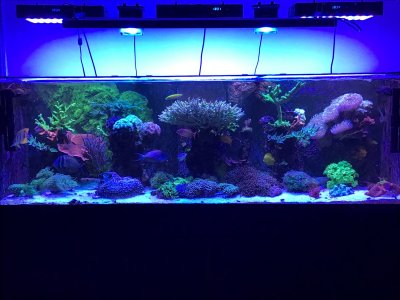
200 Gallon Mixed Reef - Rock Questions

SFMAquariums

New member
Hello!

I am a novice aquarist & in the process of building my first tank. It is a ~225 gallon tank. I have gotten to the point where I am now looking to purchase & add the sand/rock.

I have been researching what type of rock to purchase, how much, etc… and has a few questions!

1) I have read that I’ll need at least 1 lb of rock per gallon, meaning that I’d need around 200 lbs of rock to start. Does that sound about right?

2) Looking into live vs dry rock, it sounds like doing as much live rock as possible will result in the best biodiversity for my tank. Having said that, sourcing that amount of live rock in my area would both be difficult & expensive. I was therefore looking into doing a combination of live rock & dry rock. Has anybody done that before? Thoughts?

3) If I take this approach, should I aim for 50:50 live to dry? 75:25?

4) I’ve read that I should cure any live rock by letting it sit & cycle in a quarantine tank prior to introducing it to the display tank. Does this also need to be done with dry rock? Should I let it sit with any live rock to let it seed prior to introducing it to the main tank?

Any experience or knowledge anyone could share would be greatly appreciate!
 
The amount of rock really depends on your personal preference and how you want to aquascape the tank. The 1 lb per gallon was more of a suggestion than a rule.

Many people do a mix dry and live rock. My current 40 was set up with about 10 lbs dry and 30 lbs KP Aquatics premium live rock. The 150 I'm setting up will have a mix of dry and live rock. Again, the amount of live versus dry is a matter of personal preference/budget.

There is no need to "cure" live rock. It will eventually become live rock when it becomes colonized with nitrifying bacteria.

I like to cycle my live rock in the display tank and once cycled, then begin to add the other livestock. The only reason I can see to cycle outside the display tank would be if the display is already set up with other inhabitants and you're wanting to add some additional live rock.
 
The amount of rock really depends on your personal preference and how you want to aquascape the tank. The 1 lb per gallon was more of a suggestion than a rule.

Many people do a mix dry and live rock. My current 40 was set up with about 10 lbs dry and 30 lbs KP Aquatics premium live rock. The 150 I'm setting up will have a mix of dry and live rock. Again, the amount of live versus dry is a matter of personal preference/budget.

There is no need to "cure" live rock. It will eventually become live rock when it becomes colonized with nitrifying bacteria.

I like to cycle my live rock in the display tank and once cycled, then begin to add the other livestock. The only reason I can see to cycle outside the display tank would be if the display is already set up with other inhabitants and you're wanting to add some additional live rock.

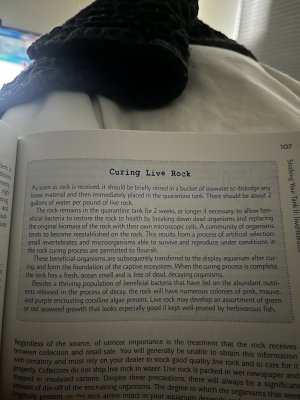
Yeah that part didn’t make a ton of sense to me. It’s just what I read in this book i was given, I’ve attached a picture.

So sounds like I could just place my sand & combination of dry/live rocks in the main tank, then let everything cycle. Do you usually need to use a cycle starter?
 

Attachments

  • IMG_6180.jpeg
    IMG_6180.jpeg
    1.7 MB · Views: 3
Yeah that part didn’t make a ton of sense to me. It’s just what I read in this book i was given, I’ve attached a picture.

So sounds like I could just place my sand & combination of dry/live rocks in the main tank, then let everything cycle. Do you usually need to use a cycle starter?
What's the name of the book? As I said, the only time I've heard of someone curing rock outside the tank is when they intended to add it to an already established tank.

Yes, that's exactly what I do. Fill the tank with RODI, add salt, adjust salinity and temperature as needed, then add the sand and rock. If you're not using live sand, I'd suggest adding it before filling with water to minimize a potential sand storm.

I don't normally add cycle starters or bottled bacteria. I prefer to let the tank cycle naturally. I did use some Microbacter 7 with the 150 I'm setting up but, that's just because I had it on hand.
 
200 pounds or so would be good. It doesn't even all have to be in the tank. You can tuck some of it in the corners of the sump.

Live rock tanks do not need to be cycled. Even if you do a 50/50 mix with dear rock.
However - you will get an ammonia spike from the stuff that dies in shipping. Depending on what you purchase this can be a big or nothing problem. I picked up 150 pounds at the airport shipped freight. The faster you get that into a tank with the correct temperature and salinity water the more of the stuff you paid big money to get will live.
Then I monitored the ammonia and knocked it down with large doses of Seachem Prime.

Understand that the directions are saying you can use up to 5 times the normal dose if needed.
Use 1 capful (5 mL) for each 200 L (50 US gallons) of new water. For smaller volumes, please note each cap thread is approximately 1 mL. May be added to aquarium directly, but better if added to new water first. If adding directly to aquarium, base dose on aquarium volume. Sulfur odor is normal. For exceptionally high chloramine concentrations, a double dose may be used safely. To detoxify nitrite in an emergency, up to 5 times normal dose may be used. If temperature is > 30 °C (86 °F) and chlorine or ammonia levels are low, use a half dose.

This reacts with the ammonia to remove (I am not sure it does remove it it, it is supposed to detoxify it) so you dose it based on testing and not ahead of time.

I got multiple crabs, shrimps, an urchin and all kinds of other things and they lived.

With live rock you do not need to add bacteria or seed the tank.

There are 2 kinds of rock. There is a lot of advertising blah blah.
Live rock has been in the ocean for some time. At least the good kind has. Some shops have vats of rock that will work but they are sterile beyond bacteria mostly. They have been exposed to water from the shops system and will work as a biofilter at minimum.
All the other cleverly name stuff is dead rock either mined or created. No matter what the name implies it brings nothing into the tank as far as microfauna goes.

The rock is the basis of the biofilter in the tank. 50/50 is fine. Just add your animals a little slower and let the dead rock colonize over a few months. In 2 years you will not be able to tell them apart.

Quarantine procedures are something you will have to decide yourself. I do not use them and have been called bad names and had my parentage questioned. I have been told all my fish will die by some rather well know people who have killed 100 times the fish I have.
That's all I will say about that.

Some things will die. It is unavoidable. It was avoidable when you could go to a LFS and pick what you wanted but there are no shops here anymore. Everything is picked and packed by someone and mailed to you now.
Some things are easy and forgiving to9 keep and some are verty hard. Some require special diets. Some thing will eat other things you add if you aren't careful.
Don't purchase on appearances and dreams. Build a stable colony of fish and things that can coexist and grow together.
 
One thing you will learn in this hobby, there is no single correct way to maintain a healthy, happy reef tank. What works for one person may not work for someone else. I generally follow pretty old school thinking when it comes to most things as these have worked for me in over 40 years in the hobby.

Some people use protein skimmers, others don't.
Some people use refugiums, others don't.
Some people use filter socks or fleece rollers, others don't.
Well, you get my drift.
 
What's the name of the book? As I said, the only time I've heard of someone curing rock outside the tank is when they intended to add it to an already established tank.

Yes, that's exactly what I do. Fill the tank with RODI, add salt, adjust salinity and temperature as needed, then add the sand and rock. If you're not using live sand, I'd suggest adding it before filling with water to minimize a potential sand storm.

I don't normally add cycle starters or bottled bacteria. I prefer to let the tank cycle naturally. I did use some Microbacter 7 with the 150 I'm setting up but, that's just because I had it on hand.
“Saltwater Aquariums Make a Great Hobby” by John Tullock.

That makes sense to me. Thank you for the information.

There are a few aquarium stores in my city (Calgary, AB Canada) that offer live rock - they have a couple tanks full. Are there any questions I should ask them re: source, etc… before purchasing them? Or do you think I’d be better off ordering online?
 
200 pounds or so would be good. It doesn't even all have to be in the tank. You can tuck some of it in the corners of the sump.

Live rock tanks do not need to be cycled. Even if you do a 50/50 mix with dear rock.
However - you will get an ammonia spike from the stuff that dies in shipping. Depending on what you purchase this can be a big or nothing problem. I picked up 150 pounds at the airport shipped freight. The faster you get that into a tank with the correct temperature and salinity water the more of the stuff you paid big money to get will live.
Then I monitored the ammonia and knocked it down with large doses of Seachem Prime.

Understand that the directions are saying you can use up to 5 times the normal dose if needed.
Use 1 capful (5 mL) for each 200 L (50 US gallons) of new water. For smaller volumes, please note each cap thread is approximately 1 mL. May be added to aquarium directly, but better if added to new water first. If adding directly to aquarium, base dose on aquarium volume. Sulfur odor is normal. For exceptionally high chloramine concentrations, a double dose may be used safely. To detoxify nitrite in an emergency, up to 5 times normal dose may be used. If temperature is > 30 °C (86 °F) and chlorine or ammonia levels are low, use a half dose.

This reacts with the ammonia to remove (I am not sure it does remove it it, it is supposed to detoxify it) so you dose it based on testing and not ahead of time.

I got multiple crabs, shrimps, an urchin and all kinds of other things and they lived.

With live rock you do not need to add bacteria or seed the tank.

There are 2 kinds of rock. There is a lot of advertising blah blah.
Live rock has been in the ocean for some time. At least the good kind has. Some shops have vats of rock that will work but they are sterile beyond bacteria mostly. They have been exposed to water from the shops system and will work as a biofilter at minimum.
All the other cleverly name stuff is dead rock either mined or created. No matter what the name implies it brings nothing into the tank as far as microfauna goes.

The rock is the basis of the biofilter in the tank. 50/50 is fine. Just add your animals a little slower and let the dead rock colonize over a few months. In 2 years you will not be able to tell them apart.

Quarantine procedures are something you will have to decide yourself. I do not use them and have been called bad names and had my parentage questioned. I have been told all my fish will die by some rather well know people who have killed 100 times the fish I have.
That's all I will say about that.

Some things will die. It is unavoidable. It was avoidable when you could go to a LFS and pick what you wanted but there are no shops here anymore. Everything is picked and packed by someone and mailed to you now.
Some things are easy and forgiving to9 keep and some are verty hard. Some require special diets. Some thing will eat other things you add if you aren't careful.
Don't purchase on appearances and dreams. Build a stable colony of fish and things that can coexist and grow together.

Wow that’s a lot of very useful information/insight. Thanks so much!

Now I’ve been looking at some local aquarium shops that offer live rock - I’ve seen some big bins of the Marco “live rock” that is clearly dry/dead. But there are also some stores that have aquariums filled with “live rock” & advertise it as such. Based on your post, seems like that may be a waste of time? Is their certain questions I should ask prior to purchase? Or is there an online retailer you’d recommend?
 
“Saltwater Aquariums Make a Great Hobby” by John Tullock.

That makes sense to me. Thank you for the information.

There are a few aquarium stores in my city (Calgary, AB Canada) that offer live rock - they have a couple tanks full. Are there any questions I should ask them re: source, etc… before purchasing them? Or do you think I’d be better off ordering online?
It looks like that book was originally published in 2006 so, 20 years ago. Don't get me wrong, Tullock did many positive things for this hobby so, I'm not criticizing him. That said, even before 2006, I never cycled live rock in an quarantine tank.

Yes, I would ask the source of the live rock. As @wvned mentioned, the term live rock is used very loosely by sellers. Dry painted rock infused with bacteria is called live rock, dry rock placed in a vat of saltwater to gain bacteria is called live rock, etc. I only consider rock live if it has spent several years in the ocean.

I personally want all the hitchhikers you get with real live rock. I've gotten corals, urchins, macroalgaes, shrimp, crabs, snails, starfish, etc. from ocean sourced live rock.
 
As you live in Canada I have no idea what is available. There are companies here that take mined rock fro ancient reefs and dump it in the ocean then come back later and collect it. There are generally several grades available based on how much life is on it.

The lighter and more porous a rock is the better it is for the tank. Yes stores are getting Marco rock and putting it in vats and selling it as live rock at a much higher price.

I don't have a handle on what's out there since I haven't bought any in a long while now. And watch for used from people getting out of the hobby.
 
Back
Top