Another overflow question...

mmittlesteadt

New member
While still in the planning stages, I'm thinking of cutting a single piece of 1/4" thick glass and siliconing it in the corner of my tank at an angle for a full height overflow.

I do NOT want teeth at the top, just a smooth top for the weir. If I do it this way, it would not have to take up so much space in my tank (lengthwise) for the overflow.

I could put the main drain lower and the emergency one higher (each being offset side to side for easier plumbing on the back) rather than side by side as when using a wider overflow "box". I cannot drill the bottom as it is tempered, but I could drill the main drain lower on the back.

The return would be on the other end of the tank.

My DT is a 40 gallon breeder and my sump is a 65 gallon tank. No matter what kind of overflow I build, it will be covered to look like rockwork, but a full height corner overflow would make it easier to do that.

Any reason why I couldn't/shouldn't do this?
 
2 reasons -
1. coast to coast overflow is generally better than a corner overflow
2. A corner overflow like you're describing generally requires a Herbie plumbing setup and a beananimal setup is safer and easier to keep adjusted than a Herbie.

I just got done cutting out my corner overflow and converting it to a coast to coast bean animal. Can see voluntarily doing a corner flow if I had the choice.
 
Well, part of my reasoning is purely aesthetic. This is only a 40 gallon breeder display tank. With my aquascaping (see pic) the left back corner of my tank (behind the left rockwork) is essentially a dead area for corals and water flow anyway (at the moment), and that's where my drains will be.

I'm looking at going with a herbie as I'm going with 1" PVC and bulkheads. Seeing as how a 1 3/4" hole (essentially...it's a 45 mm hole for the bulkheads) is going to be drilled and I need to safely keep a minimum distance between holes and edges, 3 holes are going to spread pretty far across the 40 gallon tank's back wall. It's not that I'm totally opposed to doing the beananimal. Don't know yet.

I can have the main drain line very low in the overflow with a gate valve for adjustment...with the emergency drain up at the top, with lots of adjustment room in between the two and with a 65 gallon sump, absolutely no worries of flooding. So I pretty much have the safety covered, and shouldn't have to go crazy trying to adjust in the tiniest of increments. Still considering possibilities and not set on anything yet. Just gathering information.

So...with a corner overflow I will have 10" of linear weir (where according to the calculator I only need 4"), so it should be more than sufficient (there will be no teeth...already researched that). This corner overflow can be hidden with a small rock wall with ledges (much like the rest of my rockwork) instead of having a big clunky box along the upper back corner wall, or across the entire back (if it were a c2c).

You can see the back left corner where I'm wanting to put in a corner overflow of my 40 gallon breeder. Ignore the plumbing inside the tank...it will all be in my sump now (originally was going to go sumpless and use all HOB)...

sand2.jpg


EDIT:

Found a pic online of a 40G Breeder using the beananimal and a shortened C2C overflow. Not really digging how much space is taken up by the overflow, or how it looks (apologies to the owner...just not what I'm looking for). Part of me wanting a coral reef is for it's beauty...not wanting to see a bunch of equipment in there. If I had a huge tank (which I do not have room for anyway) I would definitely go C2C (full) with a beananimal.

1243738920_nYT25-M.jpg


There are a lot of compromises one must make in the design process. Some things are just not debatable (for instance I wasn't even originally going to have an overflow at all, but after further research, felt it necessary to skim the surface).
 
Last edited:
I understand your desire for aesthetics. As you said, every design is a series of decisions and compromises, some easier than others. Like I said, after using a Herbie for 2 ½ years, the bean is definitely superior and easier to maintain if you can find a way to make it work.

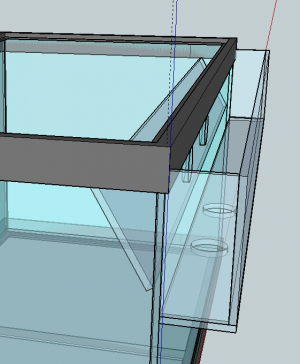
Another option to consider is an internal/external overflow, something like the attached pic. This puts the bulk of the overflow box and plumbing behind the tank, with a minimal angled weir across the back. Most people paint the back of their tank to hide the plumbing, but you can do whatever you want, of course.

Reef Savvy makes something called the ghost overflow which is basically the same idea.

Not sure it it would be better or worse for you needs, just throwing it out as an option.
 

Attachments

  • Ghost overflow.png
    Ghost overflow.png
    43.1 KB · Views: 5
Well the reason you see the internal plumbing of the example you shared is because it's a new tank. The owner likely will just let coraline algae cover the back of the tank. In 6 months you wouldn't see inside the box.

Now, I agree with doc. It really makes no sense to build an inferior design when you have the ability to setup the best overflow and plumbing with essentially no more work involved. If the width of an internal c2c bothers you then the best solution would be an internal/external overflow with a bean drain. You can search the net for "ghost overflow" to see what I'm talking about. But just about any acrylic fabricator can make you one or you can buy them on eBay.
 
That is certainly a cool idea.

The look I'm after doesn't really lend itself to the back wall being covered in much of anything (including algae, coraline or other).

Perhaps it's because I'm an artist that I want to "design" the look of the tank in a certain way. And also coming from a background of over 35 years of aquascaping heavily planted freshwater tanks. I'm well aware that nature sometimes has other plans, but I prefer to control certain design elements where I can.

This tank started with everything HOB, challenging me where and how to hide it. Well...I hid it...in my sump downstairs. Now I have to design this overflow somehow to also make it disappear into the aquascaping. Simply allowing things to grow over it isn't sufficient.

Hmmm...interesting suggestions to ponder.
 
Back
Top