Aquascape advice

dleute

Member
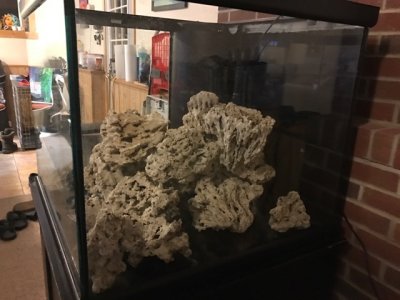
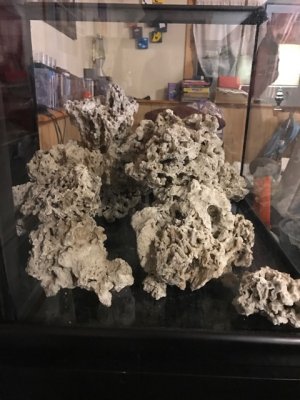
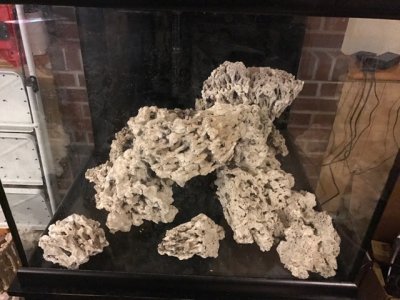
Attached are some images of my first aquascape. I don't know what will end up in my tank as this is my first reef tank. I could see myself adding SPS and anemone if reefing agrees with me.

I was really going for an airy look so fish can swim through a lot of things. In fact, I purchased roman style polyresin structures to help that I later decided are not a good idea for a reef tank.

Any thoughts? What mistakes am I making with this kind of design? How is the height? Taller? Shorter?

It's hard to see but from all angles you can see through much of the structure. I really like that for a cube tank.

I would love any feedback.

--Derrek
 

Attachments

  • IMG_1043.jpg
    IMG_1043.jpg
    102.2 KB · Views: 3
  • IMG_1039.jpg
    IMG_1039.jpg
    81.6 KB · Views: 4
  • IMG_1044.jpg
    IMG_1044.jpg
    95.1 KB · Views: 4
I would remove the front rock if your going for that cave look. That would open things up and emphasis the area. Overall I think it looks good. I like tall in cube tanks since most are deep it just looks better imo.
 
I would remove the front rock if your going for that cave look. That would open things up and emphasis the area. Overall I think it looks good. I like tall in cube tanks since most are deep it just looks better imo.

Yeah, there is a cave look from the left side (that I will likely widen a bit to make it more obvious). Tho whole structure is open on the top center, so it's not really a "cave"

Honestly, that rock in front is because I'm curing everything in tank, but after I put the couple of extra small rocks I had in the bottom corners, I didn't hate them there. And I may need some ground level rocks for mounting lower light corals.

It does look better moved.
 
Sounds good. If you change some more post another pic so we can see. Planning the scape is always one of the best phases.
 
From someone who is now kicking their self 1 year after the fact, I would heavily consider making some space between the rocks and the glass so it can be easily cleaned without having to move things around.
 
From someone who is now kicking their self 1 year after the fact, I would heavily consider making some space between the rocks and the glass so it can be easily cleaned without having to move things around.

That is a good point. I think there is enough room for my mag flipper, but I'll make sure of that before it is all completely settled. Siphoning sand won't be easy around this.

--Derrek
 
Thanks for the feedback. I basically widened up the areas where there were caves or holes. If I were to do it over, I think I'd try and go taller, but this collection of rocks is not really built for that. Besides, I want room at the top for water changes.

What I didn't account for is sand. I put 50lbs of arag-alive crushed coral. That ate up some of the open space. It looks good though! After the cure phase, I'm likely to pull all the smaller rocks in the bottom. They are just clutter with the sand in place.

Can't wait to get lights over it!

--Derrek
 
I would recommend putting the larger rocks on the bottom for a secure base. Are you going to have animals that burrow in the sand ? Heavier rocks on top means it could collapse if the livestock digs out from underneath.
 
I would recommend putting the larger rocks on the bottom for a secure base. Are you going to have animals that burrow in the sand ? Heavier rocks on top means it could collapse if the livestock digs out from underneath.

The base is all larger rocks. Not planning any burrowing life that I am aware of.

Most of the rocks were about the same size. I just didn't use the smaller ones in most of the structure.

--Derrek
 
There is a very good product called "A"poxy sculpt you can use to "glue" the rocks together. It runs about bout 40 bucks for two pounds, more than enough for your tank. (compared to 15.00 for 2 ounces of "reef putty" from some sellers, that in my opinion is no where as strong.)
Apoxy sculpt is used by several public aquariums including the Atlanta aquarium. I've built some really outlandish structures with it and still use it. It's not a fast setting epoxy (takes about 24 hours to cure), but being workable for a longer period of time can be very beneficial. It will however Harden to a solid state in about 8 hours.
 
There is a very good product called "A"poxy sculpt you can use to "glue" the rocks together. It runs about bout 40 bucks for two pounds, more than enough for your tank. (compared to 15.00 for 2 ounces of "reef putty" from some sellers, that in my opinion is no where as strong.)
Apoxy sculpt is used by several public aquariums including the Atlanta aquarium. I've built some really outlandish structures with it and still use it. It's not a fast setting epoxy (takes about 24 hours to cure), but being workable for a longer period of time can be very beneficial. It will however Harden to a solid state in about 8 hours.

Do you build dry, or can you do it in a wet tank?

I don't think I'm ready to resort to permanent structure setups. I'm content to let the rocks determine what I can do stable. Right now it's holding up to full flow. So I think I'm good.
 
I asked the Apoxy company and they said you can build wet. However, from experience (having done both) I strongly suggest NOT building wet. It's just much easier to sit at a table and build the structure in a controlled setting.

I never build a permanent set up. I build my set up in sections. Think of it like legos. But instead of having four loose pieces of rock, you only have two, while two other pieces are glued together, then they are able to lock thanks to position and weight. Less rock to move or shift and less likely to fall and break the glass.

It's also not just about the rock being able to hold up, it's being able to have an open rock scape that water can pass through and you not get dead water spots or dead matter build up such as food or other debris.
 
Back
Top