Confirm ich? salt crystals come and go

andy01748

New member
Purchased a bi-color angel on Friday from my LFS. Close inspection of fish and other fish in the tanks connected to same filtration system didn't show ich (at least not obvious, no white dots noted at all.)

Took to the tank well, very active and eating. First thing Saturday morning, it had full blown symptoms of a large ich outbreak. Looked like a pretzel rolled in salt, with at least 100 dots on body and fins!

Literally, 5 hours later looking at the fish you would swear it did not have ich. No white dots on body or fins. Confirmed with my wife the ich wasn't a bad dream I had or if she had switched fish! She was as shocked as me how the symptoms had disappeared!

This morning same thing. Fish is covered in multitude of 'salt' crystals. As the day has worn on, they have reduced to where now it doesn't have the salt look!

I'm almost 100% sure it is ich, but in the past I never saw a sudden change from what looks like a large infection to no observable white lumps in such a short time (and it has happened two days in a row). The tank he went into is ich free, so I don't see how it could be multiple generations of the parasite.

I just want to confirm if others have seen ich manifested this way. Are there other diseases that look like ich, but seem to come and go this quickly? I plan on starting ich treatment soon (tank transfer method.)

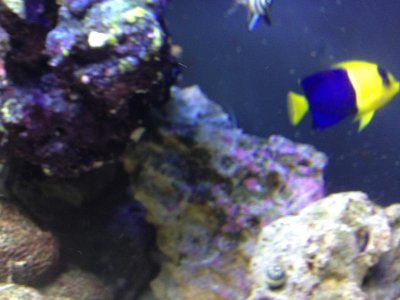
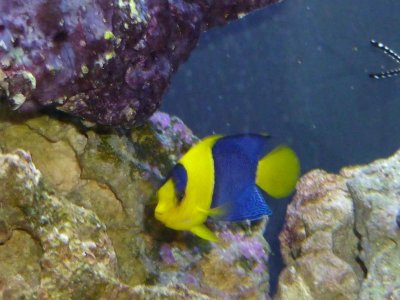
Photos attached, but he hard to catch as he is so active. What looks like white streaks in the early morning photo are an artifact of movement, and they are in fact uniform dots that look like just like salt crystals.
 

Attachments

  • IMG_1315_ICH_EARLY_MORNING_SIZED.jpg
    IMG_1315_ICH_EARLY_MORNING_SIZED.jpg
    55.5 KB · Views: 5
  • IMG_1367_ICH_EARLY_AFTERNOON_sized.jpg
    IMG_1367_ICH_EARLY_AFTERNOON_sized.jpg
    46 KB · Views: 5
While ich can leave a fish periodically as part of its life cycle, it would not be gone in five hours, return the next day, etc. Describe the fish's behavior.
 
My powder blue had the same issues a few years back, the Ich would come on more heavily in the evening, and the next morning it was mostly gone. It died within a week. Did you put your new fish directly into your display tank? Do you have a quarantine tank?
 
While ich can leave a fish periodically as part of its life cycle, it would not be gone in five hours, return the next day, etc. Describe the fish's behavior.

That is why I asked, as I understand ich to have a longer cycle. Fish is active, not laboring, and has been eating. I saw it flash against the rocks a few times yesterday, but is not a constant behavior.

 
in non severe cases you will see it come and go like that.. to put a specific time period for each part of the cycle for every situation is not possible.
from the pic don't know what else it looks like. what else in tank they showing symptoms?
 
could not see anything in the video. Keep us posted.

The afternoon one shows how the white dots becomes much less pronounced as the day goes on. I did notice on observation yesterday afternoon that lesions/lumps seem to be present and more pronounced as the fish swims away from me (perpendicular), (e.g. not a smooth skin).

Yesterday afternoon


The video of this morning is typical of yesterday morning and Saturday morning. Definitely looks like ich to me! I predict these will fade as the day wears on and will look like the afternoon video!

This morning
 
clearly see it now in the vid. no other fish showing symptoms?
what's your plan to treat the DT?

Is this definitely ich?

No other fish have symptoms. New fish added on Friday were the bicolor angel and pair of banggai cardinals. The cardinals have no symptoms.

The tank they went in (and the existing clown) is not my DT and was ich free. Long story short, this is what I call my 'observation tank', not a true quarantine, as the clown is a permanent resident. As I add life stock, they spend at least a month in this tank (with no other additions), and I closely monitor to make sure there is no sign of ich or any other issues. So far I have cycled through a bunch of inverts (crabs, shrimp, snails) and a lawn mower blenny, and they have been transferred to my DT. With the blenny's transfer, I was ready for the next round of livestock.

I had added a bunch of inverts (pair porcelain crabs and bunch of cerith snails) a week ago that were to be part of the proposed next transfer to the DT in a month, as I planned (and did) add fish this past weekend.

I knew the day would come when I would need a formal QT and treatment system, and I think that day is here now! My current setup (an observation tank) came about when I treated my DT with hyposalinity and my inverts needed a home in the meantime. Call me selfish but I much prefer the look of this tank than a bare bottomed plain QT tank in my living room! The clown is a permanent resident, the result of a newbie mistake that he couldn't live (stress free) in the DT with a pair of black and white clowns.

Assuming diagnosis is the bicolor has ich, then I will start treatment. I plan on setting up two 10 gallon tanks and using TTM to treat the angel and cardinals. Once treatment is complete, they would go directly into my DT.

I was going to ask snorvich if he thought the 10 gallon tanks for TTM are large enough to also handle adding the clown with the other fish. If not, I would cycle him through his TTM treatment after the other fish completed theirs and were moved to the DT. This would be based on the clown being symptom free as he waits his turn while he continues to stay in the observation tank. If he showed symptoms of ich, I would start TTM on him by adding to the fish already in treatment, and reset the clock to day 0 for all four.

After the clown is done, I would either transfer him to the DT sump (sad location!), or maybe keep him in one of the TTM tanks if I can keep the parameters stable.

The inverts will stay in the fish free observation tank for a couple of months after the last fish was taken out to break the ich cycle. These could then be transferred to the DT.

Looks like it will be several months before I'll be able to add any additional fish, so I'll have to deal with behavioral issues at that time, which I understand are reduced when you add new livestock within a month (which I had hoped). Oh well! At this point, down the road, I will prophylactically treat all incoming livestock via TTM, regardless of appearance.
 
clearly seems to be.
what you going to do with the observation tank now that's it's infested?

Leave it fish free for several months. I'll have to look up how long it is recommended a tank stay fallow (fish free) to make sure the ich is gone. I know its in one of the threads in this forum. It's got a whole bunch of inverts. Cleaner shrimp, fire shrimp, peppermint shrimp, emerald crab, 2 procelein crabs, 1 or 2 hermits, and about 15 snails (nassarirus, bumble bee, astraea, and ceriths). I don't want to move them to the DT until I'm sure there is no ich in the small amount of water you can't help but transfer when you make a move.

I actually find the inverts interesting, so its not a big deal. It just pauses my schedule of acquiring additional live stock.
 
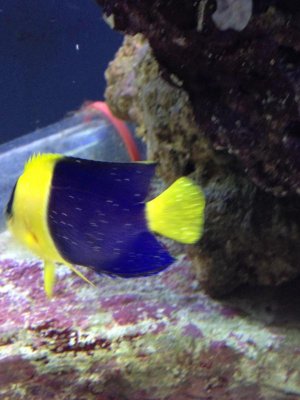
Confirm same effect this evening. If you look at this morning's video , you can see the white dots, even on the pectoral fins. This evening you can't see them, which I try to show in the attached picture I just took.

Are the angels colors subdued in the morning, and deepen during the day, masking the ich? I don't know enough about fish anatomy, but I understand the parasite is under the skin, which is why a cleaner shrimp can't get the ich of a fish. However, the pectoral fins look translucent so I don't know why the dots would be masked on these.

That is why I am trying to confirm it is ich and not some other disease. Any one else have a bicolor angel that had ich that behaved like this?
 

Attachments

  • P1020476_BICOLOR_0519_PM_SIZED.jpg
    P1020476_BICOLOR_0519_PM_SIZED.jpg
    63.9 KB · Views: 5
While ich can leave a fish periodically as part of its life cycle, it would not be gone in five hours, return the next day, etc. Describe the fish's behavior.

This morning the bicolor angel does not have the 'salted' look. Going by morning observations only, the fish has shown classic visual ich symptoms, with the 'salt crystal' look lasting three days. Although there are currently no physical symptoms, I know without treatment the infection will likely be back in about 4 to 8 days. The TTM equipment I ordered is being delivered today, so I'll start treatment tonight.

No one has weighed in on the meaning of the post-morning observations, so I'll have to attribute it to something unique about how a bicolor angel's immune system responds to ich. Seems with this species, you need to evaluate it first thing in the morning or you might not be able to tell it is infected with ich.
 
This morning the bicolor angel does not have the 'salted' look. Going by morning observations only, the fish has shown classic visual ich symptoms, with the 'salt crystal' look lasting three days. Although there are currently no physical symptoms, I know without treatment the infection will likely be back in about 4 to 8 days. The TTM equipment I ordered is being delivered today, so I'll start treatment tonight.

No one has weighed in on the meaning of the post-morning observations, so I'll have to attribute it to something unique about how a bicolor angel's immune system responds to ich. Seems with this species, you need to evaluate it first thing in the morning or you might not be able to tell it is infected with ich.

The most plausible explanation I could find (as I am still curious) about how the ich symptoms presented is at:

http://www.reefcentral.com/forums/showthread.php?p=11907724#post11907724

Some say,when the fish appears to have ich in the morning it's because it's really infected with ich. It just happens to be that the fish' skin turns lighter when they are sleeping and when we turn the light on in the morning,the ich that are deeply embeded in their skin would appear because of the light coloration.

I couldn't find the source of "Some say".

Even though the color of my angel seemed to be the same deep blue both morning and afternoon there may be a difference in intensity. When I checked on him late last night (after all lights had been out a while) his body was practically all white, both areas that I was used to seeing a vivid blue and yellow. I had never seen him at night, as he liked to sleep in the LR, but with TTM he doesn't have this option. I remember my yellow tang's vibrant color would definitely fade at night, but not to this degree. This morning, the angel seems perfectly happy, with colors as I expect.

The thread with the post I referenced is an 'interesting' read, and seems to give great examples of the many misconceptions about ich. This was from 2008, so it seems its a continuing battle educating reefers the facts about ich. I've seen the same discussion and reasoning from more recent posts as I tried to educate myself on the subject.
 

Similar threads

Back
Top