Cycling and high nitrates

Zirco

Member
Three days ago I started cycling my 150g by adding enough ammonia to bring the level ups to 1.2 ppm. I also added Instant Ocean Bio-spira at the same time.

By day 2 the ammonia had dropped to 0.2 so I added enough to bring it up to 1.5 ppm. On day 3 the ammonia had dropped to 0. But on day 3 I also measured the nitrates and they are around 100 ppm.

Where did all the nitrates come from?

The only things in the tank are BRS "reef-saver" dry rock, CaribSea aragonite sand, Instant Ocean Reef Crystals salt and RO/DI water. Just to "test to the tester", I tested some RO/DI water for nitrates and did indeed get zero.
 
All the nitrates came from the conversion of your ammonia. When cycling you should let all the parameters go down to zero again so it builds up your bacteria to help convert everything. Test your nitrates & nitrites every day or so and see if they are dropping. If they aren't dropping then you might want to do a water change to help drop the levels down. After everything has dropped to zero your tank would be cycled. You can double check to see if it has properly cycled by spiking your ammonia to 2PPM and if everything drops to zero in 24 hrs then you are good to go.
 
But how can 1.2 + 1.5 ppm of ammonia over two days lead to 100 ppm of nitrates? Each has only a single N atom (NH₃ vs NO₃).
 
Last edited:
What type of test kits are you using? My Red Sea doesn't display them that high. If you aren't letting your nitrates drop down and keep adding ammonia then it could stack your nitrates.
 
But how can 1.2 + 1.5 ppm of ammonia over two days lead to 100 ppm of nitrates? Each has only a single N atom (NH₃ vs NO₃).
ppm is more like a weight than a ratio, so the parts are not equal. One "part" of nitrate weighs more because the oxygen is like 3 or 4 times heavier than the hydrogen it replaced. Molar weight wouldn't account for all the difference you are seeing though.

The remainder I would guess to be due to nitrites present in the water. I don't remember exactly how, but our tests sometimes read a little nitrite as a whole lot of nitrate. It's not usually a problem because our nitrites are rarely out of whack once the cycle is done, but sometimes you see it come up as the different strains of nitrifying bacteria are getting established and balancing out. With stuff like biospira it's not uncommon for the populations to take a little while to level out after they get going converting ammonia.
 
What type of test kits are you using?

I'm also using the Red Sea kit. It allows you to go higher than 50 if you use RO/DI water to dilute the sample before testing.

Molar weight

Ah, OK, ppm is a ratio of masses - good to know.

tests sometimes read a little nitrite as a whole lot of nitrate

That would explain it. My nitrites are also "off the scale" (> 1 ppm). And I noticed that the reagents for the nitrite and nitrate tests overlap quite a bit.

I've developed another theory as well. The Bio-Spira claims to last for some indefinite period of time without refrigeration. I'm wondering if perhaps they put some slow release ammonia source in the bottle to feed the bacteria and keep them alive. If so, after some period of time the bottle would contain a lot of nitrates! Or perhaps, as the bacteria start to die off in the bottle, they themselves decompose and serve as the ammonia source for those that remain. I'm tempted to buy another bottle just to test this theory.
 
I looked into the claims of shelf stable bacteria about a year ago. There is a LOT of speculation on what's happening in those bottles, but very little info. I was able to learn a bit about the processes they use for live sand packaging, which I think would be fairly similar to the biospira concept basically. The way they make the sand is they take dry stuff and pour biospira on it, but of course a bit diff and with variations between brands. You could look into Stability by Seachem and Dr. tims magic potion too.

The basic idea I ended up with is they culture bacteria and package them with amino acids to eat and a phosphate based preservative that makes them sort of dormant. I think for their minimal nitrogen requirements they mostly cannibalize. But that's just my speculation. So yeah, they don't all make the trip and the dead bac would elevate nitrogen. You're on the right track.

I think it would be hard to test because idk what you would dilute the sample to. The dosage is not refined but rather a whole bottle goes into a wide range of tank sizes. So I'm not sure how you would set it up. Even if biospira were pure nitrite, you would get a diff ppm reading if you dosed a 15g vs. a 40g.

It's interesting though b/c one of the things people like about the dr. Tims brand is adding the ammonia separate. You still test the water when you do it that way. It would be funny if that were unnecessary, like a marketing gimmick to make you feel like the kits is more comprehensive or legit or whatev
 
one of the things people like about the dr. Tims brand is adding the ammonia separate

Lol... I had just assumed that that was the case with all the brands of starter bacteria. I still feel more comfortable adding ammonia and testing until all the ammonia and nitrites seem to be gone. Trying to take it slow as this is my first saltwater tank.
 
Yeah, you can always add ammonia. Or you can buy dr tims special $2 an ounce "ammonia solution" and feel like you're really on it.
Good call going slow. This part is a lot of fun!
 
The nitrate you read is partly because of the nitrite. You cannot use these drop tests for nitrate quantification as long as there is nitrite.

Regarding bacteria in bottles. Microorganisms are real artists when it comes to overcome a period of starvation. The time these bottles are good is probably much longer than 1 year. Maybe other ingredients make it only last that long. On the other hand I do not have any specific experience with bacteria from the nitrogen cycle so maybe they do behave differently under starvation, would surprise me though.

You could do an easy experiment where you test colony forming units after certain time of incubation in the bottle or use a live dead indicator and count the ratio. Personally, I would rely on the manufacturer knowing what they do ;)
 
You cannot use these drop tests for nitrate quantification as long as there is nitrite.

That's a relief then. Hopefully I won't have to do a massive water change once the nitrites settle down.

Microorganisms are real artists when it comes to overcome a period of starvation.

Ah, I was continuing with the ammonia, even though the ammonia-to-nitrites bacteria seem to be established, out of concern about starving them. Now I think I'll just hold off adding any more ammonia until the nitrites start to drop.

Thanks all for all the replies - super helpful!
 
Well, my nitrites are down to 0 and my nitrates still test high (around 75).

It seems like the tank is reasonably well cycled. If I add enough ammonia to get it over 2 ppm, it's all gone by the next day. The nitrites spike the first day but are all gone by the second day after adding the ammonia.

So now I'm wondering, can I add a couple of small fish or even a small coral with the nitrates at 75 ppm?

I was planning on setting up a refugium with Chaetomorpha as my long-term means of nutrient control but I think I'd have to dose a bit of phosphate at first to keep it alive. My phosphates are testing at 0.
 
You want to do a big water change to bring nitrate down.

You will have an algae bloom soon. Most likely diatoms. Don't panic, most of these blooms will go over on their own. Observe and don't change anything quickly once you have higher organisms in there!

If you have the possibility to set up the refugium before you add any higher organisms to the tank, that might be good as it gives you a chance to play around without worrying about mini cycles etc. Other people might be better suited to answer this though as I have no experience with refugiums. My understanding is that you can add the chaeto now without a problem. I had some in my DT from the beginning and it was doing ok. I removed it now as I only wanted it at the beginning during cycling.

You might want to bring in your clean up crew. You will have a lot of algae soon once you start feeding.
 
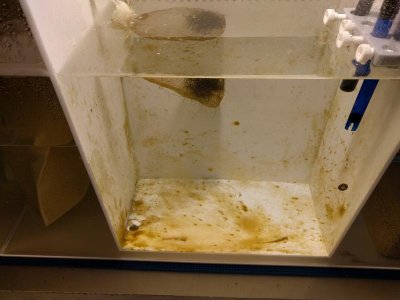
Added some chaeto to the refugium and set up a 1000 lumen "warm white" lamp shining on it. Then did a 60% water change which brought my nitrates down to about 50. Interesting I had no algae at all until the day after the water change when I started seeing what I'm guessing are diatoms in the refugium.

Went out and bought two baby clown fish and a couple of trocha snails. Put the fish in the tank and the snails in the refugium. Its only been two days but everyone seems happy so far. The clowns are eating nicely both pellet food and brine shrimp/spirulina.

The diatoms are really taking off but only in the refugium. I have a 20000K BuildMyLed light on the tank itself. I bought a GFO reactor but was hoping to wait until after New Years to set it up. Am I risking a big algae outbreak in the tank over the next week if I don't set it up right away?
 

Attachments

  • IMG_20151226_202714.jpg
    IMG_20151226_202714.jpg
    46.4 KB · Views: 3
Back
Top