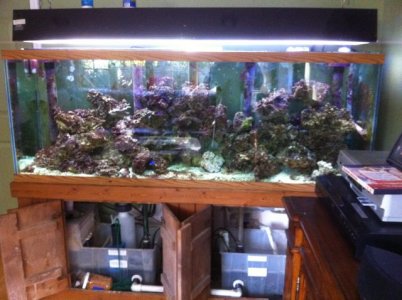
low sg to kill ich

glaukos

New member
what is the magic number for salinity that will kill ich?

i know that many use the hyposalinity method and go until 1.016 to see results.

i'm thinking of taking out my 5 fish and treat them with coper.
as for the DT i want to take out all of my corals,snails,shrimps and take
the salanity down to 1.000.

i know it will also kill a lot of stuff but will it kill ich?
maybe drop the temperature way low also 15-20 celcius.

i guess by this method i will have to deal with another cycle(rock-sand)
but i will be able to put the fish back after only a month or so(copper
for the fish) instead of waiting for this 8-12 weeks with the tank fallow-no fish


i did open the same thread in reef diseases forum but not
a lot of response.
please share your thoughts and experience in this subject
 
Leave your tank fallow for 6 weeks and temporarily raise temperature to about 82F. Treat your fish with cupramine.
 
Ok, you're going to have to do some reading to get a better handle on Ich, and be able to pick out what info is right or wrong, and be able to decide for yourself what to do.

Here is the Cliff notes on Ich life cycle: http://saltaquarium.about.com/od/ichparasiticdiseases/ss/sbsichlifecycle.htm

Here is a little more in-depth regarding Ich and treatment options: http://reefkeeping.com/issues/2003-08/sp/index.php

On to specific answers to your questions.

The therapeutic level for hyposalinity is 1.009. 1.016 will not work, Ich will survive this level.

Lowering the SG of your fallow tank to 1.000 will not speed up the ich cycle. The Ich will still cyle through, most often quoted life span is 4 weeks. So, you still need to let the Ich cycle through and get killed by the lack of fish or by the hyposalinity. Aminimum of 4 weeks, preferably 6 or 8 for the variability of the known data.

The only thing lowering the SG in a fishless tank will do is kill your inverts, and at 1.000, maybe even your beneficial bacteria, causing the need toc ycle your tank again. No gain, not worth it. Just leave your DT fishless, provide food for your CUC, and you'll be good to go in 6 weeks.

Here's a link to my hyposalinity experience with a 110 gal tank. My 150 gal DT was fishless with SG 1.026 for a planned 6 weeks, but ended up a total of 8 weeks due to scheduling. http://www.reefcentral.com/forums/showthread.php?t=1892446
 
Great advice Palting... I will reitterate what he said. 1.009 is what you need to have the water at. However, if there are no fish in the DT, you dont have to do that in Hypo. just let it sit fallow for 6 weeks and you will be fine. keep the fish in a QT for this entire period. you can treat them with copper or with Hypo, but please dont do both. it is not necessary.
 
thank you all for your replies

so wow....ich will survive and still cycle at 1.000???
even with extra low temperature?
this thing is a curse!
i guess the ones waiting to hatch won't ne affected by 1.000 sg

i tried that the fallow option before for 8 weeks and ich still came back
but not as strong as before,
i could easily have the patience to go 12 weeks but what if it comes back or be brought
back by a snail,coral etc?i can't qt everything
at this point this thread becomes like the endless ones that refer to ich

thank you for the great links palting
 
SG of 1.009 is the range you want to shot for, once you get about or around 1.013 the treatment is ineffective.

If you gonna do it, make sure you use a refractometer, test pH often and do not treat with copper in hyposalinity.
 
thank you all for your replies

so wow....ich will survive and still cycle at 1.000???
even with extra low temperature?
this thing is a curse!
i guess the ones waiting to hatch won't ne affected by 1.000 sg

i tried that the fallow option before for 8 weeks and ich still came back
but not as strong as before,
i could easily have the patience to go 12 weeks but what if it comes back or be brought
back by a snail,coral etc?i can't qt everything
at this point this thread becomes like the endless ones that refer to ich

thank you for the great links palting

Take you time, read, and digest the info. Ich will NOT survive an SG of 1.000 of 4-8 weeks. But, other than brackish livestock, I don't believe anything else in our tanks will either! :)

Failure of an 8 week fallow treatment is unusual, even rare, as I understand it. Failure can be from cross-contamination, such as leaving a mag float in the Ich or QT tank, then using it to clean the fallow tank. Or, intoducing a fish or coral with Ich by not doing QT first. I believe that if you treat your tank for Ich once, then you have to commit to QT and treat everything else afterwards. Otherwise, it's not worth the effort.

This doesn't have to be an endless thread. Read the info, take what you want from it, then do what you think is best. People will believe and do what they believe is best. I tell you what I think, but you can do whatever you want, and best of luck to you. :beer:
 
thanks again for the valuable info everyone

palting i read your hole thread.;)

at the moment i will give a good reading to the links also
weigh the pros and cons and i will proceed accordingly

i knew that sg at 1.000 would kill everything in my tank with the
expected results-ammonia,another cycle and many things dead- but the
conclusion is that
"1.000 sg(in a fishless tank) wont make the cysts explode or kill instantly the existing ich in the tank helping it to be ich free in a matter of a week at best"...correct?
 
i knew that sg at 1.000 would kill everything in my tank with the
expected results-ammonia,another cycle and many things dead- but the
conclusion is that
"1.000 sg(in a fishless tank) wont make the cysts explode or kill instantly the existing ich in the tank helping it to be ich free in a matter of a week at best"...correct?

Interesting idea. I don't know that anyone's ever tried that, so I am unaware of what the consequences may be. If you really want to try it, post the eperience and let us know. You can be the guinea pig :D.
 
The life cycle of this parasite is interesting and is important to understand when evaluating a treatment. The stage where the parasite is attached to a fish is called a trophont. The trophont will spend three to seven days (depending on temperature) feeding on the fish and that is what you see symptomatically when you see "salt sprinkled on the fish". After that, the trophont leaves the fish and becomes what is called a protomont. This protomont travels to the substrate and begins to crawl around for usually two to eight hours, but it could go for as long as eighteen hours after it leaves it's fish host. Once the protomont attaches to a surface, it begins to encyst and is now called a tomont. Division inside the cyst into hundreds of daughter parasites, called tomites, begins shortly thereafter. This noninfectious stage can last anywhere from three to twenty-eight days. During this extended period, the parasite cyst is lying in wait for a host. After this period, the tomites hatch and begin swimming around, looking for a fish host. At this point, they are called theronts, and they must find a host within twenty-four hours or die. They prefer to seek out the skin and gill tissue, then transform into trophonts, and begin the process all over again. What this means is that when your tank is infected, you can actually see symptoms during a very small part of the life cycle, and it why your tank is infected even though your fish are resistant. It will also explain why symptoms come and go.

Many hobbyists are fooled into believing they have cured their fish of the parasites, only to find Ich present again on fish a few weeks later; a reason why following through with a full treatment protocol is so important. Don't make this mistake and be lulled into a false sense of security. The parasites may be in a stage where they are merely regrouping and multiplying for their "next offensive." In the wild, this sort of massive reproductive phase ensures that a few will find a suitable host to continue on the cycle. In the close confines of our aquariums, though, it means comparatively massive infection rates.

This disease is usually associated with several environmental triggers. Changes in water temperature, exposure to high levels of ammonia, nitrite, or nitrate, low pH levels, low dissolved oxygen often associated with overcrowding, are all factors contributing to the onset of the disease. You could lump all of these in a general category of "stress", but it is more appropriate to think of all of these as "unnatural conditions". In fact, Cryptocaryon irritans is rare in the wild even more unlikely to be lethal. Ich is truly a disease that exploits the conditions of captivity to reproduce and easily find suitable hosts.

By the way, trophonts are under the skin so cleaner wrasses and cleaner shrimp have no real effect on reducing this parasite.
 
In my research and experience in dealing with Marine Ich, a SG of 1.009 is a very effective treatment for ich. A SG of 1.000 will also treat ich, but cause additional un-needed stress to a fish and a whole host of other problems that can kill the fish as well as the ich.

I have read the reefkeeping link many times and it does not suggest a SG of 1.000, nor does the other link. A SG of 1.000 is for a dip or bath but not prolonged treatment of ich.
 
i know it's freshwater that's the reason i'm thinking all of the situation in the first place

i did leave the tank for 8 weeks and went with copper treatment
i did the cycle of coper twice-14 days each-
the fish where super clean for a month in the QT and didn't show any signs.
i didn't crosscontaminate the tanks also
didn't add anything during those 2 months

and yet the damn parasite apeared again:mad:

so either my qt wasn't good(i did follow every instruction) or ich
was present in my tank eventhough 8 weeks passed

i've also read a lot of threads telling that they went 12 weeks fallow to find still ich on their fish

i think i will give it a try:confused:
i have only a couple of corals and 5 fish.

if i read correct the articles sg at 1.000 will make the cysts explode and the existing
parasites die due to the lack of fish or the low salinity.

i'm not saying i will reinvent the wheel but that way i THINK i will be sure that
ich wasn't present at least not in my DT and won't have to wait 3 months to be sure and be able to put them back at 40 days tops after the qt treatment with coper

eitherway i will let you know if eventully went with that and how it progresses

another thing i wonder about is will the cyst and existing ich die
instantly when sg reaches 1.000 or will it be after a few days?

smtnk
the fish will be in another tank
 
Last edited:
another thing i wonder about is will the cyst and existing ich die
instantly when sg reaches 1.000 or will it be after a few days?

smtnk
the fish will be in another tank

Understand that we are reef hobbyists, not Ich specialists, making deductions from what we read. That's why this discussions can be so much fun :D

In a fishless tank, the only forms of Ich are the free swimming stage and the cyst stage. If you drop the salinity quickly from, say, 1.026 down to 1.009 or even 1.000, then the exposed cysts on the substrate will try to equalize the intracyst salinity with the ambient salinity. Free water will pass through the cyst membrane faster than the salt, and the result is that the cyst will expand and explode in the process. My understanding is that this proces happens fairly quickly. Quickly as in several hours. So, in theory a fishless tank that had it's salinity dropped suddenly should be Ich cyst free within a day. That leaves the free swimming stage. I don't know if the free swimming stage will survive 1.000 or not. Regardless, in the absence of fish, those should be dead anyway in several days. So, yeah, it might actually work! In theory, by us, hobbyists ;)
 
It is all about osmosis.

The fish as well as the parasite will have adverse side effects secondary to osmosis.
 
well palting my friend thank you for your opinion

i wish sometimes i had more scientific knowledge or a high end microscope to
whitness what will really happen to the parasite

if my achilles won't show any signs of improvement tomorrow i will give it a try
 
Are eels or serpentine stars ,carriers of white spot but not affected by it.

After 4 yrs of invert only in 200 gal i introduced new fish and whitespot.
while i wait out the 3 months of no fish and only inverts again i want to put a small eel in but im afraid eels might be hosts.

Jim
 

Attachments

  • IMG_0204.jpg
    IMG_0204.jpg
    62.5 KB · Views: 8
Last edited:

Similar threads

Back
Top