Metal-case LED scrubber light safety

SantaMonica

Well-known member
With the increased usage of natural algal filtration such as algae scrubbers, comes the increased usage of illumination to make the photosynthetic filtering process occur. However a certain type of light has come onto the market, and this light needs to be addressed because it is potentially unsafe when used on ATS algae turf scrubbers. If you do not have these lights, then you can decide whether to get them or not. If you already have them, then you can learn how to protect yourself.

The following posts are one person's professional opinion on the safety of these algae scrubber lights. You should consult your own professional advice and opinion from an independent electrical engineer, electronics engineer, electrician, or safety technician.
 
The lights are typically used when people build or buy the waterfall scrubber design we invented in the year 2008.

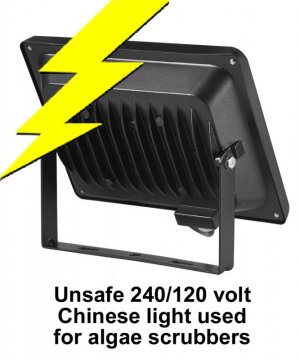
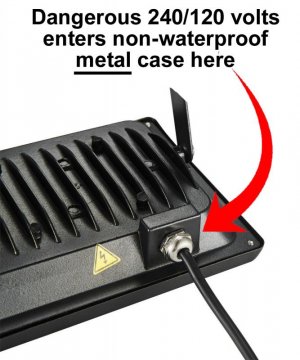
The light is a metal-case LED lighting fixture that is bolted on, and is typically made in China and sold online, but it could be made anywhere. It is designed for gardens and patios, with some rain, or for indoor growing areas that get no rain at all. See photos.
 

Attachments

  • 2008 wf on sump.jpg
    2008 wf on sump.jpg
    31.5 KB · Views: 6
  • 240-120 led light with lightening.jpg
    240-120 led light with lightening.jpg
    54.3 KB · Views: 7
  • 240-120 led light back.jpg
    240-120 led light back.jpg
    70 KB · Views: 6
How is that worse than the hardware store spring clamp light sockets used for cheato (or scrubbers before too)?

My 'dangerous barely splash proof metal chinese' grow lights are attached to my stand, above the sump. But i don't see them falling into the tank ever, so it shouldn't be an issue...
 
The spring clamp ones are not being sold as safe scrubber lights. And, you are DIY, so you can only hurt yourself; not others. But if you sold them to others, and labeled them as safe scrubber lights, and then they fell into the water and injured someone, the outcome could be different.

I'll post more details.
 
Like any other line powered equipment..(pumps/heaters,etc..)..if there is any chance of exposure to water you simply put that device on a gfci protected circuit..done..
These scrubbers you seem to be slowly trying to suggest are unsafe (and of course to attempt to promote your own products) are not intended to be located or exposed to locations where direct water exposure would be a problem.. Yes..accidents can happen though.. One could drop the power brick of a SM scrubber into their tank and be potentially exposed to the same dangers as you claim these others have..
 
you simply put that device on a gfci protected circuit

From a liability standpoint, a manufacturer of lights cannot assume the customer will do anything, at all.

are not intended to be located or exposed to locations where direct water exposure would be a problem

Yes they are. That's were scrubbers go. On top of open, wet, saltwater sumps.

One could drop the power brick of a SM scrubber into their tank

This is similar to display lighting falling in. But all customers of aquarium products know not to drop electrical products into the water. What customers don't know, is that the thing they are about to touch on their sump could have 240/120 volts on its metal case, and it is possibly not grounded, either.

That's why I recommend U.L. listed only, and 2 meters of low-voltage DC cable, to keep the brick far away.
 
Do you have proof that these lights are not properly grounded or have a record of insulation failure or energized casings?.
 
I'm giving my professional opinion on those lights, in hopes of reducing chances of injuries. Readers can then decide for themselves. I'll show how to make them safer but you can find many examples on youtube.
 
I was the first to test and use these types lights on waterfall scrubbers in the year 2010, as a way of getting away from fluorescent bulbs. There is a side-by-side test of LED vs CFL that I did in 2011 on youtube.

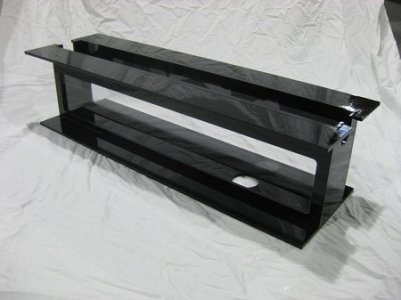
The LED lights at first were expensive and cost $150 for one set shipped from China. But the pink "œplant grow" colors worked well, and the heat was less. The lifespan was also longer, and it was not fragile to ship to customers. So I started using them on the first waterfall ATS algae scrubbers, which I invented in the year 2008; here is the acrylic box with a bottom shelf for the lights to set on, and a top shelf above the lights for protection; see photo.

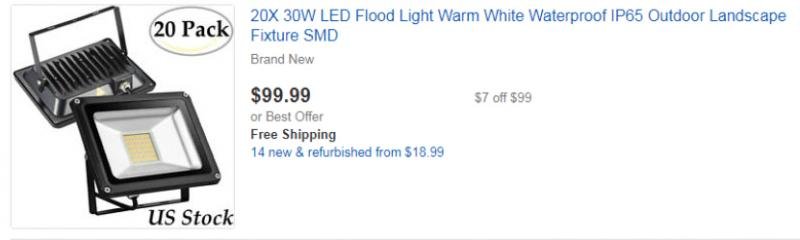
Currently, all waterfall scrubbers for sale by others use this same open source free-to-copy waterfall scrubber design because it kind of works, and because the design was given away for free by me. It has problems, but again, it's free to copy. And almost all pre-made scrubber builders also now use those metal-case LED bolt-on lights, mainly because they now cost only $5 including shipping from China. This makes the cost of those pre-made scrubbers artificially low, because they don't have to make the lights safe (or even test the lights for safety), and this transfers the electrical risk to you, the customer. This typical Ebay listing of 20 lights for $99 even says "U.S. stock" to make it less apparent that they are from China; see photo.
 

Attachments

  • 2008 sm100 box.jpg
    2008 sm100 box.jpg
    26.2 KB · Views: 5
  • ebay listing.jpg
    ebay listing.jpg
    19.5 KB · Views: 7
Having invented the waterfall scrubber design in 2008 (water flowing down a screen), I'm fairly familiar with how the scrubber works. And how the lights work too. Many people DIY their own scrubbers, and for these people the metal-case LED lights are fine to use as long as safety is observed. This is because DIY people tend to have experience with electricity, water, etc, and they are trusting their own skills to make things safe for themselves. If something goes wrong, only they get hurt. But commercial makers of scrubbers are expected to provide a safe product, because it will be purchased by consumers who are not expected to have experience in electricity. I don't use that waterfall design anymore, even though I invented it. Nor those lights. Here's why, with a focus on the safety:

The biggest problem with those lights is the fact that a line voltage of 240/120 volts comes directly into the metal-case light which is a non hermetically sealed compartment; and the light is placed within inches of splashing saltwater and salt-creep that comes out from the top of the scrubber. The scrubber is then placed on top of an open saltwater sump, where there is more splashing and more salt creep. The sump is almost always under a tank, with a simple front cabinet door that lets light out; larger tanks with sumps like these are usually located in a common area of a house such as a living room. Where children play. And it's commonly known, and almost predictable, that the floor area in front of the sump gets wet, even when the cabinet door stays closed. It does not take much to imagine one's child opening the cabinet door to see the "œpretty pink" light, and then trying to touch it, while standing on a wet floor at the exact moment that that salt creep has shorted the internal 240/120 volts of the light to its metal case. So, the idea of writing this information is to prevent this from happening.
 
I have, thanks. But I think that if anything, the safety info is more important. How about this: I send you upcoming hard-info, and you re-write it to suite your needs, and post it like that.

Or better yet, let's take a vote. If nobody wants the safety info here, that's fine.
 
Last edited:
And yet in the scrubber thread when asked specifically about these lights, you and floyd recommended them for DIY scrubbers...Even telling people they should buy them larger then whats needed and to run them on timers so they wont burn the algae off the screen. I will say you and floyd do give the warning that even though they are IP65 rated, they are not waterproof and should not be immersed.


With an IP65 rating, they should be absolutely fine for a scrubber application where they are not immersed in water but subjected only to mild moisture which it should be able to fend off and not short out causing the catastrophic event such as electrocuting someone standing near the tank. Besides, if you have a pool of water in front of your stand, you have bigger problems then some light which may not be grounded properly. And if you DIY anything electrical in this hobby and you read enough, anything electrical should be on a GFCI to prevent the catastrophic event you describe.


Wonder where I got the idea to use them in my DIY scrubber from? Oh yea you and floyd in the scrubber thread.......


And now your trying to tell us not to use them because of safety concerns? While I appreciate your efforts and help in the scrubber thread, I just see this as a way to get people to buy your "safer" product.


Sorry SM but most of us just see this thread as you shilling your own product in the general forums in a thin veiled safety measures thread.


EDIT:
After rereading the thread and your posts, I see your fine with DIY people using these light as we assume the responsibility of using them. What your having problems with is manufacturers mass marketing/mass producing their scrubbers equipped with these lights and people having no idea how dangerous they actually are. :thumbsup:


Question to you though, with an IP65 rating, unless they are dropped into the water, they should be fine? If they are grounded properly with a third prong on the plug which in my case the ones I bought are grounded properly and plugged into a GFCI outlet, they should be perfectly fine to use?
 
Last edited:
Am happy to get further into this, if people want the info. Did not see any votes though.

I've posted less than half of it so far, and the rest is still being edited.
 
No votes.

What your having problems with is manufacturers mass marketing/mass producing their scrubbers equipped with these lights and people having no idea how dangerous they actually are

Correct.

Question to you though, with an IP65 rating, unless they are dropped into the water, they should be fine? If they are grounded properly with a third prong on the plug which in my case the ones I bought are grounded properly and plugged into a GFCI outlet, they should be perfectly fine to use?

No they would not be fine. The metal can corrode and break the seal where you can't see it. And many of them don't have grounds connected at all. And it gets worse with time, not better.
 
Back
Top