
Phosphate Help

RBU1

Moving on Up
42599c8fee6157e59e85ef1e0effc017.jpg

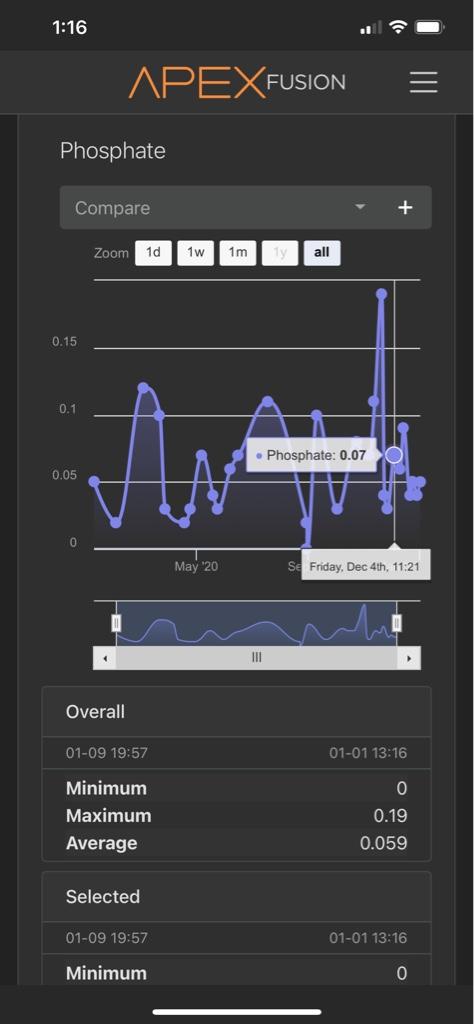
Randy. Help me out here. My phosphates average around .05. I want to get them lower and try to keep them semi consistent. As you can see from my test results I'm all over the place. How do you suggest I get a better handle on my phosphate level and a better understanding on how to keep them consistent. My tank is a 220 gallon. I have a refugium that grows feather caulerpa and I can harvest every couple weeks. I dose vinegar at a rate of 100ml daily and I run GFO and change it out like monthly. My nitrates stay around 5. Any suggestions greatly appreciated. Tank has been running over two years.


Sent from my iPhone using Tapatalk
 
Couple things to keep in mind that unfortunately demostrate how much more complicated the P cycle in aquariusm is than just keeping PO4 (aka Soluble Reactive Phosphorus [SRP] orthophsohpate, phosphate) at a certain level or range.

Everything living in a reef ecosystem is messing with phosphorus. While we tend to think only in terms of corals and algae and to a lesser extent fish, biofilms and sponges are also messing with phosphorus. Both have been shown to sequester phosphorus, some of the crytic sponges in particualr have been shown to make and store phosphorus crystals in their tissue.

The phosphorus cycle includes multiple forms we can't test for but may or may not be used by corals. Phosphorus can be in the form of particulate organic phsophate (POP), Dissolved Organic Phosphate (DOP), Dissolved inorganic phosphorus (DIP, PO4, SRP, orthophosphate) which is hte only form we can test for. Mineralized inorgainc phosphorus may also be present but so far there is no research shwoing corals use it.

Reasearch ahs shown phosphate deficiency can be a serious problem with corals and research done with corals maintained in aquaria has identified a threshold level of .03mg/l PO4 to reduce the risk of this happening. Other research has shown increasing PO4 increases coral growth although skeletal density is reduced. Here's a video by Rich Ross and additional links to research:

Richard Ross What's up with phosphate"
https://youtu.be/ZRIKW-9d2xI

https://www.cambridge.org/core/jour...reef-corals/AFB1CF4CB68823BD13AD254623FD3C7C#
An Experimental Mesocosm for Longterm Studies of Reef Corals

Phosphate Deficiency:
Nutrient enrichment can increase the susceptibility of reef corals to bleaching:
https://www.nature.com/articles/nclimate1661

Ultrastructural Biomarkers in Symbiotic Algae Reflect the Availability of Dissolved Inorganic Nutrients and Particulate Food to the Reef Coral Holobiont:
https://www.frontiersin.org/articles/10.3389/fmars.2015.00103/full

Phosphate deficiency promotes coral bleaching and is reflected by the ultrastructure of symbiotic dinoflagellates
https://www.sciencedirect.com/science/article/pii/S0025326X17301601?via=ihub

Effects of phosphate on growth and skeletal density in the scleractinian coral Acropora muricata: A controlled experimental approach
https://www.sciencedirect.com/science/article/pii/S0022098111004588

High phosphate uptake requirements of the scleractinian coral Stylophora pistillata
http://jeb.biologists.org/content/214/16/2749.full

Phosphorus metabolism of reef organisms with algal symbionts
https://esajournals.onlinelibrary.w...98e60zfBEvx5IcIVGhmlpUYmzIJuqUNVm0sG8_0vth6lq

https://therichross.com/skeptical-reefkeeping-ix-test-kits-chasing-numbers-and-phosphate/

Sponge symbionts and the marine P cycle
https://www.pnas.org/content/112/14/4191

Phosphorus sequestration in the form of polyphosphate by microbial symbionts in marine sponges
https://www.pnas.org/content/112/14/4381
 
Very interesting. Thanks for all that information. I've been trying to keep my nitrates and phosphates on the lower side. I'm scared to let them increase. Looking more for stability.


Sent from my iPhone using Tapatalk
 
[MENTION=242021]Timfish[/MENTION] - Great summary and links. Thanks

I've zeroed out my phosphates a few times and its devastating. Kicks off an instantaneous RTN event that can last weeks as things stabilize.

For me, a stable week to week P04 of 0.05-0.1 is the sweet spot, provided that N03 is around 10x higher. I believe the ratio of N:P is just as important as the actual levels.

There's a great article on ********* called "œparameters of some masters" - the average P04 is way higher than you'd think.


Sent from my iPhone using Tapatalk Pro
 
[MENTION=242021]Timfish[/MENTION] - Great summary and links. Thanks

I've zeroed out my phosphates a few times and its devastating. Kicks off an instantaneous RTN event that can last weeks as things stabilize.

For me, a stable week to week P04 of 0.05-0.1 is the sweet spot, provided that N03 is around 10x higher. I believe the ratio of N:P is just as important as the actual levels.

There's a great article on ********* called "œparameters of some masters" - the average P04 is way higher than you'd think.


Sent from my iPhone using Tapatalk Pro


So my nitrates are around 10 and phosphates .05. Does that fit in your ratio?


Sent from my iPhone using Tapatalk
 
No, your N03 is a high at 200:1 (10ppm/0.05p). But, if your tank is healthy and stable, I wouldn't make changes.

When my N03:P04 exceeds 100:1 to start to get problems like algae and STN.

If you do need to make changes, do them very slowly and track them to see how your system reacts. That 10 second addition of whatever - bacteria/carbon/aminos etc - takes days to stabilize in our systems and each system is in a unique in its demands.


Sent from my iPhone using Tapatalk Pro
 
No, your N03 is a high at 200:1 (10ppm/0.05p). But, if your tank is healthy and stable, I wouldn't make changes.

When my N03:P04 exceeds 100:1 to start to get problems like algae and STN.

If you do need to make changes, do them very slowly and track them to see how your system reacts. That 10 second addition of whatever - bacteria/carbon/aminos etc - takes days to stabilize in our systems and each system is in a unique in its demands.


Sent from my iPhone using Tapatalk Pro


I'm horrible at math. What is an ideal ratio? Nitrate? Phosphate?


Sent from my iPhone using Tapatalk
 
Lol. No worries. Whatever your phosphate reading, multiply that by 10 for a 10:1 ratio of N:P

At 0.05ppm P04x10, your looking at N03 ideally being around 0.5ppm.

To find out what your ratio is currently, divide your N03 reading by your P04 reading. So 10ppm N03/0.05ppm P04 =200. So 200:1 ratio of N:P.


Sent from my iPhone using Tapatalk Pro
 
Thanks. Learned something new. Been in the hobby 15 years. I was always under the impression low phosphate and nitrate is what you want. The ratio is new to me. Not sure I can get my nitrate that low I'm already dosing 100ml of vinegar. I already have a refugium. Not sure what else I can do. I've been doing weekly water changes of 40 gallons.


Sent from my iPhone using Tapatalk
 
No problem. It always amazes me how complex this hobby is. I've been doing this for a while as well, and every time I think I understand my tank humbles me. Lol!

The exact chemistry behind the ratio thing is a mystery to me, but the gist is that when the ratio gets skewed it benefits a certain type of organism (algae, bacteria etc) at the expense of the others. Causing a die off and furthering the problems. I'll see if I can find what I was reading and post some links.

Low N and P is still something to shoot for, but in my experience the balance of N:P is critical-especially at the low levels of P04 we aim for.

I don't carbon dose or have a refugium but I do have a ton of Siporax media in my sump which keeps N03 low( to the point that I have to dose it). If I add bacterial products, they do very well at lowering N03 (and P04 if I dose N03).


Sent from my iPhone using Tapatalk Pro
 
[MENTION=242021]Timfish[/MENTION] - Great summary and links. Thanks . . .

You're welcome! :)

I'm horrible at math. What is an ideal ratio? Nitrate? Phosphate?

There isn't one. Research ahs found ratios as little as 14:1 can cause problems. We have the same problem with nitrogen as we do with phosphorus. There's forms in our aquariums we cannot test for but are bieng used by corals. Additionally, corals have simbionts in their holobiont that are converting dissolve nitrogen gas (N2) into nitrates. Dissolved Organic Nitrogen (DON) includes amino acids and urea (fish poop), Dissolved Inorgainc Nitrogen (DIN) includes ammonia, nitrites and nitrates.

Too much nitrate can be as serious an issue as too much or not enough phosphorus so dosing should only be done by an experienced aquarist.

https://www.youtube.com/watch?v=DWItFGRQJL4

https://link.springer.com/article/10.1007/BF00942117

https://onlinelibrary.wiley.com/doi/full/10.1111/gcb.13695

https://www.nature.com/articles/s41598-020-68916-0
 
You're welcome! :)


There isn't one. Research ahs found ratios as little as 14:1 can cause problems. We have the same problem with nitrogen as we do with phosphorus. There's forms in our aquariums we cannot test for but are bieng used by corals. Additionally, corals have simbionts in their holobiont that are converting dissolve nitrogen gas (N2) into nitrates. Dissolved Organic Nitrogen (DON) includes amino acids and urea (fish poop), Dissolved Inorgainc Nitrogen (DIN) includes ammonia, nitrites and nitrates.

Too much nitrate can be as serious an issue as too much or not enough phosphorus so dosing should only be done by an experienced aquarist.

https://www.youtube.com/watch?v=DWItFGRQJL4

https://link.springer.com/article/10.1007/BF00942117

https://onlinelibrary.wiley.com/doi/full/10.1111/gcb.13695

https://www.nature.com/articles/s41598-020-68916-0


Today I tested and get 10 on the nitrates and 33 on the phosphates. That makes the phosphates .1. I can't get them under control. I just changed out the GFO a week ago.


Sent from my iPhone using Tapatalk
 
You're welcome! :)


There isn't one. Research ahs found ratios as little as 14:1 can cause problems. We have the same problem with nitrogen as we do with phosphorus. There's forms in our aquariums we cannot test for but are bieng used by corals. Additionally, corals have simbionts in their holobiont that are converting dissolve nitrogen gas (N2) into nitrates. Dissolved Organic Nitrogen (DON) includes amino acids and urea (fish poop), Dissolved Inorgainc Nitrogen (DIN) includes ammonia, nitrites and nitrates.

Too much nitrate can be as serious an issue as too much or not enough phosphorus so dosing should only be done by an experienced aquarist.

https://www.youtube.com/watch?v=DWItFGRQJL4

https://link.springer.com/article/10.1007/BF00942117

https://onlinelibrary.wiley.com/doi/full/10.1111/gcb.13695

https://www.nature.com/articles/s41598-020-68916-0


Nitrates are actually 25. They have never been that high. So nitrate 25 phosphate .1. I'm confused.


Sent from my iPhone using Tapatalk
 
Nitrates are actually 25. They have never been that high. So nitrate 25 phosphate .1. I'm confused.

That gives you a nitrate to phosphate ratio of 250:1. One thing that's helping is you phosphate is above the .03 mg/l threshold identified by Southampton. WHat may or may not be additional help is the amount of particulate and dissolved organic phosphorus available for those species that can utilize these forms of phosphorus. We also can't test or quantify how the coral's holobiont has changed to help the coral survive with such an unhealthy ratio.

Many aquarists have kept corals alive with these conditions but mean it's healthy or advisable and it doesn't discredit the research that shows high nitrates are bad for corals and has profound negative effects on they health and physiology. Using smoking for refference, that fact ~9 out of 10 lifetime smokers never get lung cancer doesn't disprove the research showing smoking causes lung cancer.

Unfortunately t can be very confusing. Especially when what is genrally advised doesn't fit the research. When I started reading up on the research on the internet it took me a bit to realize I needed to think in terms of Total Nitrogen and Total Phsophorus, not just nitrate and phosphate. And I also had to come to terms I could not test for most forms of nitrogen and phosphorus and to a large part am just guessing about what's really happening in my systems. And doing stuff like dosing nitrates or stripping phosphates just to get certain colors wasn't the best way to keep corals for their normal life expectancies.
 
That gives you a nitrate to phosphate ratio of 250:1. One thing that's helping is you phosphate is above the .03 mg/l threshold identified by Southampton. WHat may or may not be additional help is the amount of particulate and dissolved organic phosphorus available for those species that can utilize these forms of phosphorus. We also can't test or quantify how the coral's holobiont has changed to help the coral survive with such an unhealthy ratio.

Many aquarists have kept corals alive with these conditions but mean it's healthy or advisable and it doesn't discredit the research that shows high nitrates are bad for corals and has profound negative effects on they health and physiology. Using smoking for refference, that fact ~9 out of 10 lifetime smokers never get lung cancer doesn't disprove the research showing smoking causes lung cancer.

Unfortunately t can be very confusing. Especially when what is genrally advised doesn't fit the research. When I started reading up on the research on the internet it took me a bit to realize I needed to think in terms of Total Nitrogen and Total Phsophorus, not just nitrate and phosphate. And I also had to come to terms I could not test for most forms of nitrogen and phosphorus and to a large part am just guessing about what's really happening in my systems. And doing stuff like dosing nitrates or stripping phosphates just to get certain colors wasn't the best way to keep corals for their normal life expectancies.


Well I changed out the GFO yesterday cleaned out the sump and did a water change. I'll test again later today or tomorrow and see what happens with the numbers. I also ordered a new Hanna phosphate checker mine is old.


Sent from my iPhone using Tapatalk
 
Back
Top