
You are using an out of date browser. It may not display this or other websites correctly.
You should upgrade or use an alternative browser.
You should upgrade or use an alternative browser.
Reef-Central fish disease Guru?
- Thread starter Atela
- Start date
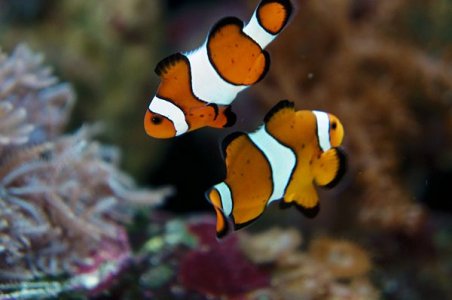
It's regarding the black dots on clown fish. Both of mine have the dots. Yes, I do have a Frogspawn along with various zoanthids. Somehow I fail to accept these dots as coral stings. From what I have read, clowns have a special skin coating to protect them from the sting of the anemones. Why would this not work for coral stings? If they are sting marks, why are they shaped in little dots, instead of a swipe formation?
Another popular idea is that the dots could be 'black ich'. Is this common in clown fish? The dots have been on my clowns for over a week now, and they have not demonstrated any other symptoms associated with ich. They do however fluff the sand as if they are trying to scratch an itch. I've been told this is normal clown behavior.
After researching black ich, I find that the parasite lives in the substrate. These clowns were in tanks at the lfs that had no sandy bottom, and were hosting an anemone. They had no black dots on them at that point. A few days after being introduced into my display tank, the black dots showed up. Lots of sand fluffing took place the first night.
My purpose for asking if we have a member here who is ultimately familiar with fish diseases, is to find out if the parasite can be viewed under a microscope. Can I take my sand to a lab and have it examined?
Here is a picture of my pair of clowns.
Another popular idea is that the dots could be 'black ich'. Is this common in clown fish? The dots have been on my clowns for over a week now, and they have not demonstrated any other symptoms associated with ich. They do however fluff the sand as if they are trying to scratch an itch. I've been told this is normal clown behavior.
After researching black ich, I find that the parasite lives in the substrate. These clowns were in tanks at the lfs that had no sandy bottom, and were hosting an anemone. They had no black dots on them at that point. A few days after being introduced into my display tank, the black dots showed up. Lots of sand fluffing took place the first night.
My purpose for asking if we have a member here who is ultimately familiar with fish diseases, is to find out if the parasite can be viewed under a microscope. Can I take my sand to a lab and have it examined?
Here is a picture of my pair of clowns.
Attachments

dviper150
New member
From what I have read, clowns have a special skin coating to protect them from the sting of the anemones.
To my understanding, they get that slime after being stung a few times to build up the immunity. They aren't naturally born with the immunity.
Not sure what those dots are though. Could be ich.

Triton_Z
Member
Your pictures are consistent with melanization from stings from your corals in the tank. I would give these time to heal. My clown did this with a new set of zooanthids and I wondered the same for awhile. They heal up over time.
Do some searching on the forums.
http://www.reefcentral.com/forums//showthread.php?t=1839048
Do some searching on the forums.
http://www.reefcentral.com/forums//showthread.php?t=1839048

Your pictures are consistent with melanization from stings from your corals in the tank. I would give these time to heal. My clown did this with a new set of zooanthids and I wondered the same for awhile. They heal up over time.
Do some searching on the forums.
http://www.reefcentral.com/forums//showthread.php?t=1839048
I would agree.
Is it rapidly shaking and biting the rock or sand, or darting / scraping its side against the sand?
I've only seen the rapid shaking a few times. I have seen on occasion what appeared to be biting at the sand, and maybe spitting it elsewhere. Have definitely witnessed it scraping it's sides against the sand. Darting once in awhile.
As you know, measuring a live 'swimming' fish is a tad bit difficult, but I managed to do it. The large one is 1.75" and the small one is 1.25". They were bought as a pair, and I have had them for about 3 weeks.What size clownfish? How long together?
The scraping against the sand is not a frequent occurrence.

MrTuskfish
Team RC
Possibly nesting behavior, its very common for clowns (especially the larger female0 to clear small areas of substrate.
Possibly nesting behavior, its very common for clowns (especially the larger female0 to clear small areas of substrate.
Yes, that is why I asked the question.
MrTuskfish
Team RC
Yes, that is why I asked the question.
I really suspected a more sinister motive; this 70+ degree weather gets to you greater Chicago folks. My relatives and friends in the area are really batty lately.
The big one has one area in the left front corner of the tank where it keeps the sand swept to the bare glass. The little one continually hovers around the big one. Annoying it occasionally to the point that it nips it. It doesn't look like there is any exceptional aggressive behave going on. Just a nip every so often.
Thank you for your replies so far.
Thank you for your replies so far.
MrTuskfish
Team RC
The big one has one area in the left front corner of the tank where it keeps the sand swept to the bare glass. The little one continually hovers around the big one. Annoying it occasionally to the point that it nips it. It doesn't look like there is any exceptional aggressive behave going on. Just a nip every so often.
Thank you for your replies so far.
Very typical clownfish spawning behavior; you may end up with eggs. The female (larger fish) is almost always a little rough on the male.
I agree with all posted so far; Melaninization from stings and mating behavior. All clowns are protandrous, means they are born male. Female clowns need to constantly "bully" the primary male and immature male clowns in the colony in order to keep them from becoming females. The stress keeps their cortisol levels up and keeps the gonads from turning female. When the female dies, the biggest male turns into a female and leads the pecking order. In nature on big anemones you can see the clowns all lined up by size and picking on their smaller comrades.
Regarding microbiology, A skin scrape with a microscope slide cover slip then put on a slide and an inspection on a cheap scope can tell you whether you are dealing with a protozoan(ciliates like ich and brook or flagellate like oodinium), metazoan (like flukes or copepods), or if you don't see anything or have a slightly better scope and stains, bacteria. You can also clip fins or gills or even collect feces and look. Better instructions are somewhere on Florida's aquaculture extension website, IFAS, somewhere.
Something like this scope is all you need for diagnosis.
http://store.amscope.com/m150c-e.html
hope I don't get in trouble for posting this link, i Don't work for them...
Regarding microbiology, A skin scrape with a microscope slide cover slip then put on a slide and an inspection on a cheap scope can tell you whether you are dealing with a protozoan(ciliates like ich and brook or flagellate like oodinium), metazoan (like flukes or copepods), or if you don't see anything or have a slightly better scope and stains, bacteria. You can also clip fins or gills or even collect feces and look. Better instructions are somewhere on Florida's aquaculture extension website, IFAS, somewhere.
Something like this scope is all you need for diagnosis.
http://store.amscope.com/m150c-e.html
hope I don't get in trouble for posting this link, i Don't work for them...
Similar threads


- Replies
- 0
- Views
- 197
- Replies
- 0
- Views
- 219

- Replies
- 3
- Views
- 551
