Reinforce Engineered Floor Joists

CafeReef

New member
I am putting in a 50 gallon cube, I estimate total weight to be between 800-900 lbs so I am going to say 1000 to be on the high end. footprint is 4 square feet. My house is built with engineered truss floor joists that have a rating of 40 10 5 for basically 55lbs per square foot. My subflooring is 3/4 tounge and groove ply.

Where we want my tank sits about 8 feet from the primary load bearing wall in my basement. The load bearing wall is built out of 2x6's and runs the length of the basement for around 40 feet.

The floor trusses are 24 feet in length and run perpendicular to the load bearing wall.

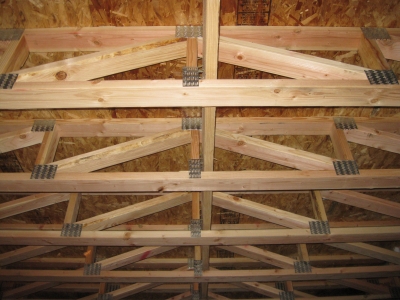
These are pictures of basically what the setup is. the floor truss joists sit on top of the load bearing wall and extend to the other side of the room to rest on my basement concrete foundation/wall. (Note this is a section/sample, not full)

The trusses are 14" high made out of 2x4's, there is plumbing pipe and electrical conduit that run perpendicular across all the trusses on the bottom 2x4.

I am concerned that with the tank being not perfectly centered over a truss (about 12" of the stand would be on subfloor only, 4" on truss, back 8" on subfloor) and being roughly 8 feet from the load bearing wall, that over time this will sag and crack my wall behind my tank.

I am considering buying 2 2x10x10's and marrying them up to each side of the joist/truss so they rest up against my subfloor. I would use construction adhesive and screw them into the trusses.

They would stretch about 5 feet in each direction from directly under the fish tank.

my other option is to have the fish tank all the way to the right putting it up against the load bearing wall but not on. I would greatly prefer the setup in the pictures as it puts the tank more in my living room.

Thoughts? is this pointless? My concern is if marrying 2x10's the the upper portion of the truss being 14" high would do no good as it would not be resting on anything outside of just being glued and screwed to the truss.

Putting posts in is not an option as this will be in the middle of a doorway in the basement and in the middle of the room.

Thank you!

current
k3nmD3o.jpg


married 2x10
ZiLymeQ.jpg
 
I am not sure where you are coming up with the 1000LB number.


  • Seawater is no more than 8.5 pounds per gallon
  • The stand is not going to weigh more than 25 pounds - call it 50
  • Rock and sand displace water so 150 pounds of rock and sand will displace around 100 pounds of water....
  • Pumps - heaters - plumbing, maybe 20 pounds, with some of them displacing water as well.
  • Your 50 gallon tank likely holds 40 gallons of water at operating level, maybe 10 gallons for your sump? So 50 total?
The total weight of your system is not likely going to be over 600 pounds, that is a far cry from 1000.

4 square feet at a 40 pound live load really mean nothing. Your floor is designed (in theory) to handle 40psf live over its entire span. That is the total area in square feet times 40 pounds = the theoretical SAFE load. Note that the floor will likely hold many times that amount safely.

If it were my floor, I would likely not worry about the 50 gallon aquarium. That said, sistering in the 2x6 members will help to some extent, as would blocking to neighboring floor trusses. Both will help move the load over the length of the stiffer section (through the sheeting) to other trusses. Though you are also moving some load to a single point at the end of the sisters if they do not rest on a load bearing surface. Sistered joists would work MUCH better if they rested on both load bearing structures.

Of course, if the space is open, a single cross support and floor jack would also allay your cause for concern.
 
If it were my floor, I would likely not worry about the 50 gallon aquarium. That said, sistering in the 2x6 members will help to some extent, as would blocking to neighboring floor trusses. Both will help move the load over the length of the stiffer section (through the sheeting) to other trusses. Though you are also moving some load to a single point at the end of the sisters if they do not rest on a load bearing surface. Sistered joists would work MUCH better if they rested on both load bearing structures.

Of course, if the space is open, a single cross support and floor jack would also allay your cause for concern.

not sure sistering as he was going to do would help much w/out blocking on the ends to put the oad back on the sill plate as it should be.

Agree w/ the fact that the load is "probably" not fatal though more bowing in the joist may be encounterd..

That said using 3/4 plywood full height and gluing it/nailing to full truss will def. stiffen the floor...14" by whatever sections starting at the wall ..
 
I didnt think about displaced water from the rock and sand. It is going to be about 55lbs of caribsea life rock with 40lbs of sand. The tank itself is 10mm glass 24x24x20. And the stand weighs around 80lbs. Sump will hold about 10 gallons.

So do you think I would be better off running stringers perpendicular across multiple joists?
 
I found a pretty good calculator that estimates the contents of my tank and sump will be about 430 lbs with water rock and sand. The tank weighs about 95 lbs (say 100) and around 80lbs for the stand. So Like you said, right at around 600 lbs. i originally assumed 800-900 and went with 1000 because I would rather over shoot then be wrong.

With that, 600 lbs does seem more reasonable. I want to avoid my floor sagging as much as possible, I know it wont fail so I am not as concerned there.

What would be my best approach without putting in posts or jacks. Where they would have to go is not an option so I am left with either laminating boards to the sides of the truss joist under the tank. Or run stringers through the joists to tie the one under the tank to one or two joists in each direction from the one under the tank (only issue with this is I can't get the boards flush with the subfloor as the 2x4 top of the truss is in the way.
 
The whole thing is more complicated than it sounds apparently..
A very quick check seems to point to bridging to load share does seem to work w/ truss joists (questionable in regards to other types of floor joists).
Catch is it seems "how" one bridges is somewhat dependent on manuf recommended methods..

One way:
floor-truss-bridging.jpg

For engineered floor joists, such as I-joists or trusses, you must follow the manufacturers’ specifications for installing bridging. Typically I-joists are braced with metal strap cross bridging and truss style joists use continuous 2x4 lumber as bracing.
https://knoji.com/how-to-install-floor-joist-bridging
Good read though..
http://www.eng-tips.com/viewthread.cfm?qid=348144

I'm not recommending anything in particular.. :)
 
My builder did bridging around my basement randomly. They just did 2x6's and nailed them up. Now I am certain it was more for sway and bounce in the floor than it was for true support.
 
The bridging prevents the trusses from twisting under load. So yes it dampens bounce. To a much lesser extent (just like the sheeting) it will transfer some load to neighboring support members.

As mentioned, laminating plywood to the full height of the webbing will also stiffen the trusses. You are, in effect, building a torsion box.

Again, strengthening an area shorter than the full span will only help to move a small portion of the load perpendicularly to neighboring support members. Most of the load will simply end up further down the joist support at the end of the stiffened section. In the end, this will likely be enough for the load in question.

In other words, right now you have a 600 pound point load. Adding stiffeners of some type will move a small portion of that load to the surrounding area, lessening the point load.

You have the design specs of the trusses, a simple beam calculation will show you the raw deflection (ignoring any load transferred by the sheeting). You would calculate a fully braced beam (assuming you bridge the bottoms) that is fixed at both ends.
 
The bridging prevents the trusses from twisting under load. So yes it dampens bounce. To a much lesser extent (just like the sheeting) it will transfer some load to neighboring support members.

As mentioned, laminating plywood to the full height of the webbing will also stiffen the trusses. You are, in effect, building a torsion box.

Again, strengthening an area shorter than the full span will only help to move a small portion of the load perpendicularly to neighboring support members. Most of the load will simply end up further down the joist support at the end of the stiffened section. In the end, this will likely be enough for the load in question.

In other words, right now you have a 600 pound point load. Adding stiffeners of some type will move a small portion of that load to the surrounding area, lessening the point load.

You have the design specs of the trusses, a simple beam calculation will show you the raw deflection (ignoring any load transferred by the sheeting). You would calculate a fully braced beam (assuming you bridge the bottoms) that is fixed at both ends.


Thanks BeanAnimal, I will take pictures tonight and see if that helps with any direction/pointers if these pics dont help. One thing that is stopping me from going the entire length of the truss is that I have duct work in the way that wont allow for me to go the entire span. I could easily put in two or three bridges across neighboring trusses for at least 10 feet fairly easily.

I guess I am just wanting to be sure that I am not going to sag the floor causing anything to be unstable. I know at 600 pounds it is nothing compared to most other setups, I just want to be safe.


The bean directly in the center is one in question. you can see one bridge/stringer to the left of the return duct and the plumbing in place that is stopping me from going full height.

cfjiGuDh.jpg


2JmvYQRh.jpg
 
If you dont have grand plans for the basement, you could just add a beam across the 3 joists with (due to how small of a boost you need if at all) perhaps only one column? Otherwise 2. Wonder if you could put them actually basically close to side by side, right at outer edge of the tank. That way you only take up like a smaller "zone" of space in basement. Given it's mostly on one joist, I wonder if unlike on a big tank, just a strip of beam with column directly under/parallel with joist wouldn't be fine in this application.

Going thru this now with my 300g, I'm a noob to this, but as long as you have space, column and beams across joists seems like easiest way to add a lot of support and it's pretty cheap and easy. (Messing with the other ribbing sistering and other methods seems a little more technical in some cases, esp given the joists usually have rules about how far apart fastenings should be and such.
 
Looks like a great space for a fish room!

:)

heh, my wife wouldn't agree near as much. I am lucky I am currently able to make it a shop.

Unfortunately the space directly under the tank is right in the middle of what will be the living room. This is why columns/posts are not a possibility. We paid quite a bit extra for engineered floor truss joists so that we would not have to have posts in our basement.
 
Pratt_truss.png

not sure, but you could probably build some "sister" trusses in place...
start by adding the floor plate.. then the bottom w/ perp. members
attach plate w/ cross members.

"Sounds" easy enough.. ;)
 
Back
Top