I would like to share a rockscaping technique that I devised and is working out real well.
In the past, my rockscaping approach was to first lay down live sand to form a shallow sand bend and then put the live rock on top of the sand. The first layer of "base" rocks immediately on top of the sand would need to be seated carefully and deep for stability. Then add layers of live rock stacked above.
However, the problems with this approach include:
- Poor water circulation in many places behind the rocks
- Detritus collects behind rocks near the sand
- Hard to find and remove a dead fish stuck behind rocks
- Hard to clean the live sand that is under/behind rocks
- Rocks on sand can be unstable, leading to an avalanche
I realize a bare bottom tank solves the above problems, but I personally do not like the appearance of a bare bottom tank. So I wanted to find a method to avoid the rocks resting directly on the sand, ideally suspended above the sand to promote good water circulation.
On the forums, I have read some attempts to use stands or short PVC tubes, but I think PVC is not very attractive and also has undesired dead space inside the tubes.
Another approach I read about was to use solid acrylic posts. But I found this to be difficult to implement because you need some kind of sheet under the sand to attach all the posts. In addition, the location of the posts are hard to determine in advance and cannot easily be changed.
So this lead me to the approach of attaching solid plastic stilts to the bottom of each base rock to hold them above the sand....
For the stilt material I chose to use inexpensive black plastic hangers that I can cut to length. I considered using solid acrylic rod, but I figured that the extra expense of acrylic was not worth the investment assuming the rods would eventually get covered with coralline algae. But using clear/acrylic rod would provide a more upscale appearance right from the start.
The following method is how rods can be attached to base rock. First, set up a temporary container to safely store live rocks outside your tank with salt water, heater and a powerhead. Remove upper layers of rocks from tank to access base rocks. If you are replacing your sand bed, then you will need to remove everything, include fish. Next set up a remote work location, with salt water rinse bucket and tools.
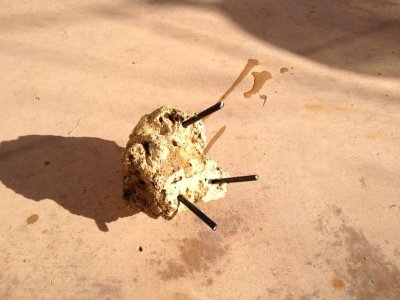
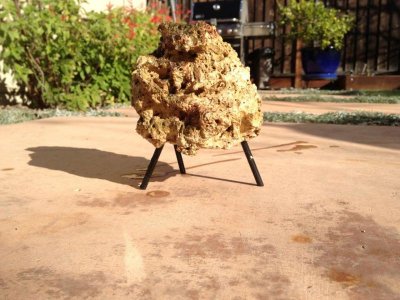
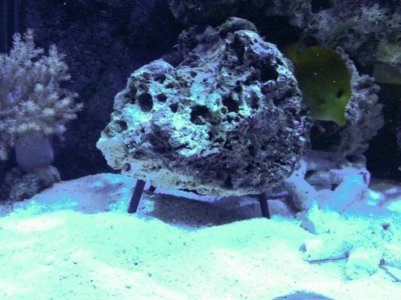
Remove selected base rocks from the tank, one at a time. Drill 3 or 4 holes in the bottom of each base rock about 1 to 2 inches deep. Use a masonry drill bit that matches the diameter of the plastic rods (I chose to use black plastic hangers with a thinner 1/4 inch diameter). I found that it is best to drill the holes near the outside edges and to angle the holes slightly at about a 10 to 30 degrees angle in order to provide the most stable base possible. I also recommend orienting the base rocks so that the most concave/flat side faces down. This is more stable and minimizes detritus collection on top. After drilling, rinse rocks thoroughly and use a turkey baster to clear drilling dust out of the holes. Then insert plastic rods firmly into the holes and trim each to desired length with a wire cutter. My sand bed is about 1.5 inches deep, so I trimmed the rods to be 2.5 inches long for rocks near the front of the tank and 3 inches long for the rocks near the back of the tank. This will suspend the rocks 1 to 1.5 inches above the sand bed. I chose to use 4 rods on larger rocks for more stability, but requires slowly trimming the legs so that all four are balanced. And finally install and arrange all the base rocks, followed by additional layers of rock on top.
If you need greater strength, you can consider using more rods per rock, larger diameter rods, acrylic rods, or attaching fishing line between the ends of all the rods to control bending.
It's possible to drill rocks that still has some living coral attached if you are careful and work quickly.
Attached are some pictures.
John
In the past, my rockscaping approach was to first lay down live sand to form a shallow sand bend and then put the live rock on top of the sand. The first layer of "base" rocks immediately on top of the sand would need to be seated carefully and deep for stability. Then add layers of live rock stacked above.
However, the problems with this approach include:
- Poor water circulation in many places behind the rocks
- Detritus collects behind rocks near the sand
- Hard to find and remove a dead fish stuck behind rocks
- Hard to clean the live sand that is under/behind rocks
- Rocks on sand can be unstable, leading to an avalanche
I realize a bare bottom tank solves the above problems, but I personally do not like the appearance of a bare bottom tank. So I wanted to find a method to avoid the rocks resting directly on the sand, ideally suspended above the sand to promote good water circulation.
On the forums, I have read some attempts to use stands or short PVC tubes, but I think PVC is not very attractive and also has undesired dead space inside the tubes.
Another approach I read about was to use solid acrylic posts. But I found this to be difficult to implement because you need some kind of sheet under the sand to attach all the posts. In addition, the location of the posts are hard to determine in advance and cannot easily be changed.
So this lead me to the approach of attaching solid plastic stilts to the bottom of each base rock to hold them above the sand....
For the stilt material I chose to use inexpensive black plastic hangers that I can cut to length. I considered using solid acrylic rod, but I figured that the extra expense of acrylic was not worth the investment assuming the rods would eventually get covered with coralline algae. But using clear/acrylic rod would provide a more upscale appearance right from the start.
The following method is how rods can be attached to base rock. First, set up a temporary container to safely store live rocks outside your tank with salt water, heater and a powerhead. Remove upper layers of rocks from tank to access base rocks. If you are replacing your sand bed, then you will need to remove everything, include fish. Next set up a remote work location, with salt water rinse bucket and tools.
Remove selected base rocks from the tank, one at a time. Drill 3 or 4 holes in the bottom of each base rock about 1 to 2 inches deep. Use a masonry drill bit that matches the diameter of the plastic rods (I chose to use black plastic hangers with a thinner 1/4 inch diameter). I found that it is best to drill the holes near the outside edges and to angle the holes slightly at about a 10 to 30 degrees angle in order to provide the most stable base possible. I also recommend orienting the base rocks so that the most concave/flat side faces down. This is more stable and minimizes detritus collection on top. After drilling, rinse rocks thoroughly and use a turkey baster to clear drilling dust out of the holes. Then insert plastic rods firmly into the holes and trim each to desired length with a wire cutter. My sand bed is about 1.5 inches deep, so I trimmed the rods to be 2.5 inches long for rocks near the front of the tank and 3 inches long for the rocks near the back of the tank. This will suspend the rocks 1 to 1.5 inches above the sand bed. I chose to use 4 rods on larger rocks for more stability, but requires slowly trimming the legs so that all four are balanced. And finally install and arrange all the base rocks, followed by additional layers of rock on top.
If you need greater strength, you can consider using more rods per rock, larger diameter rods, acrylic rods, or attaching fishing line between the ends of all the rods to control bending.
It's possible to drill rocks that still has some living coral attached if you are careful and work quickly.
Attached are some pictures.
John