
..................12 gallon nano.....................

juniorjose

New member
i decided to start a thread on my 12 gallon instead of asking questions everywhere on here.
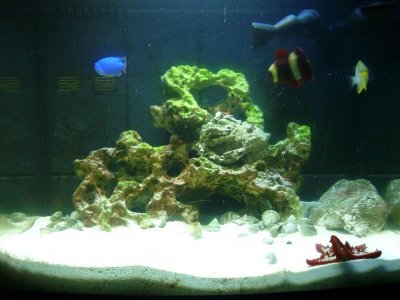
ok so here is the deal: this tank was given to me by a friend last year that moved. in there i have a maroon clown fish with two other damsels that get along great and look very healthy. i also have a red knob starfish thats really cool looking for about 2 months that i added in there myself. i had a coral banded shrimp in there at one time when i first added the starfish but it died. i never tested the water in this nano ever since it was given to me. i got really into this hobby and this year i started a 29 gallon myself, but thats another thread. i bought a API test kit to see how the water on the 29 gallon was cycling. i also tested the 12 gallon nano and was pretty surprised by the numbers i got in the nano and here they are.
ph. 7.8
ammonia: 0ppm
Nitrite: 0ppm
NITRATE: 160PPM
i also had it double checked by my LFS and he said the ph was low and told me to buy seachem buffer and add three scoops of it into the tank, so i did. now the ph is at 8.4 with only one dose, i did this last week and everything is still good. but now the nitrate is the problem in the tank. i was told to add CHEATOMORPHA to the tank and later on this week i plan on getting some:thumbsup:. i was also told to do a water change every 3-4 days till the nitrate changes. i now the nitrates isnt that much of a big deal to the fishes but i got a lot of responses on here that it is dangerouse for the starfish, which i dont want to lose. i was also reading that nitrates can be other factors of poor water quality.:mad::furious:

heres is what i do throughout the week:
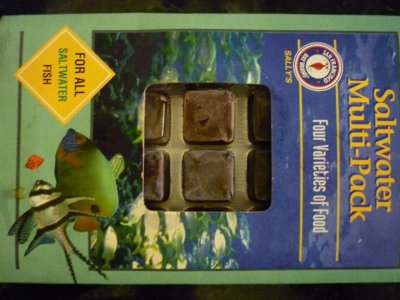
every other day i cut half a cube of the saltwater multipack and two pieces of prawn (for the starfish) and soak it in selcom for 2 min and feed it to the tank. they all eat including the hermit crabs.
HERES A FULL TANK SHOT
P1020058.jpg
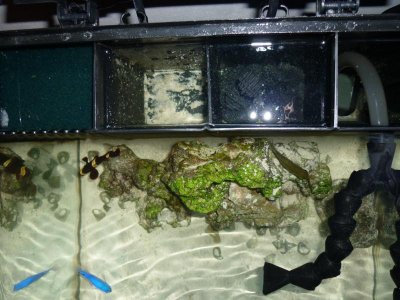
HERE IS THE BACK OF THE FILTER SYSTEM, THE FIRST CHAMBER I HAVE A RECTANGULAR SPONGE, THE SECOND IS EMPTY, THE THIRD HAS CARBON BIOBALLS THATS BEEN THERE EVER SINCE I GOT THE TANK, AND THE FOURTH IS THE RETURN PUMP
P1020061.jpg
THIS IS WHAT I FEED MY TANK, HALF A CUBE OF THIS WITH TWO PRAWN THEN SOAKED IN SELCOM.
P1020070.jpg

when i do get the cheatomorpha do i add it to the empty chamber or the main display?

some people say that the API test kit is not very good,? but i dont really now because im new to all of this. so far today i only did about 20% water change

any help out there is appreciated.
 
Cheato in the empty chameber will work if it can get light back there and has the ability to "tumble". API is fine for test kits. I use them along with many others. There are more expensive kits out ther, salifert for example. You will find that the experts pick and choose pending on what they are testing. For example John Doe has found that for Nitrates salifert is more accurate while Amonia is better tested with API. I have found the best thing to do is shoot for consistancy as opposed to accuracy. If a salifert kit reads a PH level of 8.2 while API reads 8.0, dont fret over the difference. Pick a test kit and do your best to make sure your readings are always the same.

Oh and you will have many people telling you to go ahead and take the bio balls out. They accelerate nitrate build up.
 
i dont believe that API is bad, its just that when alot of people starts saying the same thing ur conscence starts to wonder. but i agree its good or else they wouldnt be in business.

wait, i was always wondering what these balls do. i went to my LFS to ask them and they said to NEVER take those balls out because they are the biological filter of the tank? can someone explain how they work and what are the pros and cons of taking them out. instead of bioballs what do i add in there?
 
Yes, I agree with shane. I use API for some tests, and others for other test kits. I do plan to go with higher quality test kits once my API runs out, but until then I will use it.

Also, yes, get rid of the bioballs, they are a nitrate factory. If you do not plan to add too much more to the tank, it looks like your rocks should handle the bioload fine. When ditching the bioballs, do NOT grab them all out at one shot, as they house bacteria, and if you remove all that bacteria at once, you can have HORRIBLE results. Take one or 2 out every week, watch for any spikes on your ammonia namely(that will be the biggest indicator). This gives the bacteria time to build up in the rocks, and going too quickly can cause ammonia, nitrite, or both to spike. Sounds like you're doing well so far.
 
OK, a little more. In a marine tank, like any fish tank, you will have ammonia. This comes from anything decaying, like extra food, fish poop, and fish respiration. To take away this toxic ammonia(think of like top job bathroom cleaner which is almost 100% ammonia), we must have "beneficial" bacteria. These bacteria use ammonia for food, digest it(or in a process similar to digestion) and their waste is nitrite. Then there is another species of bacteria that uses nitrite as food, and their waste is nitrates. I am pretty sure that from there, there is another that processes nitrates, but not real sure, thats where my knowledge ends.

In our tanks, these bacteria should MOSTLY live in our rock. In a FW tank, they would live mostly in the filter media, and filter canister. What happens is they made these bio-balls that people could install in their tanks, which are pourous, like the rock in our tanks, for the bacteria to live in. I am not really sure why they produce a lot of nitrates, but it could have something to do with the bacteria. Whatever the reason, they produce a lot more nitrates than your system can process. In FW tanks, they can work fine, but for the most part, that's where they should stay. It is believed by MANY that live rock is a much better filtration medium than bioballs, and most FW filtration applications. Hope that helps.
 
o i forgot to post this in the first post but the biggest rock in there is base rock thats been there for a year. would u say its "live" right now? the only real live rock in there is 1/2 pound. does this affact anything? will the ammonia spike that i get from taking out the balls kill anything? and what can i add to the empty chamber ill have?

taking the balls out wont makeit unstable?
 
Last edited:
i also tried to add coral in there once, a mushroom, it looked healthy for a week and was full. but then it started to disappear all of a sudden and one day i never saw it again.:thumbdown can the nitrates have something to do with it?
 
Don't mean to be hogging the thread.

If what you have in there has been there for more than like 2 months, it is "live" by most definitions. Some will dispute this, because it does not have what a lot of LR has, that your base rock will never have. Stuff like sponges, barncales, tunicates, worms, etc. However if you define LR as housing living bacteria and "pods", your rock is LR.

What is the overall amount of rock in the tank? Most go with the 1-2lb/gallon rule. I find that more accurately it is closer to 2lbs/gallon under about 40 gallons, 40-100, it's like 1.25lbs/gallon, and over 100, its 1lb/gallon. Basically, you need enough to house the bacteria needed to process your tanks waste. As mentioned above that is excess food, fish waste, and fish respiration. I would say you need at least 12lbs in that tank with current stock. I would say 18-25lbs would be better. If you can afford it, I would get the rock up to at least 18 lbs(I am only assuming about double what you have right now). This DOES NOT have to be LR. It can be Base Rock that you give time to seed with bacteria, then you can start removing the bioballs.

As for the empty chamber, if the seperator between compartments 2 and 3 is removable, you can remove it and have more chaeto. If not, you can add LR rubble. This is a good way to have a lot of LR for bacteria to hide while not cluttering your display area with tons of rock. It can also house a heater, or be empty.
 
ok from what i learned so far from u guys is that i need to add more rock in this tank and let it be seeded for a while BEFORE i start to take out the bioballs? i am not sure how much pounds of rock is in this tank but it is definalty not 12 pounds. i would say by holding it is only 5 pounds, but the sand is very "live" also.

the compartment are not removable. how do i go about adding the rubble? do i add rubble to the main display for a while, while having cheato in chamber 2 then slowly remove all the bioballs, then when they are gone transfer the rubble to the chamber the bioball are in? or do i add rubble in chamber 2 with the cheato and then transfer the rubble to were the bioballs are? what do u mean that the cheato has to "tumble"?
 
You can put the LR rubble in your DT and then once the bioballs are gone, transfer it. There is no need to put the rubble in the chaeto compartment with it.

what "tumble" refers to how chaeto will move and rotate inside whatever container it is in. Basically, it means do not let it get too big so it doesn't get even light 360 degrees.
 
do u guys think that if i added more live rock to this tank it would start another cycle and kill thefish and starfish?...how do i add more rocks?
 
More live rock, balls out, star out, clown out, they get to big for a 12 gallon. throw a bag of carbon in. water changes once a month, about 2-3 gallons. If the rock is live from the lfs, just throw it in. if it was live, and fried out,,, then you would have to cycle it. if it is dry, and never live, just add it slowly. and the critters and bacteria will move onto it, turning it live.
 
Back
Top