Hey all - I'm looking for some friendly advice before I spend any more money. This is my first plunge (pun intended) back into the saltwater hobby in five years. Previously I had a 75g reef aquarium and kept fish, inverts and mostly softies. I did a cross country move and sold everything off rather than attempt to transport it.
I've had a Biocube 28 HQI for quite a while and just recently started the set up process when I unexpectedly acquired a lot of live rock from a friend. I chose the BC HQI because it was a deal at the time and I wanted an "all in one" due to space constraints.
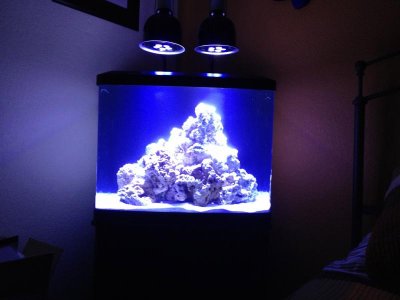
I decided to ditch the HQI lighting - ironic because that's one of the reasons I bought the tank - in favor of a pair of Ecoxotic par38 LED lamps. As you can see in the pic, they are mounted using reptile lighting set ups. They're pretty bright, barely get warm, and do produce glitter lines. So far I love them.
A thread on this site turned me inTank's media basket. I'm happy about that because Oceanic's stock set up leaves something to be desired. I also ordered a Tunze 9002 skimmer as well as the water deflector. I don't want to have a sump, so this seems like it will be ideal.
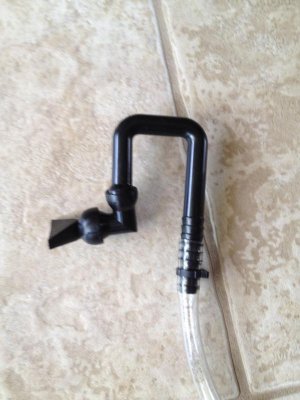
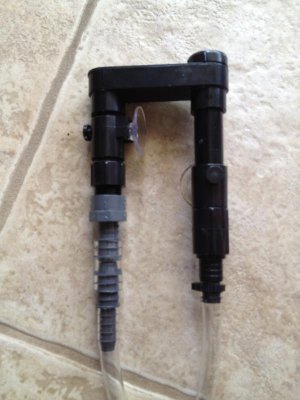
Heat is a potential problem where the tank is located. In the summer, the room is often 82 - 83'. Our AC runs continuously all summer long here in the desert and I keep it at 80 but that doesn't mean it's exactly 80 in all the rooms. So I picked up a used 1/10 HP Arctica chiller for half the price of a new one. I'd like to keep the tank at about 78'. Plumbing the chiller into the system is what's got me stumped, so that's where I could use some advice. My original plan was to route the output of the pump in chamber 3 up over the side of the aquarium, into the chiller and then back into the main tank. I have barbed hard plastic over-the-tank plumbing and I'm planning on using 1/2" flexible vinyl tubing. I've never had a problem with leaks in the past, But I realized this setup would empty nearly the entire tank if a leak happened. There's no way to have a "siphon break" when the water is being pumped OUT of the aquarium. Here are a couple of ideas (in order of favor)... I'm not sure how they'd work though:
1. I have a JBJ ATO. In it's intended use, you can configure it to shut down the pump from a freshwater reservoir if the level in the reservoir drops too low. I would have to mount sensor 1 somewhere in the tank (unless it will work without sensor 1 plugged in) so that the unit will always be calling for the pump to be on. I would mount sensor 2 near the water line. The pump should run continuously unless the water level drops below sensor 2 and the unit shuts down. I would drill a small hole in the output piece below the water line to stop the passive siphon effect that would likely occur even with the pump off.
2. Use an external pump...but it would have to be not a whole lot stronger than 250 gph because I don't think the chambers in the back of the tank could handle much more than about 300 gph. I would try to position the intake in chamber 3 so that it would break contact with the water if the entire tank level goes down. The problem with that is the normal water level (at 250 gph) is about 1/3 lower in chamber 3 than the main tank and quite a bit of water would have to leak out based on where the intake tube would have to be placed. A canister filter (run without media) could also be used instead of an external pump, but that wouldn't solve the issue of losing about 1/3 of the tank's water before the intake breaks contact.
3. Add a second water flow circuit (using an external pump or empty canister filter as in otion 2) and leave the filtration system as is. In this case the intake can be positioned in the main part of the tank closer to the surface so it wouldn't take a lot of water loss to break contact. My concern with this scenario is excessive current in the aquarium. Right now I have a 250 gph Eheim pump running. I'm thinking that is close to an optimal amount of current for the entire aquarium (Am I wrong?) The chiller requires no less than 250 gph, so whatever I use for that water circuit, it would have to be about 250 gph. I could turn the filtration pump down a bit, but I don't know if I'd still have too much flow.
Well, if you've managed to read this entire too-long post, I appreciate it. If you have any thoughts or suggestions, I'd be really grateful! Thanks a bunch!
I've had a Biocube 28 HQI for quite a while and just recently started the set up process when I unexpectedly acquired a lot of live rock from a friend. I chose the BC HQI because it was a deal at the time and I wanted an "all in one" due to space constraints.
I decided to ditch the HQI lighting - ironic because that's one of the reasons I bought the tank - in favor of a pair of Ecoxotic par38 LED lamps. As you can see in the pic, they are mounted using reptile lighting set ups. They're pretty bright, barely get warm, and do produce glitter lines. So far I love them.
A thread on this site turned me inTank's media basket. I'm happy about that because Oceanic's stock set up leaves something to be desired. I also ordered a Tunze 9002 skimmer as well as the water deflector. I don't want to have a sump, so this seems like it will be ideal.
Heat is a potential problem where the tank is located. In the summer, the room is often 82 - 83'. Our AC runs continuously all summer long here in the desert and I keep it at 80 but that doesn't mean it's exactly 80 in all the rooms. So I picked up a used 1/10 HP Arctica chiller for half the price of a new one. I'd like to keep the tank at about 78'. Plumbing the chiller into the system is what's got me stumped, so that's where I could use some advice. My original plan was to route the output of the pump in chamber 3 up over the side of the aquarium, into the chiller and then back into the main tank. I have barbed hard plastic over-the-tank plumbing and I'm planning on using 1/2" flexible vinyl tubing. I've never had a problem with leaks in the past, But I realized this setup would empty nearly the entire tank if a leak happened. There's no way to have a "siphon break" when the water is being pumped OUT of the aquarium. Here are a couple of ideas (in order of favor)... I'm not sure how they'd work though:
1. I have a JBJ ATO. In it's intended use, you can configure it to shut down the pump from a freshwater reservoir if the level in the reservoir drops too low. I would have to mount sensor 1 somewhere in the tank (unless it will work without sensor 1 plugged in) so that the unit will always be calling for the pump to be on. I would mount sensor 2 near the water line. The pump should run continuously unless the water level drops below sensor 2 and the unit shuts down. I would drill a small hole in the output piece below the water line to stop the passive siphon effect that would likely occur even with the pump off.
2. Use an external pump...but it would have to be not a whole lot stronger than 250 gph because I don't think the chambers in the back of the tank could handle much more than about 300 gph. I would try to position the intake in chamber 3 so that it would break contact with the water if the entire tank level goes down. The problem with that is the normal water level (at 250 gph) is about 1/3 lower in chamber 3 than the main tank and quite a bit of water would have to leak out based on where the intake tube would have to be placed. A canister filter (run without media) could also be used instead of an external pump, but that wouldn't solve the issue of losing about 1/3 of the tank's water before the intake breaks contact.
3. Add a second water flow circuit (using an external pump or empty canister filter as in otion 2) and leave the filtration system as is. In this case the intake can be positioned in the main part of the tank closer to the surface so it wouldn't take a lot of water loss to break contact. My concern with this scenario is excessive current in the aquarium. Right now I have a 250 gph Eheim pump running. I'm thinking that is close to an optimal amount of current for the entire aquarium (Am I wrong?) The chiller requires no less than 250 gph, so whatever I use for that water circuit, it would have to be about 250 gph. I could turn the filtration pump down a bit, but I don't know if I'd still have too much flow.
Well, if you've managed to read this entire too-long post, I appreciate it. If you have any thoughts or suggestions, I'd be really grateful! Thanks a bunch!