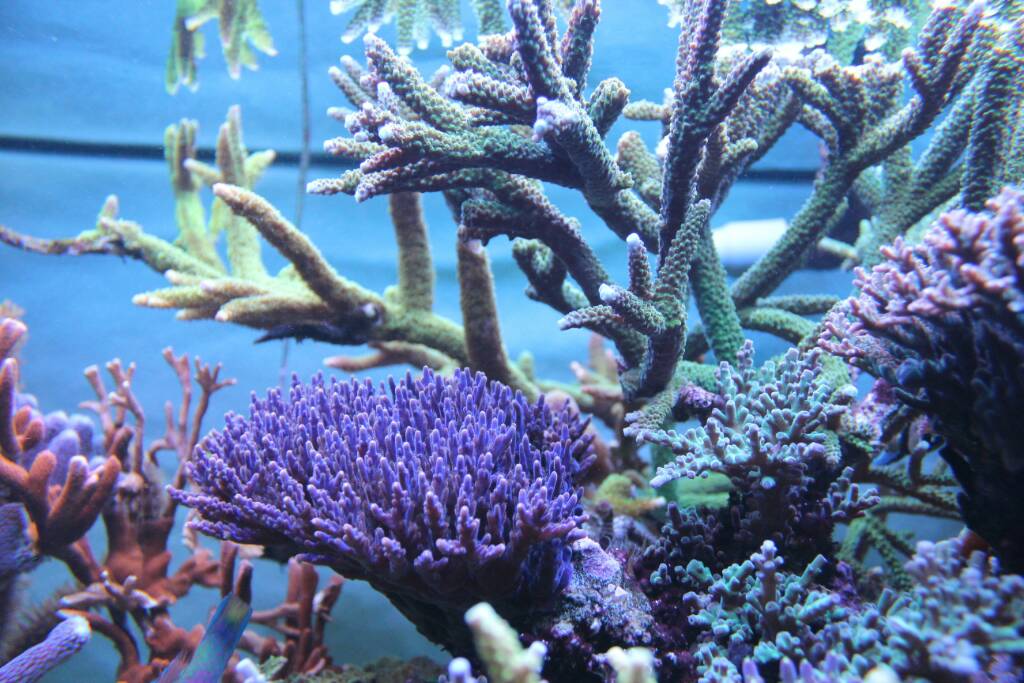
Any way to get away with not doing water changes?

Beautiful tank Tybota!! What do you do for nutrient export?
Thank you!

Nothing novel here, just biopellets for nitrates, GFO for phosphates, carbon passively in a bag, a calcium reactor for foundation elements and some trace elements, and a giant skimmer. I do have two Marinepure ceramic blocks in the sump for additional filtration as well.
 
I'm just complimenting his beautiful work. Was not even talking to u, and u start insulting me?

This is a PUBLIC forum: When you post, it is assumed that you are posting in context to the content of the thread and to those following along, unless you specifically direct your comments to a person or persons:

YOU SAID:

Post #68 answered this question once and for all

That certainly appears to be a comment in context to the topic at hand. A comment that appears to quite succinctly address the issue as settled, based on information given in post #68.

You were not insulted. I responded to your comment and articulated that I suspected a flaw in the logic that helped you arrive at your conclusion.

Happy Reefing :)
 
Bean,
I would contend that water changes are not the end all be all that you are making them out to be. After all, salt mixes are just man-made combinations of salts, do they cover the full array of complex requirements like you say they do? Probably not.
They are pretty close to NSW...

And the basic point was in that context. Yes, surely we can nitpick about the differences, but the point was larger :)


I have seen no evidence to suggest that a calcium reactor with supplemental trace elements dosing is in any way inferior to a salt mix for supplying essential elements. In fact, I would argue that it is superior.
That is somewhat outside of the scope of my point. You can IMPROVE certain aspects of any environment, but the supplemental improvement in this context does not provide for the export mechanism or provide for other missing components.

I think the spirit of the origin of this thread is "how can i do this hobby without doing biweekly or monthly water changes." Maybe I'm completely wrong on that, But I think any reasonable person can look at a very robust filtration and supplementation regimen coupled with biannual or annual water changes to avert OTS, and see that it is definitely not headed for disaster like you say it is, While significantly reducing the amount of maintenance needed...which is what I think this thread was looking for.
I partially agree in the sense that, given a robust set of mechanisms and a target timeframe, one could forgo water changes for that timeframe. That, I suspect, does answer the OPs question :)

The larger point I guess I am trying to make is that the methodology required for supplemental additions and exports becomes more complex as the timeframe between water changes increases. Most of the "I have not done a water change in 2 years" folks are headed for certain disaster. It is basic physics at work.

FWIW - I was (am?) one of those folks who has gone, literally 2 years without a SINGLE water change in an ~10 year old system. 75G display, maybe 50 in sump, 10 in 6' tall skimmer. Turf scrubber and maybe 150-200 pounds of LR. Shallow sand bed and 9 fish. PO4 levels slowly increased over those 2 years but were still in a very manageable range. Everything stayed VERY healthy.

A simple overheating event stressed some corals and kicked off a disaster that took 2 years, dozens of water changes and rock replacement to correct. You see OTS is rarely obvious until it is far too late. In my case, the ROCK was so saturated with phosphate, that it took dozens of 80% water changes over 6 months (3 a week) to bring it back down.

Thanks for the thoughtful response!

 
They are pretty close to NSW...

And the basic point was in that context. Yes, surely we can nitpick about the differences, but the point was larger :)


That is somewhat outside of the scope of my point. You can IMPROVE certain aspects of any environment, but the supplemental improvement in this context does not provide for the export mechanism or provide for other missing components.

I partially agree in the sense that, given a robust set of mechanisms and a target timeframe, one could forgo water changes for that timeframe. That, I suspect, does answer the OPs question :)

The larger point I guess I am trying to make is that the methodology required for supplemental additions and exports becomes more complex as the timeframe between water changes increases. Most of the "I have not done a water change in 2 years" folks are headed for certain disaster. It is basic physics at work.

FWIW - I was (am?) one of those folks who has gone, literally 2 years without a SINGLE water change in an ~10 year old system. 75G display, maybe 50 in sump, 10 in 6' tall skimmer. Turf scrubber and maybe 150-200 pounds of LR. Shallow sand bed and 9 fish. PO4 levels slowly increased over those 2 years but were still in a very manageable range. Everything stayed VERY healthy.

A simple overheating event stressed some corals and kicked off a disaster that took 2 years, dozens of water changes and rock replacement to correct. You see OTS is rarely obvious until it is far too late. In my case, the ROCK was so saturated with phosphate, that it took dozens of 80% water changes over 6 months (3 a week) to bring it back down.

Thanks for the thoughtful response!
Any thought to if you were more aggressive to phosphate removal that the accumulation in your rock would never had occurred?
 
I have a huge skimmer, was running a huge dump style ATS and regularly used GFO. I am not really sure how much more aggressive I could have been in a reasonable context.
 
I have a huge skimmer, was running a huge dump style ATS and regularly used GFO. I am not really sure how much more aggressive I could have been in a reasonable context.
Yeah, that's about max aggressiveness there. [emoji4]

What was the verification that the rocks were leaching phosphates? Did you place one in a bucket and test the water after that?
 
I was doing very large volume water changes, up to 80%. After the change the levels would (obviously) drop by roughly 80% but would creep right back up to where they were over the next 24-72 hours. This happened for months. I sucked almost ALL of the sand out of the system (it was a shallow sand bed to begin with). No help. I started using lanthanum chloride to keep it knocked down (killed a scopas tang and irritated the other tangs in the process) and that helped a bit.

Bucket test.... positive. I replaced what rock in the display that I could and almost ALL of the rock (50 - 75 pounds) in the sump.
 
I was doing very large volume water changes, up to 80%. After the change the levels would (obviously) drop by roughly 80% but would creep right back up to where they were over the next 24-72 hours. This happened for months. I sucked almost ALL of the sand out of the system (it was a shallow sand bed to begin with). No help. I started using lanthanum chloride to keep it knocked down (killed a scopas tang and irritated the other tangs in the process) and that helped a bit.

Bucket test.... positive. I replaced what rock in the display that I could and almost ALL of the rock (50 - 75 pounds) in the sump.

That's very interesting to hear. Thank you for sharing your experiences with it. I might have to incorporate a regiment of removing rocks through the years and treating them with lanthanum chloride to remove bound phosphates and then replacing them back in the tank.
 
To add to this thread, I went just over a year without a water change before doubling the size of my system. I added new water to the old, then had an anemone shred shortly after the upgrade. I changed some water because of that but now its been about 5 months without changing. I will continue on no changes unless I see an issue

FullSizeRender%203_zpsirbhkhla.jpg


FullSizeRender%204_zps52ih6lzt.jpg


This was what the original tank looked like after one year without water changes:

Full%20Tank%20031015_zpsqiobtsoo.jpg


My experience with no water changes is that that when any of the major trace elements that are added end up high they tend to drift back toward NSW values when dosing is suspended. With a little trial and error I was able to arrive at a set dosing regimen that works well and requires very little time or effort. Bacteria, diatoms, sponges, and algae sequester several elements and this is why they must be added back.

I don't add all that much outside the calcium and alkalinity 2-part solutions- 4 drops lugols per day, 5Ml each of two Fauna Marin color elements supplements per week, 8 drops iron citrate per week, and a ml of sponge supplement twice a week. I add Magnesium every month or so to keep the level above 1400. If I was changing water I would be dosing these items as well. I test a few items once or twice a week, mainly alkalinity to keep it stable.

If you don't believe that long term success can be had without regular water changes, even when presented with evidence and beautiful tanks that haven't had water changed for years, I don't really know what to tell you. Most aquariums last less than two years - saying the standard is 20 years is ridiculous. Saying that the corals would be better, grow faster, more colorful if there were water changes in these long term examples is speculative at best. For many systems, the water changes that are performed do very little other than to make the owner feel better.
 
Not sure who said the standard is 20 years. I don't think anything under 5 years can be considered a success though. I myself look towards tanks running for at least a decade as successful. GlennF's tank for me is a good example for someone that has successfully gone with no water changes. If one person can do it I'm sure others could. I truly hope his tank can keep looking as amazing as it does for the next decade and beyond.

Does it convince me that I shouldn't do water changes? Not at all. I still see no reason for me to not do water changes. Only other examples of tanks lasting longer than a decade all do some kind of periodic partial water change.


Many things we state are very speculative and anecdotal. Like stating that doing water changes do very little. There's a lot of documentation on the benefits of doing water changes. Very little on not doing them and what process is involved in maintaining them "successfully." What ever success means to an individual. Water changes to me is a very simple and cheap solution to a part of my import/export methods and in one tank my only method.
 
Not sure who said the standard is 20 years. I don't think anything under 5 years can be considered a success though.

Get back to me in 10 or 20 years and let me know how the tank is doing. 2 years is a long time to not do a water change, but I've seen tanks go longer with out a change with nitrates and phosphates way over the chart, and still sustaining some sps corals. I think "long term" success is more than 2 years.

Why shouldn't people plan to have a tank for 20 years?


Based on your success criteria the majority of the TOTMs would not be successes, since they are less than 5 years old - whether or not they change water. If you feel better regularly changing water, by all means please do. To me its like using leeches to lower a fever.
 
Based on your success criteria the majority of the TOTMs would not be successes, since they are less than 5 years old - whether or not they change water. If you feel better regularly changing water, by all means please do. To me its like using leeches to lower a fever.

Agree, to me many of the TOTM are there because they are beautiful not because they are successful. :strooper:

I do feel better about doing regular water changes because it works for me. Nothing like a good leaching.
 
Obviously, not doing water changes is a viable option. It seems that "something" must be done to, among other things, replace necessary minor trace elements and dilute/export accumulated undesirable ions. I try to do water changes, ~10-15 gallons/week. I miss a week or two every once in a while with no noticeable effects. The tank does appear to suffer if I let it go more than 3 weeks in a row.

Over the years, I've considered other options very seriously because... well... I'm a lazy reefer. :dance:. I also don't like to spend any more money on basic husbandry than necessary. I have yet to find a less expensive AND lower labor method to maintain water chemistry. When my laziness exceeds my cheapness, I'll add a daily water change system. That day is near. I'm really getting tired of buckets!
 
it certainly is a goodlooking tank sir !

Thank you kindly sir. Your tank was definitely an inspiration when I came across it. I'll have to look into this NaCl issue you mentioned as I haven't thought to keep an eye on that up to this point.
 
To add to this thread, I went just over a year without a water change before doubling the size of my system. I added new water to the old, then had an anemone shred shortly after the upgrade. I changed some water because of that but now its been about 5 months without changing. I will continue on no changes unless I see an issue

FullSizeRender%203_zpsirbhkhla.jpg


FullSizeRender%204_zps52ih6lzt.jpg


This was what the original tank looked like after one year without water changes:

Full%20Tank%20031015_zpsqiobtsoo.jpg


My experience with no water changes is that that when any of the major trace elements that are added end up high they tend to drift back toward NSW values when dosing is suspended. With a little trial and error I was able to arrive at a set dosing regimen that works well and requires very little time or effort. Bacteria, diatoms, sponges, and algae sequester several elements and this is why they must be added back.

I don't add all that much outside the calcium and alkalinity 2-part solutions- 4 drops lugols per day, 5Ml each of two Fauna Marin color elements supplements per week, 8 drops iron citrate per week, and a ml of sponge supplement twice a week. I add Magnesium every month or so to keep the level above 1400. If I was changing water I would be dosing these items as well. I test a few items once or twice a week, mainly alkalinity to keep it stable.

If you don't believe that long term success can be had without regular water changes, even when presented with evidence and beautiful tanks that haven't had water changed for years, I don't really know what to tell you. Most aquariums last less than two years - saying the standard is 20 years is ridiculous. Saying that the corals would be better, grow faster, more colorful if there were water changes in these long term examples is speculative at best. For many systems, the water changes that are performed do very little other than to make the owner feel better.
nice looking tank sir.
its about finding the sweetspot. some do is with "the green fingers" and the right known supplements.
other go about more thouroughly with calculations.
on thing is sure .. it can be done and it will be done more and more in the future.
it is the ecological way of reefing and the dutch reefers are leading the way in this way of reefing because many dutch reefers are now succesful without WC.
and there are different ways being applied to achieve this.

what is a long time? what is proof?
most reefers don't even stay long enough in te hobby to experience OTS or any other strange long term "decease".

most of then struggle with getting their nutrients and basis macro element in check.
WC take care of those within a certain bandwidth, but when you get outside that WC won't cut it anymore.

you need to go for more specialised additions like calcium reactors and carbon dosing....

why not take it to the next level?
total control............
 
Last edited:
T
a8cbf79b92268e999c73cdf03143f729.jpg

If you don't believe that long term success can be had without regular water changes, even when presented with evidence and beautiful tanks that haven't had water changed for years, I don't really know what to tell you. Most aquariums last less than two years - saying the standard is 20 years is ridiculous. Saying that the corals would be better, grow faster, more colorful if there were water changes in these long term examples is speculative at best. For many systems, the water changes that are performed do very little other than to make the owner feel better.

i agree...
but for most people the choice is obvious to do what most people do.
not everbody is willing to go the extra mile to gain new knowledge.

sometimes just going through the WC motions is just easier to do.

working without WC require some more learning and research into the matter.
Once managed it save a lot of work and money.
 
nice looking tank sir.
its about finding the sweetspot. some do is with "the green fingers" and the right known supplements.
other go about more thouroughly with calculations.
on thing is sure .. it can be done and it will be done more and more in the future.
it is the ecological way of reefing and the dutch reefers are leading the way in this way of reefing because many dutch reefers are now succesful without WC.
and there are different ways being applied to achieve this.

what is a long time? what is proof?
most reefers don't even stay long enough in te hobby to experience OTS or any other strange long term "decease".

most of then struggle with getting their nutrients and basis macro element in check.
WC take care of those within a certain bandwidth, but when you get outside that WC won't cut it anymore.

you need to go for more specialised additions like calcium reactors and carbon dosing....

why not take it to the next level?
total control............

I agree. I started skipping water changes when I didn't see any improvement or change after performing them. In some cases, I screwed up the Alkalinity due to the new water not matching the tank water. As the time without performing a water change increased, I was even able to keep the salinity stable by balancing the salt export with salt creation from the two part.

I thought maybe I just got lucky with being able to dial in the system I had, but then I upgraded the system to double the volume and 3 times the surface area. After a month or so, I had the new system dialed in as well. It really wasn't that hard to do.

Regularly changing water to me is a little like using paper plates. For some situations the ease of just throwing something away and replacing it with something new just works. In other situations, its pretty expensive and wasteful. Recycling the water works well for me and I think it can work for many large tanks. In a decade I wouldn't be surprised to see it as the norm, especially once more testing/supplementing companies get into the game to make it easy.
 
i agree...
but for most people the choice is obvious to do what most people do.
not everbody is willing to go the extra mile to gain new knowledge.

sometimes just going through the WC motions is just easier to do.

working without WC require some more learning and research into the matter.
Once managed it save a lot of work and money.

I don't know. I research and read a lot. I would also be very interested in the comparisons of long term cost and time involved. So far, I've seen nothing to convince me that doing periodic water changes of some kind is not beneficial. I also have not seen anything to show me how all elements are accounted for, good and bad.

It's absolutely nothing against the no water change folk or certainly you. There is absolutely no doubt that to me you've been successful and have a beautiful display. I also understand you've been testing out a Dymico system that looks quite interesting. I love my RUGF so I'm not opposed to old or new methods. But I do want something that at least to my thick head is not going to be detrimental and is easy to maintain.
 
I don't know. I research and read a lot. I would also be very interested in the comparisons of long term cost and time involved. So far, I've seen nothing to convince me that doing periodic water changes of some kind is not beneficial. I also have not seen anything to show me how all elements are accounted for, good and bad.

It's absolutely nothing against the no water change folk or certainly you. There is absolutely no doubt that to me you've been successful and have a beautiful display. I also understand you've been testing out a Dymico system that looks quite interesting. I love my RUGF so I'm not opposed to old or new methods. But I do want something that at least to my thick head is not going to be detrimental and is easy to maintain.
i can't go into details because my previous thread in which i try to explain, was not according to forum guidlines and was removed.

like any method or way of working it need time. Time will tell how this how future reefers wil go about.
in holland hobbyist are conducting this "experiment" very succesful.
 
Back
Top