
You are using an out of date browser. It may not display this or other websites correctly.
You should upgrade or use an alternative browser.
You should upgrade or use an alternative browser.
Anyone kept a Choati Wrasse longer than 6 months?
- Thread starter reef_doug
- Start date


iamwrasseman
New member
i have had eleven in the past year and 4 months was the longest that i have been able to keep one for . usually they don't make it past six days but i have had a few make it to a month or two . they are almost impossible for some reason as i have been treating with prazi pro for parasites and given them so many different settings but they still die . i really think that they are very delicate and cannot deal with the collection and shipping process . it is very disheartning however as they come in fat and looking healthy and usually eat very well for a while . i have found that they will not survive a QT process and do so much better going directly into the display tank.after a bit of time they just seem to slow their eating response and stay under the sand bed longer with every passing day .i have had them in tanks with many other wrasses and none caught any disease from the choats so i am sure that they are not contagious with any disease .the internal parasite situation is my main concern and from what i have observed i really think most are clean as i never get them in skinny and unhealthy looking which really baffles me .i am at a point now where i am pretty sure that i will not continue to try to keep them as they really should be left on the reef IMO.
what is your experience with them doug ? have you tried them ? do you QT ?do you treat for parasites ?how long have you been able to keep them ?
what is your experience with them doug ? have you tried them ? do you QT ?do you treat for parasites ?how long have you been able to keep them ?
iamwrasseman
New member
Steve ,send me one please as my last one died yesterday after doing so well .

iamwrasseman
New member
i wish i knew but i did post my thoughts above . if i knew i would have a dozen as they are simply stunning !

Iwishihadgills
New member
First people that came to mind when i read this title was snorvich and iamwrasseman. From what ive heard these guys are delicate though imo are the best looking leopard wrasse. It helps to have an ample pod population because these guys predate on them. I belive the owner of Live aquaria had a trio for a year and then sold them on divers den.
Do you have one doug?
Do you have one doug?

DFS
.Registered Member

I still have all four Macropharyngodon choati in my 120 gallon office aquarium. The male and three females have been thriving for almost two years now. The male (pictured above) constantly herds the females all day long, every day trying to entice them to spawn.
These fish are delicate shippers no doubt, but there are some important criteria that must be met in order to maintain them in top condition:
1) Obtaining healthy specimens that were harvested and handled properly; smaller females seem to adapt more easily than full grown adults.
2) Providing a very well established aquarium for them to reside with a very mature sand bed and abundant micro-crustacean populations as a natural food source as these fishes hunt for food all day.
3) An adequate sized aquarium of at least four feet in length when maintained in a group as there is a distinct hierarchy among them, with the largest of the fish constantly chasing and interacting with the smaller females or juveniles.
4) They spook so easily they must be one of the first introductions into the display, prior to other more active or territorial fishes. They do not fare well when threatened by other Labroids or very active fishes, as this stressor is normally too much for them to handle. (this is one of the most important criteria that must be met IMO).
5) Feeding- These fishes require numerous small feedings per day, especially during the first few months after their introduction into the display, which is difficult for most people to do. I normally feed my Choat's Leopard wrasse small portions of enriched mysis and brine shrimp 6-8 times per day.
I would encourage anyone who is interested in these fishes, to ask yourself can you meet these requirements? If not I would recommend steering clear of these guys, but if you can they are definitely one spectacular fish for a mature reef aquarium!
Cheers,
Last edited:

reef_doug
Premium Member
Do you have one doug?
No but I was thinking about the possibility. I do have a meleagris leopard and a common indo pacific cleaner wrasse for 2+ years.
Thanks to all who replied, especially DFS. Is there anyway we can get a picture of the trio? :beer:
iamwrasseman
New member
reef_doug
Premium Member
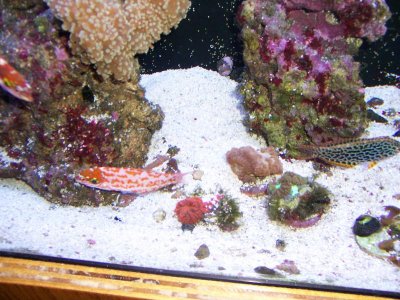
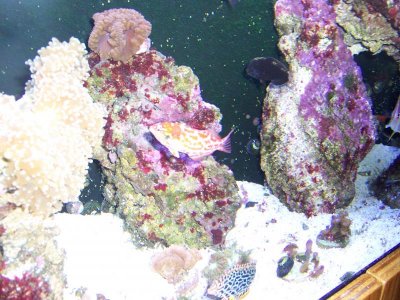
heres mine ! thease guys made it the longest ,3 months before the last one passed . i just found a weak spot in my defenses , some how two wrasses have gotten into my overflow and it is covered . houdini i guess .
Any problems with the meleagris & choati together? Looks great!

29reef
It's all about the flow
A bit off topic but I think these fish might do better in a nutrient rich algae based tank, rather than a reef. I would think the added available foods in that system would naturally help with feeding sense it seems these animals suffer from loss of available foods. Just a thought. I've only tried once keeping a juv. of about 2" it lasted about 8 weeks and up and died on me; it was eating mysis and some cyclops.

ShrimpChipGal
New member
5) Feeding- These fishes require numerous small feedings per day, especially during the first few months after their introduction into the display, which is difficult for most people to do. I normally feed my Choat's Leopard wrasse small portions of enriched mysis and brine shrimp 6-8 times per day.
Cheers,
Thank you for the detailed information. It's very useful. I also did the same feeding regiment for both MM and Potters but with prawn eggs mixed in during the first few months. It really seems to be a crucial step.
iamwrasseman
New member
it is very helpfull with a huge pod population but i think its the stress factor also and they do not ship well .funny thing is that almost every choati ate well and died fat and i did multiple dosings of prazi pro but there still may be some kind of internal parasite that could be alive and hurting them . they are noted for having internal parasites and the prazi pro along with jungle jims treated food are my only defence against the parasites.
Doug ,no problems that i ever saw and i am home four times a day to feed the choati's in order to give them a chance of survival .
my last batch were basically in a empty tank except for a juv. bipartus leopard and a very small potters leopard and there was no aggresion issues at all even during feeding they are mellow.
Doug ,no problems that i ever saw and i am home four times a day to feed the choati's in order to give them a chance of survival .
my last batch were basically in a empty tank except for a juv. bipartus leopard and a very small potters leopard and there was no aggresion issues at all even during feeding they are mellow.
tanglovers
New member
Any updates on these guys?
I have a pair, the male I have had for around 7 months now and the female about 2 months, both doing fantastic!
I have a pair, the male I have had for around 7 months now and the female about 2 months, both doing fantastic!
iamwrasseman
New member
if you have the time after you do your water testing please post your results as im getting to think its something to do with them . im not trying to critique but rather learn what works for them .
thanks Dave
thanks Dave
tanglovers
New member
Yeah I can. They are in my 60g sub-tropical NPS tank, temperature runs around 69-70 and they love it, they are housed with my bandit angel pair. The male came from a fellow hobbyist who had it in a 150ish gallon tank full of SPS and LPS and it was the only fish. The female came from Diver's Den. I actually ran both through QT when I got them as well.
Similar threads


- Replies
- 9
- Views
- 431
- Replies
- 8
- Views
- 232