Broad band LED thoughts

Foxy Brown

New member
I've read alot of post about LED lights that use a combination of "cool white" and "royal blue", with the CREE XP-G and XP-E being often preferred.

Alot of discussion then pops up about whether LED light can provide the kind of spectrum that corals need. I've also seen a few RGB and even some RGBY lights out on the market that try to provide a better color spectrum for this very reason.

The trouble is what looks good to eye has very little to do with the actual spectrum, because our color sense is terrible. Even actual PAR measurements aren't perfect because a really intense light at only one wavelength (say green for instance) could give excellent par readings, but still not be of much use to corals. So what we really need is some actual spectra.

Lets look at the colored XP-E's
picture.php


So you can see that even with the commercial R-G-B-Y mix, while it may look white to you and me, the peaks are quite sharp and with some honking big holes in between. Not much like the solar spectrum.

Now, the bandwidths of the white LEDs are much better but still have holes around cyan and red. You can use "warm white" leds, but that just leaves a really big hole in the green (500nm ish). So, why not find a couple more LEDs to fill that in... this is what I got from extracting the spectral data from Cree's datasheets, and adding some selected ones together.

picture.php


Notice how flat and broad it is, no wavelengths below about 60% of peak (so no holes) and plenty of red intensity even out past 650 nm.

This is a combination of Green, Blue, Royal Blue, and Warm White. Of course, the actual intensities are arbitrary, so I can't be sure of the actual ratios you'd need but it looks like about 1-1-2-3 should give a nice balance, though probably a lot more blue than what is shown here, which is desirable anyway for most folks. Of course, there's no need to run them all at 100%, so it could easily be tweaked.

So what do you think, has anyone tried this combo?
 
Great plots. Thanks for the legwork. :beer:

This is a hot topic right now. Seems many DIY'ers and manufacturers are pushing past the RB/CW standard. I've used a few WW and been happy with what they add. I'd like to try your Green, Blue, Royal Blue, and Warm White combo, but I'd probably want them all on separate dimmable circuits, for color mixing.
 
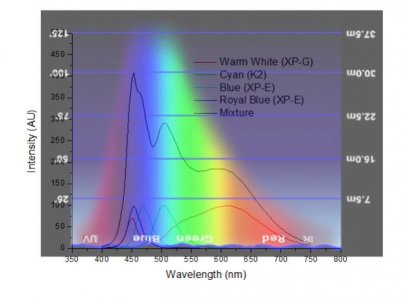
With the first one I posted, I stuck with only CREE leds, but by replacing the XP-E green with a K2 cyan, I get a much nicer result.

picture.php


Also the first rev used specially binned blues for longer wavelength, this one uses the most common version.

Nice broad blue spectrum and very flat output in the green yellow and red. I think this may be the winner.

If anyone wants the actual data just let me know, and I can send an Excel spreadsheet.
 
Anyone know how to post attachments? This can be copy-pasted into a text file and opened in excel.
Wavelength CW WW
400.0 0.847 0.852
403.5 1.218 1.256
407.1 1.605 1.660
410.6 2.037 2.063
414.1 2.735 2.467
417.7 4.374 2.870
421.2 7.359 3.746
424.7 12.161 6.503
428.2 18.445 9.951
431.8 26.896 15.123
435.3 39.938 21.519
438.8 56.586 33.261
442.4 81.589 48.232
445.9 97.284 61.146
449.4 93.312 70.788
453.0 77.654 69.301
456.5 54.343 51.454
460.0 41.924 38.427
463.6 32.791 29.261
467.1 25.879 24.857
470.6 20.245 19.642
474.1 15.937 17.071
477.7 13.756 15.190
481.2 12.765 14.238
484.7 12.146 13.968
488.3 12.211 13.827
491.8 14.030 15.327
495.3 15.945 18.420
498.9 19.094 21.436
502.4 22.864 25.915
505.9 26.754 30.750
509.5 30.762 35.465
513.0 34.387 40.321
516.5 37.666 45.269
520.1 40.589 49.659
523.6 42.501 53.635
527.1 44.396 57.305
530.6 45.645 60.062
534.2 46.830 62.926
537.7 47.228 65.245
541.2 47.574 67.446
544.8 47.717 69.356
548.3 47.633 71.079
551.8 47.549 72.733
555.4 47.428 74.323
558.9 47.246 76.464
562.4 46.904 78.572
566.0 46.447 80.614
569.5 45.835 82.656
573.0 45.119 84.690
576.5 44.357 86.700
580.1 43.428 89.310
583.6 42.319 91.408
587.1 41.132 92.929
590.7 39.822 94.117
594.2 38.362 95.266
597.7 36.534 96.632
601.3 34.873 97.779
604.8 33.430 98.641
608.3 31.961 98.783
611.9 30.247 98.690
615.4 28.620 98.366
618.9 27.060 97.839
622.4 25.574 96.330
626.0 24.025 94.612
629.5 22.311 92.612
633.0 20.669 90.420
636.6 19.358 87.841
640.1 18.039 84.924
643.6 16.628 81.660
647.2 15.216 77.792
650.7 14.128 73.606
654.2 13.046 70.496
657.8 12.066 66.364
661.3 11.143 63.451
664.8 10.220 59.607
668.4 9.379 55.993
671.9 8.645 52.464
675.4 7.969 48.873
678.9 7.317 45.293
682.5 6.676 42.627
686.0 6.126 39.008
689.5 5.576 35.954
693.1 5.026 33.506
696.6 4.614 30.648
700.1 4.272 27.986
703.7 3.931 25.701
707.2 3.589 23.552
710.7 3.271 21.410
714.3 2.996 19.267
717.8 2.721 17.795
721.3 2.446 16.293
724.8 2.239 14.702
728.4 2.093 13.250
731.9 1.948 11.916
735.4 1.803 10.719
739.0 1.661 9.812
742.5 1.531 8.895
746.0 1.401 7.943
749.6 1.271 6.991
 
The data extraction wasn't exactly easy but not to bad either... PDFs first converted to images using print-screen and paint. The the data was extracted using a freeware program called Plot Digitizer, which involves clicking on points along the curve. I then interpolated the data in Origin using a spline fitting so that they all had common x-coordinates.

It took about an hour to get them all. If anyone knows a better way I'd love to hear it.
 
Thanks for the overlays. I think the issue will ultimately be resolved this way. The problem is, sunlight doesn't exactly make for nice looking corals. We like them enhanced. What needs to happen, is someone who has the time and money, makes an array that has full coverage of each color LED on a dimming circuit. Then tweak each color until the desired effect. With that information, the ratios of LEDs could be estimated and full coverage achieved through optics, etc., so you don't have to have an overkill array(s).
 
Foxy it's good to have a pro chiming in on this subject. So if I understand you correctly, you took the plot published by Cree, digitized it and then extracted the data points? That's alot of work but doesn't get us anywhere. We're back to Cree's plot either way. What I would like to see is the actual spectroradiometer data for the white LEDs. You don't see that kind of broadband spectrum with T5's (which also use phosphor doping to create their various spectra).
 
Foxy it's good to have a pro chiming in on this subject. So if I understand you correctly, you took the plot published by Cree, digitized it and then extracted the data points? That's alot of work but doesn't get us anywhere. We're back to Cree's plot either way. What I would like to see is the actual spectroradiometer data for the white LEDs. You don't see that kind of broadband spectrum with T5's (which also use phosphor doping to create their various spectra).

Yes you are correct, I am trusting CREE's data here. Unfortunately while I do have a spectrometer at work, it's not a radiometric one and while it could be modified, I doubt my boss would like it. A company called Ocean optics makes some very affordable units, and I suppose if a bunch of people were that interested some kind of group buy could be done.

T5s use a very different phosphor system because it has to be able to stand up against the high energy plasma and UV light inside the tube and not change color too fast. They also have some very sharp emission lines from the gas to deal with. There is no UV produced by the LED and the effective temps (energy densities) are much lower, so they have more options.
 
How important is the cyan/green? I am currently running 9 RB, 9CW in a hexagonal pattern as pendants. I was thinking of switching to 5 CW, 5 NW, 5 WW, 6 RB, 9 Blue. It is still 50/50 white blue, but the white should be shifted to a better curve and the blue should also be shifted to include the higher wave lengths.
 
How important is the cyan/green? I am currently running 9 RB, 9CW in a hexagonal pattern as pendants. I was thinking of switching to 5 CW, 5 NW, 5 WW, 6 RB, 9 Blue. It is still 50/50 white blue, but the white should be shifted to a better curve and the blue should also be shifted to include the higher wave lengths.

We've been discussing this very idea on another thread:
http://www.reefcentral.com/forums/showthread.php?p=17491417&posted=1#post17491417

I would think that replacing say 3 blues with cyan would round that pendant out nicely, and they could easily be placed to give uniform coverage in a hexagonal pattern.

That's almost exactly what I'm planning for my next tank.

Oh and IMO don't bother with the NW... particularly if they will be driven by a dimmable driver. you can get almost the exact same spectrum by mixing CW and WW, so by adding in NW you just loose some of your ability to tweak the color spectrum.

Next idea: how about 1 UV led?
 
How about an overlay of say the current spectrum of popular halides vs the common cw / rb leds used today? I do not see halides, well at least the 20K's I used to run producing much of anything in the green, red or cyan ranges and they looked spectacular and my sps growth was excellent. I had equal growth with my SPS & other corals under my leds as well.

Looks to me with that graph, you are building more of an 6-8K halide looks wise. It is my personal beleife that what we are missing is between the 400 & 420nm range & that we should be going to an even higher K cool white, in the 8-10K range. But who knows, I could be wrong :)

Some examples...
Reef optics 20K
Figure6-ReefOptics-250W-20K.gif


Radium 400W
Figure3.gif


Aquamaxx 14K
fig_4_aquamaxx_250w_de_all_ballasts.jpg


6K GE lamp
Image5.gif
 
Last edited:
Which is why I stated it looks more like a 6-8K, 6Kish being daylight. I doubt anyone wants their tank to look like a natural reef under natural sunlight as they are not very breathtaking in person color wise, although they are breathtaking with the diversity of life!
 
I agree... the spectra are not optimized... the problem is that they are relative intensities and don't reflect the actual brightness of the different LEDs with their different lumen ratings. Here's another try by getting away from integer ratios.

picture.php


I wont tell the actual numbers of each LED, as it's not important... driving them on different channels will let you tune it to however you like the color balance. The more important thing is the breadth and position of the spectra of each source, that lets you fill in holes in the spectrum of the white LEDs for a more normal color pallet.
 
Just for fun, I overlayed an open ocean absorption spectrum with your LED graph. I'm not sure it's lined up exactly, but it makes the point.

This set of LEDs might be good for corals that live around the 50-75 feet deep range, and would also cause a good level of fluorescence.

attachment.php
 

Attachments

  • LEDvsOpenOceanSun.jpg
    LEDvsOpenOceanSun.jpg
    26 KB · Views: 7
That's helpful Koyaanisqatsi... shows the importane of that overlooked cyan band. Also, there's still that pesky ~420nm band that we're not doing a good job of covering. Also, looking at the slopes of the two graphs, the WW is out-of-scale. I'll bet we'd get a better match using NW.
 
Back
Top