Brookynella?

i8beef

New member
Hey guys,

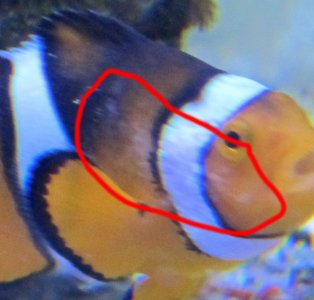
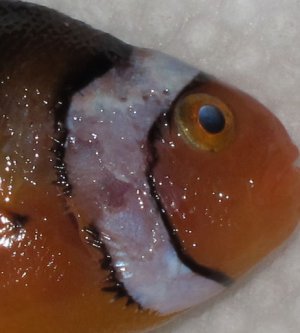
I have a display tank that I fear has something going on, and I'm thinking it's Brookynella. I didn't QT (My fault). I lost one ocellaris two days ago, and the female of the pair is now looking poor (Left side by gills seems to be rubbed raw, didn't eat tonight). The clown that died didn't appear to have any external symptoms, besides swimming vertically in the corner (Which for a clown fish, didn't seem THAT weird).

I have seen my blue hippo tang also rubbing himself on rocks from time to time, but I haven't been seeing any other issues with him.

At this point, I'm thinking I need to just pull everyone, treat with formalin and an anti-bacterial, and leave the tank fallow for 6 weeks to let whatever might be in there die off, and reintroduce them.

I have the following:
1 Yellow tang
1 Blue Hippo Tang
6 Green chromis
1 Ocellaris clown
1 Royal Gramma
1 Mandarin
1 Sailfin Blenny
1 Heniochus Butterfly

I have a 30 gallon that I can QT and treat in. I know this is a ridiculous amount of fish to stick in a 30 long term, but I'm hoping I can get away with 6 weeks (And if you have any other suggestions, I'm open).

My concern though are the sailfin and the mandarin... I'd like to go completely fallow, but of course the mandarin isn't going to handle the lack of pods, and the sailfin only eats surface algae, which won't be in the QT tank.

Can anyone suggest a better course of action?

/ Michael /
 
Feed more, keep the temp salinity Ph alk and other levels as stable as possible.

Fish have good immune systems but are cold blooded so our system temps regulate their body.
When the fish are stressed from environmental changes like that their system is weakened.
If you can remove the fish with no stress then I would pull the sick fish. If not it is probably a good idea just to feed them and manage the stress so they can fight it. Depending on what the fish has I would probably just leave them alone to build up some immunity.
Putting those fish in a 30 will just stress them more including the water quality swings and you will probably lose more fish.
 
it's a reef tank so whole tank dosing is out of the question.

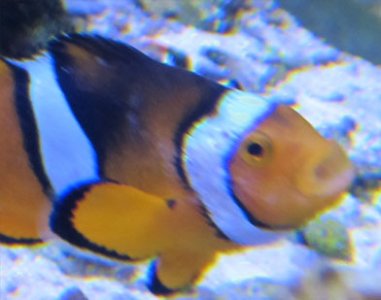
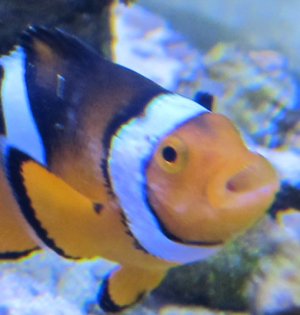
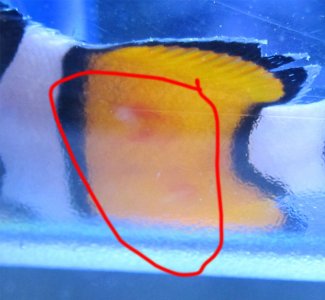
Unfortunately I don't have a DSLR so it's hard to get good pictures... I tried to highlight the area. It looks to have a pinkish hue to it, but that may be just because it is centered right on the white stripe of the fish...

They also usually had stringy feces that held on to them a while, another sign of brook from what I've read.

It's also hard to see in these pics, but she also has pinholes above and behind her eyes tha I would associate with lateral line, which I was going to stop and get some vitamin supplements for Monday (and still am) when I noticed this.

==

As an aside, everyone had a rough week, as I actually was re-aquascaping Friday and Saturday. The first clown fish died PRIOR to this though (They had been in the tank for three months I'd say), but it may have stressed the female enough for the disease to take hold.

/ Michael /
 

Attachments

  • fish3.jpg
    fish3.jpg
    91.5 KB · Views: 12
  • fish2.jpg
    fish2.jpg
    50.5 KB · Views: 13
  • fish1.jpg
    fish1.jpg
    70.6 KB · Views: 9
I agree that removing all of these fish for dipping on a daily basis for a week is going to be difficult... but I'm trying to find a way to ensure that my tank doesn't suffer from anything like this in the future, and a completely fallow tank for six weeks is the only way I can think of to do it...
 
it's a reef tank so whole tank dosing is out of the question.

Unfortunately I don't have a DSLR so it's hard to get good pictures... I tried to highlight the area. It looks to have a pinkish hue to it, but that may be just because it is centered right on the white stripe of the fish...

They also usually had stringy feces that held on to them a while, another sign of brook from what I've read.

It's also hard to see in these pics, but she also has pinholes above and behind her eyes tha I would associate with lateral line, which I was going to stop and get some vitamin supplements for Monday (and still am) when I noticed this.

==

As an aside, everyone had a rough week, as I actually was re-aquascaping Friday and Saturday. The first clown fish died PRIOR to this though (They had been in the tank for three months I'd say), but it may have stressed the female enough for the disease to take hold.

/ Michael /

Correct me if im wrong but those round light colored spots look like flukes. In which case you can dose the display with prazipro its reef safe. To me it looks like flukes but i could be wrong. Look it up on google.
 
The camera isn't very good at focusing through water unfortunately...

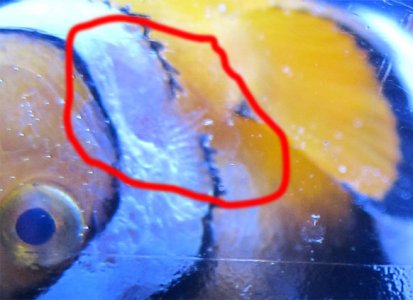
I don't think these are flukes. I can't find any pictures online of an infested fish though, so I'm not completely sure. The area in the front white stripe in particular has me worried... my first thought was that she had scraped up against something, or been caught by a rock I was moving when I was reaquascaping or something, but as I kepy looking at it, it looks more like a lesion, where the scales have been shedding or something...

The other thing we've noticed is that she is suddenly swimming with her mouth open pretty wide most of the time... but she doesn't seem to be gasping or anything else I would associate with respiratory issues.

==

About a month or two ago I tried to introduce a school of green chromis to the tank that were shipped from Dr Fosters... unfortunately they all died off within three days. I replaced them from a local store I trust, and they are all fine, save for one which disappeared around the same time my one clown died, showed up after my reaquascaping showing signs of distress (rapid breathing, gills were pretty wide open and bright red, was swimming near bottom or top all day) and finally died last night.

/ Michael /
 
I had an outbreak not to long ago with Brooklynella on my two clowns, My female had started to look pretty bad. I looked around for several different medications and the one that I found is actually very cheap and seems to work really well. Its Quick Cure from AP comes in a small bottle and is only about 4 dollars. I tried others but they werent as effective.
 
That's right! I used Quick Cure to get rid of white spot disease and it worked really good. Now I have the same problem as i8beef. I guess my clown now has Brooklynella, because it looks pretty similar to the one in this picture, can I use Quick Cure for Brooklynella?
 
Came home to find the female laying upside down on the bottom of the tank. Still alive, but she just died a moment ago... depressing to watch.

Unfortunately on the way home from work I hit some boulder in the road and it knocked my wheel alignment off, so I couldn't make the fish store to get Formalin, or M. Green, etc. and I am completely unprepared for any kind of infection like this, and probably won't be able to make it to the fish store until tomorrow afternoon at the earliest.

==

So now I'm worried about everyone else.

The female's right gill seemed to completely rot off overnight. When I found her and netted her to get her into another container until she died, she was swimming like a corkscrew. Looking at her against the light I see red, worm-like structures inside her tail end, but I don't know if these are normal or are worms, etc. All of this happened in the span of 3 days.

Prior to this, I have seen them flashing (and my hippo tang does it from time to time, but doesn't show any other signs of disease), but never for extended periods. The clowns always seemed to have stringy feces that would hang on for a few minutes before falling off.

Is this still saying Brookynella? I've attached pictures, showing the gill damage and the red spots I am worried about. Any suggestions for treating, etc. for the rest of the tank mates are appreciated.

/ Michael /
 

Attachments

  • fish2.jpg
    fish2.jpg
    74.2 KB · Views: 12
  • fish1.jpg
    fish1.jpg
    61.1 KB · Views: 13
  • fish3.jpg
    fish3.jpg
    94.6 KB · Views: 10
Came home to find the female laying upside down on the bottom of the tank. Still alive, but she just died a moment ago... depressing to watch.

Unfortunately on the way home from work I hit some boulder in the road and it knocked my wheel alignment off, so I couldn't make the fish store to get Formalin, or M. Green, etc. and I am completely unprepared for any kind of infection like this, and probably won't be able to make it to the fish store until tomorrow afternoon at the earliest.

==

So now I'm worried about everyone else.

The female's right gill seemed to completely rot off overnight. When I found her and netted her to get her into another container until she died, she was swimming like a corkscrew. Looking at her against the light I see red, worm-like structures inside her tail end, but I don't know if these are normal or are worms, etc. All of this happened in the span of 3 days.

Prior to this, I have seen them flashing (and my hippo tang does it from time to time, but doesn't show any other signs of disease), but never for extended periods. The clowns always seemed to have stringy feces that would hang on for a few minutes before falling off.

Is this still saying Brookynella? I've attached pictures, showing the gill damage and the red spots I am worried about. Any suggestions for treating, etc. for the rest of the tank mates are appreciated.

/ Michael /

Hey Buddy,

Sorry to hear about that. Check this link out http://www.fishdeals.com/fish_diseases/skin_gill_flukes/

I really think that they could have flukes. Here is a link showing flukes on a fish's eye

http://www.google.com/imgres?imgurl...a=X&ei=WqHYTNWbFs2enwe-yvGECg&ved=0CBcQ9QEwAA

Check these out and see if thats what your experiencing. If so go with prazipro. Espesially if your tang is flashing. Its clearly trying to get something off of it.

White stringy poop indicates internal parasites which you can treat by soaking food in metronidazole. Your clowns my have had a combo of brook and flukes. Hope this helps.
 
one of my clowns caught brook after a introduced an new wild caught, i used Hydrogen Proxide as a disinfectant treatment. worked wonders. at 50 to 75 ppm
se of Hydrogen Peroxide as a disinfectant treatment in the control of external parasites such as A.ocellatum, C.irritans and Brooklynella.

Applications:

1. 50-75ppm Bath for 30mins. Used as a disinfectant for newly acquired fish before adding to QT and DT.

2. 50-75ppm Bath for 30mins as a treatment for fish suffering from an infectious parasitic outbreak. Does not prevent recurrent outbreaks of A.ocellatum or C.irritans in an infected system, only provides temporary relief if returned to an infected system. Treated fish should be removed from the system and the infected system left fishless for a period no shorter than 28days in order to break the life cycle.

3. 50-75ppm Bath for 30mins every 3 days for a period no shorter than 28days. Used as a means of breaking the life cycle of parasitic protozoans such as A.ocellatum and C.irritans within an infected system whilst fish remain in the system. All fish within the system must be treated, regardless of whether an infection appears to be present.
 
Well, even if it is flukes, the treatment would be the same I would think, Formalin / Malachite Green (From what I've read).

So here's my game plan right now:

I'm going to remove all fish to quarantine (A 30 gallon tank, and a 40 gallon rubbermaid container... I think I should be able to house all of them in this amount of space).
1. I'm going to run the QT tanks in a hyposalinic setup.
2. I'm going to dip everyone individually. I have a second 40 gallon rubbermaid container to help with this, cycling out containers as I go to ensure I always have a "clean" container to move fish to while dipping. (IE dip everyone and move to new container in one. Wash out old one and refill, dip everyone from container 2 and put in that one, etc.)
3. I'm going to dip everyone individually in Formalin / Malachite Green.
4. I'll be feeding vitamin enriched food (Anything else? Like treatment for internal parasites?)
5. Once I've run the course on the formalin baths, possibly a run of Prazipro on top for flukes?
6. After 6 weeks, transfer everyone back into the display tank, where everything will have died from having no hosts.

Does this sound like a thorough enough course of action?

My current issue is FINDING Formalin / Malachite Green. Apparently formaldahide is used in making Meth, so my local fish store doesn't sell it... I can order QuickCure though. What is the Formaldahide percentage in it? Is it around 37%? I can't find a percentage online anywhere...

/ Michael /
 
Well, even if it is flukes, the treatment would be the same I would think, Formalin / Malachite Green (From what I've read).

So here's my game plan right now:

I'm going to remove all fish to quarantine (A 30 gallon tank, and a 40 gallon rubbermaid container... I think I should be able to house all of them in this amount of space).
1. I'm going to run the QT tanks in a hyposalinic setup.
2. I'm going to dip everyone individually. I have a second 40 gallon rubbermaid container to help with this, cycling out containers as I go to ensure I always have a "clean" container to move fish to while dipping. (IE dip everyone and move to new container in one. Wash out old one and refill, dip everyone from container 2 and put in that one, etc.)
3. I'm going to dip everyone individually in Formalin / Malachite Green.
4. I'll be feeding vitamin enriched food (Anything else? Like treatment for internal parasites?)
5. Once I've run the course on the formalin baths, possibly a run of Prazipro on top for flukes?
6. After 6 weeks, transfer everyone back into the display tank, where everything will have died from having no hosts.

Does this sound like a thorough enough course of action?

My current issue is FINDING Formalin / Malachite Green. Apparently formaldahide is used in making Meth, so my local fish store doesn't sell it... I can order QuickCure though. What is the Formaldahide percentage in it? Is it around 37%? I can't find a percentage online anywhere...

/ Michael /

He buddy,

I hope it all works out for you. Also kick up the temperature slowly in the DT to speed up the life cycle of whatever you may have. I have done hypo with great success. Fish looked like the loved to be at 1.009. I had to buy a refractometer to make sure it was accurate. Also pick up some brightwell garlic or kent marine garlic and soak the food in that as it couldnt hurt. Remember if your concerned with any internal things soak the food in something like metronidazole. Good luck sir!
 
Back
Top