Brown Algae Issues

firejackal

New member
Hopefully this is the right forum for this question/issue I'm having.

I've had a 55 gallon saltwater tank set up for probably a year now, for half of this time I've been battling with this brown slimy algae, it builds up in the sand, rocks, side of tank, pumps, filters, everything.

So I clean up the tank, take out rocks, clean them up. Take off filters and pumps, clean them up. Suck out the top layer of sand. I then take out 10 gallons and replace it with fresh water that I've had sitting for a week, and plus the appropriate amount of reef salt. A day and a half later then the brown algae starts growing again. I've even tried limiting food, and light time.

I only have four fish. A Ocellaris Clownfish, a Three Stripe Damselfish, a Three Spot Domino Damselfish, and a Arc Eye Hawkfish.
I've tried introducing new fish here and there, but they always end up dying* (disappearing from the tank) and the ones I've already had survive.
I've also introduced clean up crews but they don't seem to last long.

This is the set up I have at the moment:
* 55 gallon glass tank
* Two HOB penguin filters, I was using the filter + carbon cartridge inserts, but at the moment I am only using bags of carbon in the filters. I am not using the bio wheels or anything.
* Three Hydor Koralia pumps (1 x 1050gph, 2 x 425gph)
* Light fixture is a 48" two bulb ceiling light I have slightly above the top of the tank. Right now I have two daylight bulbs in it.

At the moment I'm trying to gather parts to make a 6 gallon bucket into a filter system, kind of similar to how a magnum 350 filter works (I have one on my fresh water tank.) But I'm not very familiar with how plumbing works or how the pump will sit in there so I'm taking my time.

I was also wanting to get my tank into accepting reefs, but I need to fix this algae problem first obviously.
So does anyone have any advice how to go about this? I'm lost, I'm to the point I want to set up a new tank using my current water.

Also apologies if the images are too big, they was taken with my phone and I don't know if this forum automatically resizes images or not.

Starting to clean the tank down again:
YGRVArp.jpg


The algae on the rocks:
gX8Tj6F.jpg


Hanging out behind the filter tube:
MPl2THD.jpg


After doing some cleaning up, and everyone is expecting food:
QJUkyGV.jpg
 
Looks like cyanobacteria to me. You definitely need to start using RO/DI water or at the very least distilled water. And the spectrum of the those bulbs aren't helping your situation either.
 
Thanks for the reply Putnam419, what spectrum do you recommend for the lights? More then 8000k? I think the bulbs I have now is 6000k.
 
I'd go 10000k+ depending on your preference. And yes you definitely need to start using ro water. Have you tested your phosphates? Or nitrates for that matter?
 
I ordered some 10,000k bulbs, and i don't think i have any tests for phosphates, just a basic salt water test kit that includes nitrates (which was fine). I've also just done a 10 gallon change. Now in a few days i need to do another 10 gallons.

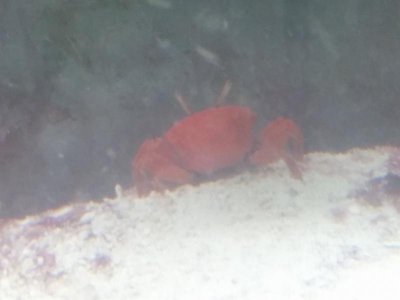
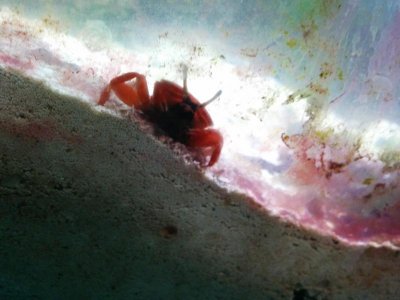
So while i was cleaning up the tank and removing some rocks temporary i came across a little guy i didn't know i had. An orange crab, i didn't buy it so it must have tagged along on a live rock.
 

Attachments

  • uploadfromtaptalk1416187930455.jpg
    uploadfromtaptalk1416187930455.jpg
    23.7 KB · Views: 4
  • uploadfromtaptalk1416187941660.jpg
    uploadfromtaptalk1416187941660.jpg
    50.4 KB · Views: 3
Many things seem to be wrong with your tank. First, is this live rock that you have in your tank? Also, how much of it do you have (seems way to little). Your lights not only are not helping, but are rather fuelling this whole mess. You need to get reef-capable lights. If you go for T5 check out ATI lights.
What does "fine" nitrate mean in numbers?
If you're using tap water this is what you get. You need a RO/DI filter. Check out BRS or SpectraPure units.
Start improving things and in 4-6 months it might look better.
 
I've had a 55 gallon saltwater tank set up for probably a year now, for half of this time I've been battling with this brown slimy algae, it builds up in the sand, rocks, side of tank, pumps, filters, everything

You are not having the average new aquarium issue. By this time in your aquarium's development, you should being seeing the end of nuissance blooms. Cyanobacteria is a nuissance bacteria that can plague new aquariums. Your bloom looks particularly robust. A likely cause of your robust and continuous cyanobacteria growth is a poorly developed microorganism community.


So I clean up the tank, take out rocks, clean them up. Take off filters and pumps, clean them up. Suck out the top layer of sand. I then take out 10 gallons and replace it with fresh water that I've had sitting for a week, and plus the appropriate amount of reef salt. A day and a half later then the brown algae starts growing again. I've even tried limiting food, and light time.

You might be damaging the ecology of the aquarium by aggressive cleaning. Generally, rocks are not removed to clean them. Suctioning off cyanobacteria from rocks with a turkey baster is the way to go.

Suctioning the substrate is likely doing substantial damage to the biological filter, weakening it and allowing nutrients usually consumed by it to "fertilize" the cyanobacteria. Mats on the substrate should also be gently removed, without disturbing it. This might be harder to accomplish.

You should also check your nitrate and phosphate numbers. While these levels may or may not be enough to be fueling the cyanobacteria growth, the measurements will provide some insight into how well you are balance nutrient input versus how well the biological filter is exporting nutrients.


I only have four fish. A Ocellaris Clownfish, a Three Stripe Damselfish, a Three Spot Domino Damselfish, and a Arc Eye Hawkfish.
I've tried introducing new fish here and there, but they always end up dying* (disappearing from the tank) and the ones I've already had survive.
I've also introduced clean up crews but they don't seem to last long.

Not being able to keep animals alive is evidence that you could have a serious problem with your set up. The dead animals may be the source of nutrients feeding cyanobacteria blooms. Ammonia levels could be high enough to be stressing the animals.

I am going to guess that you might need to brush up on how to keep a salt water aquarium. Lights are not your problem. Based on your information, I suggest that you do not attempt to add any more animals to your aquarium until your cysnobacteria is under control. It will take some months. After physically removing the slime mats as I described above use the lights out method. In your case, you will likely need to do this once a week until the cyanobacteria growth slows and other microorganisms can get a foot hold. Also, measures your water parameters and make sure they are in order.

This is just a start. Down the road, you may need additional water purification treatments depending on the water parameter results.

Keep us posted.

Good luck.
 
+1 on the ro di. I was constantly fighting diatoms and small batches of cyno. After one 5% water change with rodi, the problem stopped. I was feeding these uglies with my relatively clean tap water.
 
Thanks for the replies everyone, I'm going to try to cover some of the parts mentioned.

Many things seem to be wrong with your tank. First, is this live rock that you have in your tank? Also, how much of it do you have (seems way to little). Your lights not only are not helping, but are rather fuelling this whole mess. You need to get reef-capable lights. If you go for T5 check out ATI lights.
What does "fine" nitrate mean in numbers?
If you're using tap water this is what you get. You need a RO/DI filter. Check out BRS or SpectraPure units.
Start improving things and in 4-6 months it might look better.

A few of the rocks was live rock bought from Jacks Pets (about three) which I left them in the tank and attempted to clean them off while in the tank. The other rocks was from when I use to live in Florida.

I ordered two 10,000k T5 lights from a company called Coralife, but that won't come until Friday.

"Fine" means 0ppm. But my ammonia was reading at 0.25ppm. My kit (API Saltwater Master Test Kit) only tests High Range pH, Ammonia (NH3/NH4+), Nitrate (NO2-), and Nitrate (NO3-). I would assume I need to buy the reef version they sell.

The water I'm using is not tap water, it's well water running through a softener.
I'm thinking about buying this RO unit with the DI attachment http://www.amazon.com/Aquatic-Life-...upplies_2?ie=UTF8&refRID=0HV1N6270DVF9X7DBR4F no idea how good it is, but for now until I buy one, I'm going to be buying distilled water from the store and using that until something positive happens to the condition of the water.

You might be damaging the ecology of the aquarium by aggressive cleaning. Generally, rocks are not removed to clean them. Suctioning off cyanobacteria from rocks with a turkey baster is the way to go.

Suctioning the substrate is likely doing substantial damage to the biological filter, weakening it and allowing nutrients usually consumed by it to "fertilize" the cyanobacteria. Mats on the substrate should also be gently removed, without disturbing it. This might be harder to accomplish.

Right now my cleaning process has been for basic cleaning: turn off filters, using the end of my cleaner to break up the algae in the substrate, wipe off the sides, then use a fish net to catch the algae that is now floating in the water, take out a few of the rocks to run under the sink to scrub off the algae, put the rocks back in.
Then once a week I've been doing the 10% water changes. But now that I'm using distilled water I will probably be doing it every 3 days for now.

Not being able to keep animals alive is evidence that you could have a serious problem with your set up. The dead animals may be the source of nutrients feeding cyanobacteria blooms. Ammonia levels could be high enough to be stressing the animals.
Yeah, I figured this; the guys I have right now are surviving, but if I introduce anything new to the tank, the new ones don't last.

After physically removing the slime mats as I described above use the lights out method. In your case, you will likely need to do this once a week until the cyanobacteria growth slows and other microorganisms can get a foot hold. Also, measures your water parameters and make sure they are in order.

I didn't see you mentioning anything about slime mats or lights out methods? I don't even know what a slime mat is. But I have been limiting the time the lights are on.

I will keep you guys up to date concerning how this is going and progressing. I'll try not to mysteriously disappear from here haha.
Also, apologies for any spelling or grammar mistakes, I often tend to make those.
 
Get an rodi filter. Get a better light fixture. Get quality test kits (Red Sea & Seifert make good ones).

Stop scrubbing your rock. You have probably killed off any beneficial bacteria in the rock.

Start cleaning your filters more frequently. Power filters can trap nitrates which will fuel cyano.

It can take a little while to get things under control, be patient.
 
Like others have said
- get an RO/DI system
- get appropriate lights, yours are all wrong for SW
- ditch the home made filter idea, asking for trouble
- get a skimmer

Check your SG. If fish are surviving but your cleanup crew does not, this may indicate a salinity issue. If you use a swing arm, throw it in the garbage and get a refractometer.
Consider getting a reactor and running gac/gfo.

I don't have a "filter" on my tank, just lots of live rock and a skimmer.
I do run Chemipure blue and purigen.

And, is that an air stone?
Get rid of it and point a PH toward the surface.
 
Every time you are rinsing the rocks off you are most likely getting rid of all the beneficial bacteria that’s on the rocks.

Theres a few options you can try to help with your battle against cyano. First start pointing at least two of your power heads toward the surface. That will help with aeration. Try placing a bag of gfo in one of your HOB filters.

Or if you can try and build yourself a sump for the tank. There you can buy and place a GFO reactor to help with your phosphates.

Don’t worry I have been battling Cyano also. Mine started after my GBTA died. I did the constant water changes every other day. In the end I ended up with Cyano and hair algae. I have started a GFO reactor and notice the algae stop growing and I am slowly winning the battle.

It takes time and months to win.
 
Back
Top