Calcium Choride and baking soda balance

Frogmanx82

New member
So I'm trying to figure how much baking soda I should add to balance the chlorine from adding calcium chloride. The molecular weight of CaCl2 is 111 for 2 moles of Cl. The molecular weight of baking soda is 84 for 1 mole of sodium. So the ratio of baking soda to calcium chloride should be 84 to 55.5 or 1.5 to 1 by weight.

I am currently doing a weekly adjustment to supplement the kalk in my ATO. Typically I add 5tsp of calcium chloride and 8 tsp of baking soda in separate solutions. Anyone see an issue with this procedure?

FYI, I have a 90 gallon tank and 20 gallon sump and the ATO requirement is 3 to 4 gallons per week with 1tbs kalk and 45 ml vinegar per gallon.
 
Baking soda adds alkalinity, which should be the driving force behind the dosing ratio. This article gives the ratios that should be used:

http://reefkeeping.com/issues/2006-02/rhf/index.php#10

It's close to 1:1 by volume for the standard ingredients.

The tank will need water changes to keep the ionic balance in line. The calcium and chloride levels, even if added in balance, will lead to an ionic shift over time, and often a significant salinity increase.

If you want to reduce the ionic balance issue, Kalk (lime) adds only small amounts of ions that are not consumed by the corals, as impurities.
 
Thanks Bertoni. I've read that link several times and hence my question as I don't understand the 1:1 ratio as the math would seem to indicate 1.5:1, especially considering that most tables show calcium chloride to be slightly more dense than baking soda.

On second thought, if your balancing the calcium with the bicarbonate then the ratio is probably right. I was looking at it the other way figuring to balance the sodium and chlorine. I'm not that concerned with the bicarbonate balancing since the CO2 cycle is a whole other complex situation that should come to its own equilibrium. If I'm adding too much bicarbonate and my kH gets high vs calcium I have this article by the chemistry guru Randy Holmes-Farley to go by. http://www.advancedaquarist.com/2002/11/chemistry

I'm just wondering then if I'm overlooking the likelyhood that my kH will get too high with this ratio. The plus side of my way is that I can measure kH and Ca pretty easily while the sodium:chloride balance is not so easy to check.
 
Last edited:
The dKH should rise quite a bit with that 1:1.5 ratio. You'll be adding close to 50% more than the corals will consume.
 
So is it just better to use soda ash instead of baking soda so the sodium and chloride are balanced as well as the calcium and carbonate. I was thinking the pH could go too high but that seems like the better way to stay balanced.
 
What Jonathan is getting at, I think, is that attempting to balance the sodium and chlorine in a 2-part dosing scheme is not appropriate. It is not possible to prevent ionic shift using the 2-part dosing method. The only way you can add calcium and alkalinity in balance to a reef aquarium and not affect the overall salinity of the tank is to add these two compounds by way of a calcium reactor or kalkwasser.

Kalkwasser is a useful tool, but most find it inadequate to fulfill their coral's needs as the tank becomes more crowded and calcification increases. At that point, you can of course use 2-part dosing to supplement the Ca and Alk added by the kalkwasser, but you do that by adding the amount of sodium bicarbonate/sodium carbonate solution necessary to maintain a steady alkalinity level in the aquarium, and the equivalent molar ratio of calcium in the form of the calcium chloride solution.

In practical terms, however, one's ability to precisely make alkalinity and calcium chloride solutions and some tank's imbalanced consumption of those two compounds means that one simply tests alkalinity and calcium separately, and doses the appropriate amount to hold their concentrations steady.

By the way, in reference to your original question, your calculations will be a bit off because calcium chloride is generally supplied as calcium chloride dihydrate, not calcium chloride (anhydrous).

Therefore, the molar mass of the "calcium" is 147 grams/mole, of which 40 grams is calcium, 71 grams is chloride, and 36 grams is water (it doesn't add up to 147 because I've rounded the molecular weights for the sake of brevity).
 
Last edited:
It does add up to 147. Thanks for the comment though. Several good points to consider. I'm still thinking that soda ash is better balanced with calcium chloride than baking soda and less likely to shift the sodium to chloride ratio.
 
Last edited:
As long as I'm not precipitating due to the higher pH of soda ash I think I'll give that a try. The important thing is keeping Ca and kH levels where they need to be. I only do 5% water changes a couple times a month so hate to rely on that to keep things balanced and thus my concern.
 
I suspect that 10% a month total will be fine to keep the balance in line, but sodium carbonate is safe to use. The tank might do a bit better with the small increase in pH.
 
So I'm trying to figure how much baking soda I should add to balance the chlorine from adding calcium chloride. The molecular weight of CaCl2 is 111 for 2 moles of Cl. The molecular weight of baking soda is 84 for 1 mole of sodium. So the ratio of baking soda to calcium chloride should be 84 to 55.5 or 1.5 to 1 by weight.

I am currently doing a weekly adjustment to supplement the kalk in my ATO. Typically I add 5tsp of calcium chloride and 8 tsp of baking soda in separate solutions. Anyone see an issue with this procedure?

FYI, I have a 90 gallon tank and 20 gallon sump and the ATO requirement is 3 to 4 gallons per week with 1tbs kalk and 45 ml vinegar per gallon.
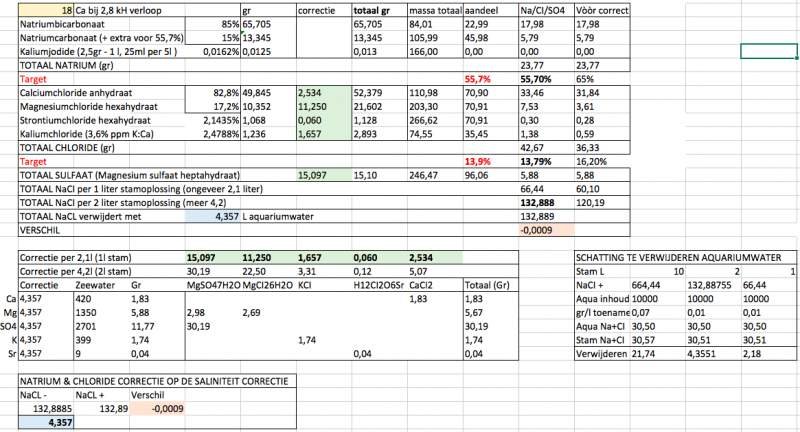
With sodium/chloride/sulfate balanced, I would look somewhat like this. 84gr of sodiumbicarbonate can be used instead of the bicarbonate-carbonate mix I use. The picture is a bit old but the ratio for kH:Ca is approximateoy the same .. 18,5 ca per 2,8 kH is what I use.. these are the calculations for 18Ca per 2,8 kH. (mg needs some kH too)
d89449ef30bcdecbbb5febeb11b56d59.jpg


Verstuurd vanaf mijn SM-G930F met Tapatalk
 
What Jonathan is getting at, I think, is that attempting to balance the sodium and chlorine in a 2-part dosing scheme is not appropriate. It is not possible to prevent ionic shift using the 2-part dosing method. The only way you can add calcium and alkalinity in balance to a reef aquarium and not affect the overall salinity of the tank is to add these two compounds by way of a calcium reactor or kalkwasser.

Kalkwasser is a useful tool, but most find it inadequate to fulfill their coral's needs as the tank becomes more crowded and calcification increases. At that point, you can of course use 2-part dosing to supplement the Ca and Alk added by the kalkwasser, but you do that by adding the amount of sodium bicarbonate/sodium carbonate solution necessary to maintain a steady alkalinity level in the aquarium, and the equivalent molar ratio of calcium in the form of the calcium chloride solution.

In practical terms, however, one's ability to precisely make alkalinity and calcium chloride solutions and some tank's imbalanced consumption of those two compounds means that one simply tests alkalinity and calcium separately, and doses the appropriate amount to hold their concentrations steady.

By the way, in reference to your original question, your calculations will be a bit off because calcium chloride is generally supplied as calcium chloride dihydrate, not calcium chloride (anhydrous).

Therefore, the molar mass of the "calcium" is 147 grams/mole, of which 40 grams is calcium, 71 grams is chloride, and 36 grams is water (it doesn't add up to 147 because I've rounded the molecular weights for the sake of brevity).
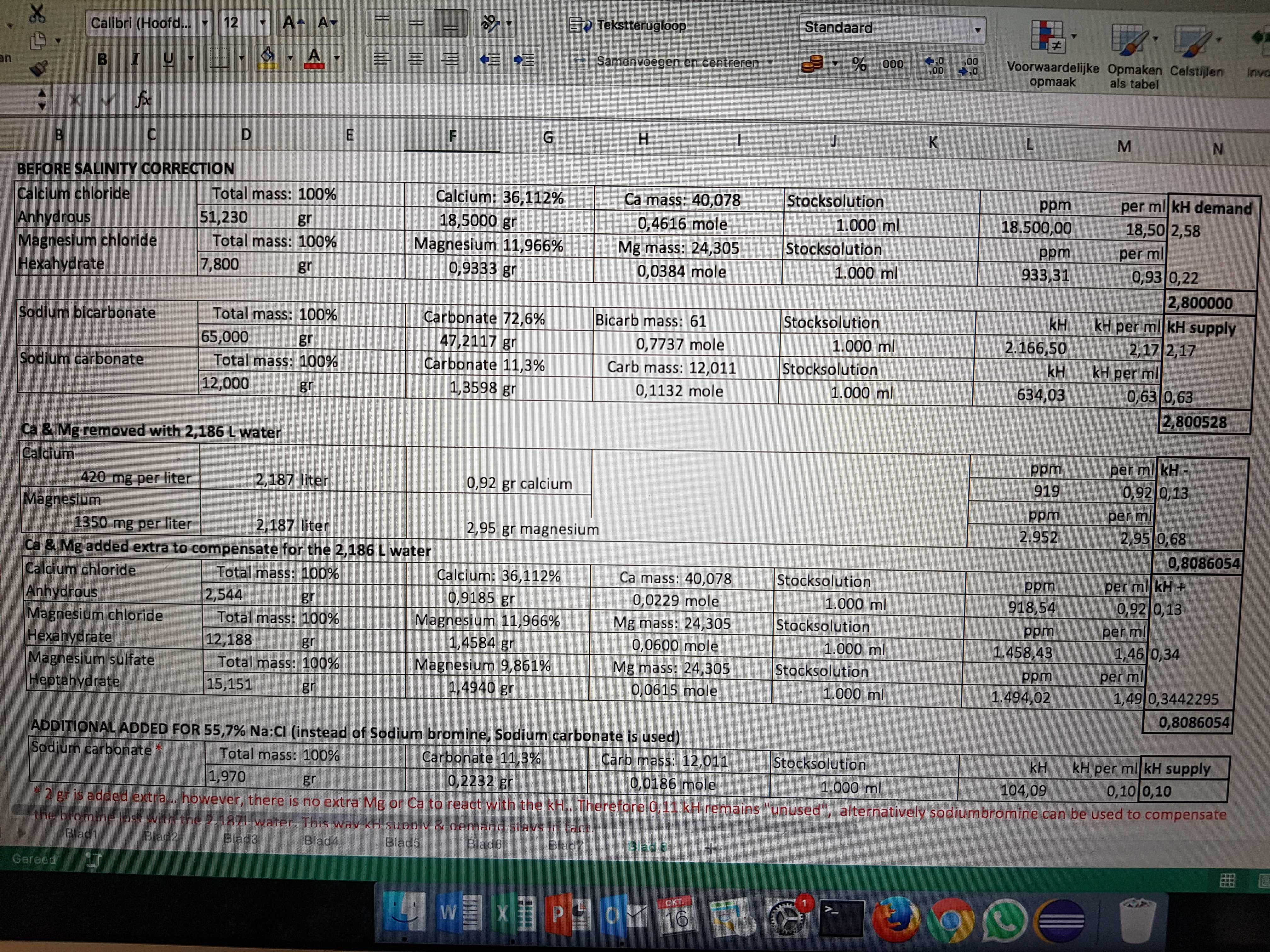
This is possible. You can calculate how much Mg/So4/Ca/K/Sr etc is removed per liter *natural saltwater* to compensate the salinity and compensate for that loss.

b4cecde7ef1c59b09f310ca3fb86d82f.jpg


Verstuurd vanaf mijn SM-G930F met Tapatalk
 
Back
Top