
You are using an out of date browser. It may not display this or other websites correctly.
You should upgrade or use an alternative browser.
You should upgrade or use an alternative browser.
Can you identify my clownfish?
- Thread starter stupac21
- Start date


Travis L. Stevens
Active member
Actually, here is your definitive way to tell them apart. They are either Amhiprion percula or Amphiprion ocellaris. I bet juvenile A. ocellaris in all the pictures. As they get older, their orange face will fade and they will be all black.
A. percula: Dorsal spines (total): 9 - 10; Dorsal soft rays (total): 14 - 17; Anal spines: 2; Anal soft rays: 11 ââ"šÂ¬Ã¢â‚¬Å“ 13
http://filaman.ifm-geomar.de/Summar...9209&genusname=Amphiprion&speciesname=percula
A. ocellaris: Dorsal spines (total): 10 - 11; Dorsal soft rays (total): 13 - 17; Anal spines: 2; Anal soft rays: 11 ââ"šÂ¬Ã¢â‚¬Å“ 13
http://filaman.ifm-geomar.de/Summar...09&genusname=Amphiprion&speciesname=ocellaris
***Note: If the links generate an error, refresh. Fishbase.org is a heavily browsed site.
Here are some pictures with their common names with them.
A. ocellaris black var.: Black and White Clownfish, Black and White Ocellaris

A. percula black var.: Onyx Percula, Onyx Clownfish, Black and White Percula, Black and White Clownfish.
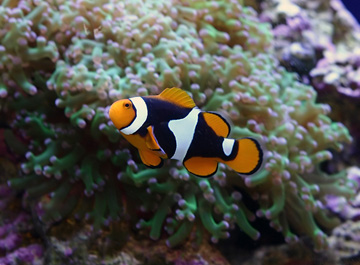
Also, when shopping for a Black and White Percula or Ocellaris, make sure that you aren't buying an A. polymnus black variant.
Black and White Saddleback (Amphiprion polymnus): Dorsal spines (total): 10 - 11; Dorsal soft rays (total): 16 - 18; Anal spines: 2; Anal soft rays: 12 ââ"šÂ¬Ã¢â‚¬Å“ 14
http://fishbase.org/Summary/speciesSummary.php?ID=8086&genusname=Amphiprion&speciesname=polymnus
<img src="http://www.geocities.com/rbreefclam/carpet_clown1.jpg" width=320 height=240>
A. percula: Dorsal spines (total): 9 - 10; Dorsal soft rays (total): 14 - 17; Anal spines: 2; Anal soft rays: 11 ââ"šÂ¬Ã¢â‚¬Å“ 13
http://filaman.ifm-geomar.de/Summar...9209&genusname=Amphiprion&speciesname=percula
A. ocellaris: Dorsal spines (total): 10 - 11; Dorsal soft rays (total): 13 - 17; Anal spines: 2; Anal soft rays: 11 ââ"šÂ¬Ã¢â‚¬Å“ 13
http://filaman.ifm-geomar.de/Summar...09&genusname=Amphiprion&speciesname=ocellaris
***Note: If the links generate an error, refresh. Fishbase.org is a heavily browsed site.
Here are some pictures with their common names with them.
A. ocellaris black var.: Black and White Clownfish, Black and White Ocellaris
A. percula black var.: Onyx Percula, Onyx Clownfish, Black and White Percula, Black and White Clownfish.
Also, when shopping for a Black and White Percula or Ocellaris, make sure that you aren't buying an A. polymnus black variant.
Black and White Saddleback (Amphiprion polymnus): Dorsal spines (total): 10 - 11; Dorsal soft rays (total): 16 - 18; Anal spines: 2; Anal soft rays: 12 ââ"šÂ¬Ã¢â‚¬Å“ 14
http://fishbase.org/Summary/speciesSummary.php?ID=8086&genusname=Amphiprion&speciesname=polymnus
<img src="http://www.geocities.com/rbreefclam/carpet_clown1.jpg" width=320 height=240>

Cutiewitbooty
New member
just to let you know that anemone is bleached, it looks the worse in thoes middle pics.

stupac21
New member
they are two different anenomes
I've been hearing that about the white one, its been like that for 6 1/2 months since i got it, i've seen many like it living in the stores tank.
Aren't there any anenomes that are supposed to be white? It has purple tips.
I don't have good lighting though, so u may be right. .
I've been hearing that about the white one, its been like that for 6 1/2 months since i got it, i've seen many like it living in the stores tank.
Aren't there any anenomes that are supposed to be white? It has purple tips.
I don't have good lighting though, so u may be right. .
Cutiewitbooty
New member
thoes are sebae anemones. Even the darker one is looking bleached. Sebaes are supost to be a brown color not white with the purple tips. All the anemones are that color in the LFS because they are bleached and dying. Sebaes are a more light demanding anemone and usually do the best with metal halide lighting.
Cutiewitbooty
New member
sorry to tell you but i would say thoes two anemones don't stand a good chance of living and recovering in your tank without perfect water and perfect lighting. IMO the bleached ones are more pretty, but they are far from healthy.
Travis L. Stevens
Active member
No problem, stupac21
Cutie, I'm going to have to disagree with you.

Condylactis Anemone (Condylactis gigantea)
<img src="http://www.oceanviewenterprise.com/anemones/Condylactis_Anemone.jpg" width=300 height=225>
Cutie, I'm going to have to disagree with you.
Some are on the recovery, and not actually getting worse. This also depends on how reputable the retailer is. If they are keeping them under NO or PC lighting, then I would suspect neglegence. If they are being housed under VHO, T5, or MH, it would seem like the retailer knows what is going on and is trying to help correct the problem.color in the LFS because they are bleached and dying
Not necessarily. With the proper care in even sub par tanks, they can make a dramatic recovery. It takes some real research though in order to get them to recover in a sub par tank, but it can be done. The survival rate of most bleached Sebae Anemones in good tanks is actually pretty high. Now something like an S. hadonni, that's another storythoes two anemones don't stand a good chance of living and recovering in your tank without perfect water and perfect lighting
That would be a Condylactis Anemone. Clownfish very rarely host in them. They are also not a natural host. And even worse, they pack a powerful sting and have been known to eat fish.Aren't there any anenomes that are supposed to be white? It has purple tips.
Condylactis Anemone (Condylactis gigantea)
<img src="http://www.oceanviewenterprise.com/anemones/Condylactis_Anemone.jpg" width=300 height=225>
stupac21
New member
Thanks travis,
Thats what I like to hear, rather than you have no chance of saving your pets!
The stores I go to have mh lighting and great conditions, and they have many anenomes that look like this they also keep many other inverts.
I fed them krill yesterday and they seemed to appriciate it.
Should I wait a week for another feeding?
I plan on getting some better lighting and a new tank, but I'm moving soon and don't want to have to pack that all up once I get the tank started.
Thanks!
Thats what I like to hear, rather than you have no chance of saving your pets!
The stores I go to have mh lighting and great conditions, and they have many anenomes that look like this they also keep many other inverts.
I fed them krill yesterday and they seemed to appriciate it.
Should I wait a week for another feeding?
I plan on getting some better lighting and a new tank, but I'm moving soon and don't want to have to pack that all up once I get the tank started.
Thanks!
Travis L. Stevens
Active member
I would try to get them better lighting ASAP, but make sure you acclimate them to it. I would also feed little pieces as often as possible until they refuse to eat. This will keep it well fed to ensure its health. Unfortunately, since you already have a clown hosting in the deteriorated anemone, it will be a lot more difficult to get it to recuperate because of the stress the clowns often place on their hosts.
Also, I'm not 100% sure when A. ocellaris black variants lose their orange face. It probably differs from specimen to specimen. I would suspect when they are about 1-2 years old. This is when they become sexually mature.
Also, I'm not 100% sure when A. ocellaris black variants lose their orange face. It probably differs from specimen to specimen. I would suspect when they are about 1-2 years old. This is when they become sexually mature.
Travis L. Stevens
Active member
Well, since anemones can move on their own, it's worthless to move them around manually. I would just leave it where it's at and do one of these two.
1) Start with small increments of photoperiod. For example, 4 hours for one week, 6 hours for the next two weeks, 8 hours for another couple weeks, 10 hours for another two more, and finally 12 hours. That's assuming that you are on a 12 hour period and if it's a huge change in light such as switching from power compacts to metal halides.
2) Keep the same photoperiod, but lay many sheets of window screen over the tank. Every week, take a layer off until there are no window screens left.
1) Start with small increments of photoperiod. For example, 4 hours for one week, 6 hours for the next two weeks, 8 hours for another couple weeks, 10 hours for another two more, and finally 12 hours. That's assuming that you are on a 12 hour period and if it's a huge change in light such as switching from power compacts to metal halides.
2) Keep the same photoperiod, but lay many sheets of window screen over the tank. Every week, take a layer off until there are no window screens left.
Similar threads


- Replies
- 11
- Views
- 1K
