
Clownfish disease ID please

MikeInToronto

New member
I should know this but looking at the symptoms confuses me.

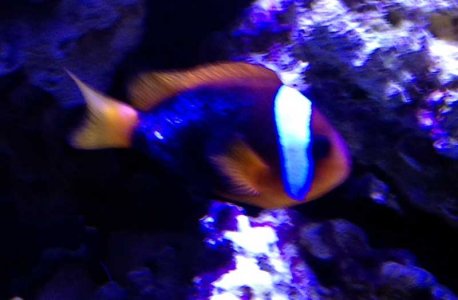
This is a cinnamon clown and she had white fluff/fuzz on her side. I thought it was ich and because she was eating and swimming normally and shows no signs of behavioral change I didn't want to treat too intensely.

Yesterday I noticed that now she has open sores where the fuzz is. She still swims actively and it doesn't seem to have spread to her mate. She also doesn't seem to scratch herself.

I added a pic but it's not good. Those bright white spots on the side are actually red holes.

Can anyone give me an idea what this is so I can treat it properly? I was dosing copper and Furan-2 but ran out/expired.
 

Attachments

  • sickfishy.jpg
    sickfishy.jpg
    29.2 KB · Views: 5
Is this a newly acquired clown or have you had her awhile? I can't tell anything from the pic, but the "open sores" thing makes me think skin peeling, which makes me think Brooklynella.
 
I'm pretty sure it's brooklynella as well. My concern is that since only formalin works and the fish had open sites AND formalin can kill fished with open sores I don't know if the fish can make it. I've had her for over a week and she's had it since then. It's just gotten worse. Copper obviously didn't work. It might be too late. I don't know. I will be treating both fishes and see how it goes. Thanks.
 
The only other treatment I know for Brook is Chloroquine phosphate, but you are going to have a hard time finding that on short notice. So, I think formalin dips are her best chance for survival. Cinnamon clowns are pretty tough, so you've got that going for you.

Run a lot of aeration when you dip her. Try to find something like Formalin-MS, which contains 37% formaldehyde. But in a pinch, go to Walmart and buy some Quick Cure. I'm not sure what % formaldehyde it contains, but it's better than nothing...
 
The only other treatment I know for Brook is Chloroquine phosphate, but you are going to have a hard time finding that on short notice. So, I think formalin dips are her best chance for survival. Cinnamon clowns are pretty tough, so you've got that going for you.

Run a lot of aeration when you dip her. Try to find something like Formalin-MS, which contains 37% formaldehyde. But in a pinch, go to Walmart and buy some Quick Cure. I'm not sure what % formaldehyde it contains, but it's better than nothing...

I've got 37%. It's actually banned in fish stores but I still found it. We'll see what happens in the next few days ...
 
Last night I treated her with a FW dip then I gave her a dip in formalin.

Well it didn't work out. Up until early this afternoon she was doing fine but when I checked on her to feed her she was one her side in the QT.

The other fish is doing fine. Either she was too far gone when the treatment started or the formalin killed her. I'm betting on the formalin since she had open sores. Lesson learned (even though I knew it could happen).

Anyway, I will replace her tomorrow. I already have fresh formalin so now is probably the best time before it goes bad.
 
Anyway, I will replace her tomorrow. I already have fresh formalin so now is probably the best time before it goes bad.

I would QT her replacement, and carefully observe all your other fish that shared water with the deceased. Brook is contagious - especially to other clownfish.
 
I would QT her replacement, and carefully observe all your other fish that shared water with the deceased. Brook is contagious - especially to other clownfish.

Yeah, I will QT her. The only other fish in the tank was the second clown and he is already in QT. The parasite has a life cycle of 6 weeks or something so the fish will stay in QT until then.
 
it's impossible to tell w/the pic you provided, due to the excessive blue light, and it's being out of focus, but"¦.

it could be a few things, or a combination of things-from lympho or fungus (the white fuzz) to brook or euronema, or any combo of the above.

brook is easily treated by repetitive, frequent fw dips, that are done for as long as the fish can stand per dip-you should be able to knock it out completely in less than a week. (formalin isn't necessary, and adds other dangers/stresses of its own, ime).

euronema isn't that easy to cure-more often than not i'll remove destroy a fish w/euronema asap, as it's also highly contagious while being much more difficult to treat than brook

once a sore is bleeding, or ulcerated (read: bloody or red), your odds of 'fixing' go down by the hour, as osmoregulation is then affected severely.

just my experience...
 
Back
Top