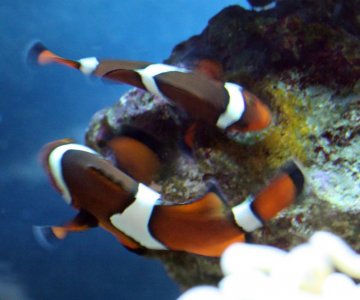
Clowns won't spawn

raising the temp and lowering the salinity will allow more O2 in the water and jump their metabolism so they can eat more and store essential omega and fatty acids to be able to produce eggs.

Warmer water actually holds less oxygen. Raising the temperature can help them spawn though. Feeding them until they won't eat anymore at least twice a day usually works. Feed them slowly so you don't pollute the water more. You're going to be increasing the feedings, which will increase the nutrients going into the system. Make sure your protein skimmer, macro algae, and other filters are up to the task.

Can you tell us a little more about your tank? How large is their tank? What are the other inhabitants?
 
Can you tell us a little more about your tank? How large is their tank? What are the other inhabitants?

My favorite subject. Talking about my tank! :D

I'm about to head off to an office party where I doubt anyone will be interested in hearing about my tank... ;)

Anyway, the display tank is a 90 gallon bow front. In the basement is a 30 gallon sump, a 20 gallon fuge, and a 20 gallon frag tank. The tank has been set up for about six years, although it's been about a year since the last major overhaul.

The display has about 1" sand and 1" crushed coral. Although little by little I've been whittling it down. Eventually I might take it out all together.. But first I need a better skimmer. There is a RBTA, now two GBTAs (split), and an H Crispa, which is the clowns main home. The btas are like apartments they like to visit! Besides that there are a bunch of soft corals mixed in.

The other inhabitants include a kole tang, a starry blenny, a foxface, and four black mollies. Eventually I planned to replace the black mollies with cardinals.

The main filtration is a bio-pellet reactor in-line with a crappy skimmer I modded to be recirculating and now works infinitely better. I skim about one or two cups of dark crud per week. I run GFO and carbon. The fuge has a deep sand bed with cheato and ulva. The frag tank is all rubble rock.

The lighting in the DT is four T5HO lamps. Photoperiod is set from 12:00 - 9:00 PM. The room gets plenty of daylight. Fuge and frag tank are on reverse cycles.

Up until recently I didn't bother with a heater in my tank. This goes back to the days of Dr. Ron on this forum. When I found out how cold reefs get in the winter, I boxed them all up and never had a problem as a result. I did however add it back in when my LFS made such a big deal about it recently. Although I keep the temp below 80. It sounds like I need to bump this up if I want baby fish.

Feeding is usually once a day. Selcon soaked - either a couple of types of flakes (including nori), or a blended mixture of frozen formula 1, formula 2, decapsulated brine shrimp eggs, and mysis.

On special occasions (when I clean the cultures!), I add home grown tigriopus copepods. And I usually dump any leftover green water into the tank.

 
The clowns pictured above do not look to be the same size to me.:confused:
Percula absolutely do show a size difference between male and female, just like most other clowns. I have had many percula pairs in the past, and two pairs now. All of them showed a size difference between male and female.
<iframe width="420" height="315" src="http://www.youtube.com/embed/ugVktUZV-bE" frameborder="0" allowfullscreen></iframe>

<a href='http://www.easyfreesmileys.com/skype-emoticons.html' title='Skype Emoticons'><img src='http://www.easyfreesmileys.com/smileys/free-scared-smileys-306.gif' alt='Skype Emoticons' border='0'></a> :thumbsup:
 
Sounds like everything is in order. Keep feeding them lots of food, including something with lots of protein. Maybe finely chopped raw shrimp or something.
 
From Wilkerson book to encourage reluctant spawners.
Increase the photo period gradually from 12 to 14 hours a day. If that doesn't work, return it to 12 hours a day after two months.
Increase the water temperature to 80 degrees F for a few days, if it is not already there.
Decrease specific gravity, moving as low a 1.017.
Add a nightlight in the pair's vicinity to simulate moonlight.
Offer live adult brine shrimp to your pair at least twice per week.
Flood the tank with newly hatched brine shrimp for three consecutive days to simulate a plankton bloom. (Use caution to avoid ammonia spikes)
Make a significant water change of 40 to 50%
Increase water movement in the aquarium
Increase redox through the additions of potassium permangante

Discontinue these measures once pair is spawning.
 
Why does the brine have to be adult? My percs love BBS.

Summer temps, more small feedings, bbs, and a night light all seem like good practice things to do anyway, so I will start there.

For what it's worth, when I feed, I tend to feed heavy. I'm sure plenty of food goes down the overflow, so perhaps a little more food overall, but having a higher percentage of food eaten will make it less drastic from a bioload standpoint. Also, I could start using my sump socks again and physically remove any food that goes over the overflow if it seems like nutrients are building up. I had pulled the socks in favor of plankton mobility...

Thanks guys. You've given me lots to think about.

Mark
 
PS the anemones in that video are gigantic! I thought my H Crispa was a spectacular specimen, but the anemone the clowns are hosting in makes my nems look small.
 
What a surprise!

What a surprise!

:bounce3::celeb2::celeb1::celeb3:

I went to feed the tank today and found the clowns just spawned! :bdaysmile:

Yesterday I dumped a ton of copepods into the tank after I cleaned one of the cultures. I wonder if that triggered this?

I must say I was impressed with how the male clown kept the other fish away from the eggs. Even after I fed, he didn't venture far from the nest.

Now I have to figure out what to do! How long does it take to raise rotifers?
 

Attachments

  • EGGS.jpg
    EGGS.jpg
    52.1 KB · Views: 15
wow congrats! the caption in my avatar says " This is the not the hope you were looking for" hehe


the clarkii pair i picked up 3 weeks ago just starting spawing for me too.
 
I have the book. Had not read it in a long time. Just got through the first 1/3.

It left me with one question... what kind of fish do I have? Ocellaris? Perculas? I always assumed they were Ocellaris, but the book talks about the black banding more prominent on Perculas, and these have a pronounced black banding.

Also, the fish live at the bottom due to where their anemone likes to hang. So I can't go by the top third / middle third rule.

Also, not sure the pictures in the first post are good enough to count fin rays. I guess I could look at the high-res originals.

I'm going to need a ruler... Female percs are supposed to be smaller. Seems to be the only practical way to tell the difference and even that does not seem very practical as there are bound to be size variations between individuals.
 
it's his job to protect the nest and care for the eggs. if he doesn't do his job, he will have to deal with the boss.

it's prolly to late to start rotifers for this batch. but i would start now to get a big enough culture for the next go around. start going through the threads on the breeding forum.

http://www.eco-aquatics.com/liverotifers.html
 
Last night there were probably 200 eggs. This morning there were about 50 eggs. Someone had a midnight snack!
 
Wow gratz!! :D :D :D

Also thx for starting this thread and for everyone's useful suggestions. I'm going to have a go at as many as possible (reef tank so I can't do them all.)

Your clowns are occ... you can tell by the dark eyes. Don't be too worried about them eating the eggs, in fact I'd leave them and maybe the next ones too. The first few spawns can be weak/defective. Start reading up and getting everything ready for future spawns. There's lots of info online and in the breeding forum.

Good luck! :)
 
Wow! Maybe what I need to do is to start a thread on why my clowns aren't spawning. Maybe I'll get them to spawn as well. Mines are on their 4th year(bought it when they are fries) and they aint got nothing. Same size too so not sure which is male or female.
 
in the clownfish world 3/4"-1" is alot(significant). and with all the clowns i own and have raised. i hope i can tell the difference in a male and female from a pic of them side by side, nose to nose. and it is obvious that the female has 3/4" to a 1" on the male. who cares if the percula complex is not as significant as other fish, it's enough to tell the difference between the two without a doubt.

Take a look at the pictures again. In the first picture they are clearly not right next to each other so the size difference is ambiguous. In the second picture you could say that the one in the forefront is a bit larger. A quarter inch? I suppose. As I said - on closer inspection the one does look larger.

My point was that it is more difficult to tell with Perculas than other complexes because the size difference is less pronounced. It wasn't a personal attack on your ability to tell the difference. The best way to tell if there isn't a pronounced difference is by their actions.
 
Feeding them previously frozen raw table shrimp has always worked for me. You can find it at your local grocery. Just peel, wash them well, and freeze. When ready to feed, just take out and shred over cheese grater while still frozen. Shrimp also contains chitin which is vital for good egg development.
 
It's normal for the first few clutches to not get 100% fertilized. Keep feeding them lots of high quality foods (including lots of protein), and they should get better. Think of the first time you made babies. You get better after a few tries ;)
 
Feeding them previously frozen raw table shrimp has always worked for me. You can find it at your local grocery. Just peel, wash them well, and freeze. When ready to feed, just take out and shred over cheese grater while still frozen. Shrimp also contains chitin which is vital for good egg development.

awesome idea, "cheese grater on frozen shrimp". i never thought of that.
 
Hi guys. Well my update is that this morning I woke up, opened the windows and found the male hanging out in one of the remote anemones while the eggs were completely gone.

Never saw any of them turn white. Also, I never thought they had the rich color you see in all of the books. Hopefully that will improve as my quality of feedings improve.

Sounds like that is not unusual. But still kind of a bummer.

My illusions (or delusions) of raising hundreds of baby clowns had already vanished yesterday, so it was not a big surprise.

I've been reading about raising rotifers. Sounds like they are going to be a daily chore to maintain. I'm going to try it. Hopefully they won't be as hard to maintain as they sound. (They sound like a lot of work!)

My biggest concern is that all of my phyto, copepods, and tanks are at 1.025. I can add anything at any time with no worry. So trying to maintain them at 1.017 is going to complicate my routine.

----

And that cheese grater idea is pretty good. My current method to put my food in a chopper (small food processor). Then I put the food in a bag, flatten it out so it's easy to break, freeze the food that is now finely chopped (I wish formula 1 cubes crumbled) and feed as needed. That would probably work for shrimp as long as it does not get pureed.
 
Back
Top