Did I restart my rocks?

Str8linespeed

New member
Hi all, Sorry for the long post

Some backstory about my tank. I upgraded from a 35 gallon that was running great and no algae problems to my 65 gallon just shy of 3 months ago. I cured out some dry Pukani rock and once that was done is when I started up the larger tank.

About a month after start up the Pukani rock started getting some Bryopsis on it (I think it came from a frag I got). None of the existing rock covered in Coralline has any on it. It was small isolated spots only on the new rock, but spot treating it with peroxide did nothing. So i took a chance and did a peroxide dip (about 35% peroxide to water). It killed the Bryopsis, brown Diatoms and the little bit of Coralline algae that was starting on the rocks. The rocks basically looked brand new again.

Fast forward to today. Like I said just 3 months shy of the tank running. The Bryopsis has returned in the same spots, the diatoms are not as bad, but the rock is really brown in certain spots. So did I basically restart my rocks building up its natural filtration by doing that dip?

How long does it take for the rocks to establish their natural filtration and at this point what the heck should I do with these rocks? They are 50% of my structure. My wife wanted to just go and buy cured rock, but I thought I would save some money curing it out myself. I also dont want the Bryopsis taking over my tank and its still early enough I should be able to prevent it.

Also what I think is Bryopsis has that fern like structure, but its not thick. It could be 2-6 stems at each spot its at in my tank. So Im looking for input, before this becomes a problem. Thank you in advance.
 
You sure that's not caulerpa algae ---which is large, has visibly fleshy stems, while bryopsis is kind of threadlike by comparison. For Bryopsis, I think it's somewhat elevated magnesium that does it in, but can't remember the level. Ask with bryopsis in the title and someone will know.

It's not that common. Hair algae is practically universal, and it'd be kind of unusual to start right out with bryopsis, though it could happen. A---be sure what you've got.

A dip of no more than 30 seconds will kill off the surface. And if all there was was surface, you may have necessitated a new cycle. If that is happening, and you see it going, (ammonia) get everything you value into a qt tank and wait. Many corals and algaes can survive a cycle; fish may not.

What you need is just to let this tank shake out and see (get some photos of your bryopsis) what's actually left. Rock comes in with stuff all the time and it's rarely a disaster. Including specimen rocks. Just let's find out what you've really got: if you've never seen this stuff before, it's hard to id from descriptions.
 
Thank you for the quick reply. I looked into the elevated Mg. but everything recent I've read was that the Tech M no longer works. I did raise my mag to 1600 but stopped when my snails were dying off.

For reference these were my last water readings on 1/22 and have always been this consistent.

Temp 77.1
Sal. 1.024
PH 7.97 (has always been between 7.96 and 8.1)
Am 0
No2 0
No3 0
Cal 450 (dosed 3 days before)
Po4 0
Mg. 1420 (still coming down from the rise)
dKH 10.3 (dosed 3 days before)

I'll get some good pics of what I have and I'll post it, so we can move forward.
 
Last edited:
We'll try to figure this out. I'm going to be kind of spotty over the next few days---personal stuff; but with pix, someone should be able to help you if I can't. If you've not done pix, try a photobucket free account, get the url, and put it into the image icon thingie above: sun and mountain: it auto-re-sizes.
 
is this bryopsis, sk8r? I appreciate an opinion from senior reefer like you. I am having a hard time to identify this one.

It only grows on the dry glue portion that join two rocks together. It does not grow on rocks.

20161230_150101_zpsgglq6dyq.jpg


20161230_152157_zpsqzr0ifep.jpg


20161230_160211_zpsnxlszmj1.jpg


20170103_204634_zpsnsg1mnqw.jpg


20170103_204619_zpsazct1dr5.jpg

www.youtube.com/embed/Ki3TXR3DDhc?wmode=opaque
 
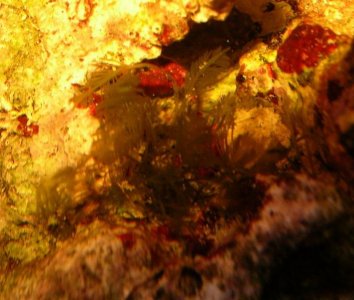
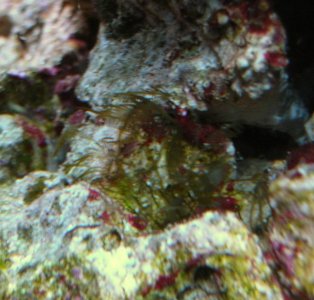
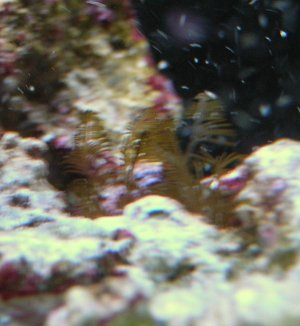
Alright, lets try these pics. This is the biggest group, which by big I mean all of this is on the size of a nickel. The other groups usually only have 1 or 2 stems with very minimal fern like stuff on them.

DSCN2729.jpg

DSCN2730.JPG

DSCN2732.JPG
 
Third one bottom looks like bryopsis. First of 3 looks more like caulerpa---fleshy central stem. Both are bad. Bryopsis is a little harder to get rid of, but I'd expect that toothbrushing the rock area, then a 30 second soak in hydrogen peroxide followed by a thorough rinse of the area works with caulerpa, halimeda, and unwanted xenia. *Might* work with bryopsis.
 
Third one bottom looks like bryopsis. First of 3 looks more like caulerpa---fleshy central stem. Both are bad. Bryopsis is a little harder to get rid of, but I'd expect that toothbrushing the rock area, then a 30 second soak in hydrogen peroxide followed by a thorough rinse of the area works with caulerpa, halimeda, and unwanted xenia. *Might* work with bryopsis.

Soaking new corals in CoralRX dip for 10 minutes will prevent these types of pest going to DT 100%?
 
Third one bottom looks like bryopsis. First of 3 looks more like caulerpa---fleshy central stem. Both are bad. Bryopsis is a little harder to get rid of, but I'd expect that toothbrushing the rock area, then a 30 second soak in hydrogen peroxide followed by a thorough rinse of the area works with caulerpa, halimeda, and unwanted xenia. *Might* work with bryopsis.

My pics are all of the same location just different angles and with/wo flash on.

I already tried tooth brushing and peroxide dip, and it came back. Its some interesting stuff, as it doesnt get really thick and full like some of the pics I've seen on here. Just stays like those pics.

Since it did come back would I be better off pulling all these rocks out of my tank, letting them dry out or even trying muriatic acid on it to certainly kill it??

Its just odd that it does not grow on my established rocks.
 
THere's a nutrient in the rocks it likes. When it runs out, it'll probably die off on its own. [Yep, I'm looking at your 3 images.] If it's minor and not spreading, just isolate the rock and keep an eye on it. If it's a small rock that doesn't matter, ditch it. It reproduces by fragmentation, so whatever breaks it up but doesn't destroy it, spreads it.
 
THere's a nutrient in the rocks it likes. When it runs out, it'll probably die off on its own. [Yep, I'm looking at your 3 images.] If it's minor and not spreading, just isolate the rock and keep an eye on it. If it's a small rock that doesn't matter, ditch it. It reproduces by fragmentation, so whatever breaks it up but doesn't destroy it, spreads it.


Sk8r, Soaking new corals in CoralRX dip for 10 minutes will prevent these types of pest going to DT 100%?
 
THere's a nutrient in the rocks it likes. When it runs out, it'll probably die off on its own. [Yep, I'm looking at your 3 images.] If it's minor and not spreading, just isolate the rock and keep an eye on it. If it's a small rock that doesn't matter, ditch it. It reproduces by fragmentation, so whatever breaks it up but doesn't destroy it, spreads it.

Thank you Sir! Unfortunately its on 2 of the biggest rocks in my tank. I'll keep an eye on it. Im hoping it eventually just disappears!
 
Sk8r, Soaking new corals in CoralRX dip for 10 minutes will prevent these types of pest going to DT 100%?

Everything I know about it is only for pest like Red bugs, nudi's, etc... Like fleas and ticks but on coral. I use Bayer and dip all of my corals and it does not kill the algae.
 
Back
Top