Dosing pumps better than Ca reactor?

plancton

Active member
Can dosing pumps be future for reef tanks?

For one thing I know they are cheaper, less complicated, take less space, easier to install and are very precise, probably more than Ca reactors. They also consume less energy.

Yet there´s much I need to find out about them, like why do people prefer Calcium reactors?,

Would it be more expensive on the long run because of the supplements?, on the other side a Calcium reactors spends much more electricity doesn´t it?.

Can they go a good job with cheaper supplements such as Kalkwasser?, is adding Kalkwasser in small doses the same that the calcium reactor basically does?.

How do you supplement etc.

I´m basically looking to see what is cheaper, less complicated and precise, and better for the corals.
 
for my 300 calcium reactor was the only option for me. I was using 240 ml of 2 part a day, (480ml total).

My Geo calcium reactor is set it and forget about IT!!, I clean it out and change the media every six months.:D
 
i use a kalk reactor for now and used dosing pumps before it the kalk reactor works good for my level of calcium usage. i like the idea of calcium reactors due to the fact that u are disolving coral skeleton in its natural form thus adding other trace elements other than just calcium and carbonate.
 
I use dosing pumps. I mix about 5 gal's of Randy's 2-part every 6 months and like the above post.. forget about.

I use my RKE to control my pumps.

With Obama wanting to regulate CO2 I can see the cost of CO2 going way up, and harder to find.
 
I use two part for my 200g tank i don;t think i change over from calcium reactor because $ i change over because i was not able to keep my pH up where i like to the house is all closed upalways .
Now with two part dosing with a LM is a breeze i never saw my tank as good but i don;t have a tank full of acro any more so calcium demands are low .
 
When to use one or the other cost wise depends on your alkalinity consumption rate and the size of your system.
As an example:
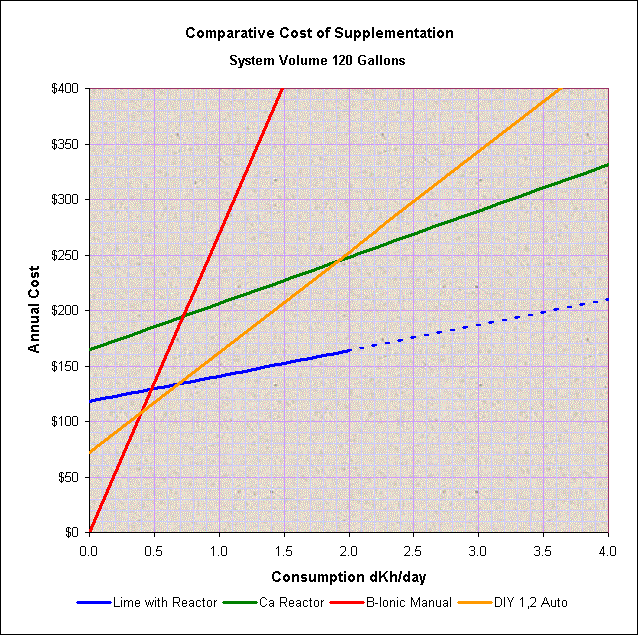
This chart shows a comparative cost for a 120 gal system assuming average sourcing cost and recovery of the initial equipment investment in 5 years.
In this case a calcium reactor becomes more economical when the alkalinity consumption is 2 dKh per day or higher were the Kalk reactor can no longer supply the required consumption.

cost120.gif


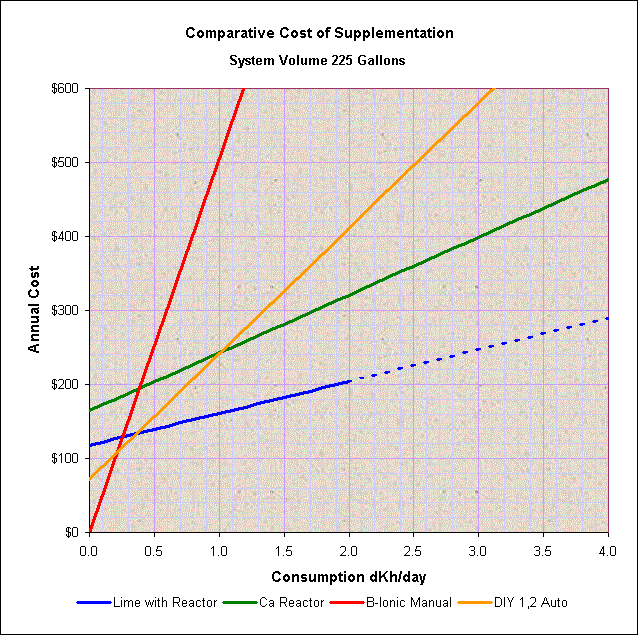
In this next chart for a 225 gal system, again the calcium reactor does not become more economical until the Kalk reactor can no longer supply the required alkalinity but note that it becomes more economical than an automated two part if the consumption is higher than 1 dKh per day.

cost225.gif


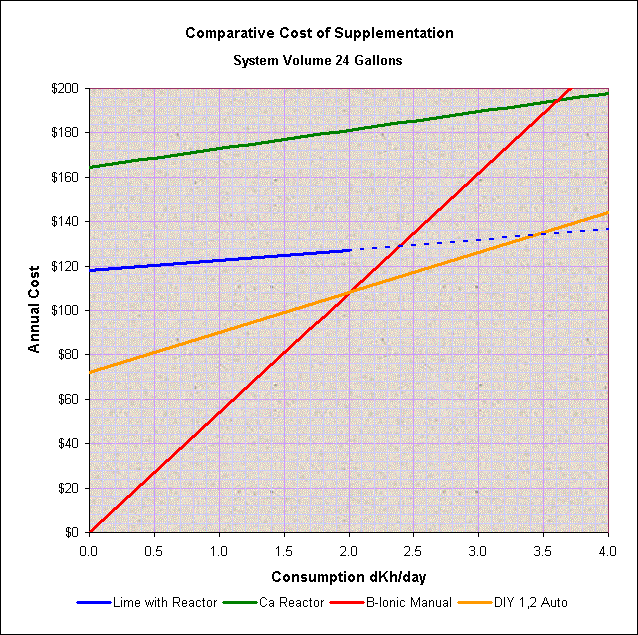
Finally the chart below shows the comparison for a 24 gal nano. In this case a calcium reactor can not be economically justifiable and manual addition using a commercial supplement is more economical than a DIY two part automated. Note that the automation cost is what makes for the higher the initial cost in the DIY.

cost24.gif


Note that the cost of consumables and equipment cost vary significantly depending on brands, sources and location so basically the charts above are just a comparison reference to explain the cost behavior but the crossing break even points will change depending on your particular circumstances.
 
<a href=showthread.php?s=&postid=14853517#post14853517 target=_blank>Originally posted</a> by atvdave
With Obama wanting to regulate CO2 I can see the cost of CO2 going way up, and harder to find.

The way I see it it will probably be the opposite.
A good portion of the CO2 sold for industrial, medical and welding purposes is obtained by purifying the CO2 generated by chemical plants and those plants will be fighting to giving it away to the purifiers and bottlers just to get the credit on emissions.
On the other hand production of sodium bicarbonate and calcination of lime generates a sizable amount of CO2 emissions which will cost a bunch to sequester or get rid of so; if the bottled CO2 gas cost goes up, the cost of lime and sodium bicarbonate will increase in a higher proportion.

BTW the actual cost of CO2 for a medium calcium reactor amounts to only about $2.50 to $3.00 per month which compared to the cost of salt, RO/DI cartridges, power, light bulbs and equipment repairs seems insignificant.
 
<a href=showthread.php?s=&postid=14853908#post14853908 target=_blank>Originally posted</a> by jdieck
BTW the actual cost of CO2 for a medium calcium reactor amounts to only about $2.50 to $3.00 per month which compared to the cost of salt, RO/DI cartridges, power, light bulbs and equipment repairs seems insignificant.

Yep.. I agree with the cost per month... However I use a 50# bag of Dow Flake which I haven't even broke into yet, and a 50# bag of Mag Flake as well. The cost is very little and will last me years....

On the CO2... I work in the electric motor business. We use dry Ice (frozen CO2) (Ice Blast) to clean dirty motors & generators. We have already been told by our suppliers that if Obama passes what he wants to do, then the price of dry ice will increase my 4x of what it is now. Also it will be regulated like freon is now.. you will need a spacial licenses to sale or purchases it.

If this is true I can see many places not selling CO2 any more like paint-ball supply companies

This is just my opinion and have no evidence to back it up.. just what I read about in the papers.. I hope I'm worng...
 
As I mentioned the comparison cost depends a lot on your sourcing and circumstances. In the cases shown above the cost of calcium chloride and sodium bicarbonate was taken from those coming from buckeye supply which seems to be the most readily available for the hobby and in general are higher than purchasing a bag of de-icer and if considering manual addition yes the or dripping the Kalk dripping will be the cheapest then the manual addition of DIY two part but again the break even point will just move to the right meaning a larger system volume or alkalinity consumption.

On the CO2 I think we will need to wait and see. There is a significant difference between CO2 and halocarbons. In the case of halocarbons it was relatively easy for the nations in the protocol in Montreal to eventually ban them because they could be replaced by heavier halocarbons or many of it's applications (like halocarbon-ethylene mixes for sterilization) had alternative processes that could replace them, they just provided for ample schedule to establish and increase the production of those heavier halocarbons. For CO2 they need to come with a totally different approach. Although there are some applications that can replace it like in your case at certain point you may need to phase to using glass beads or for food freezing and transportation were liquid Nitrogen can be used instead but there are uses and applications that can't avoid it, like driving a car, using your mower, food packaging, welding, anaerobic chambers in medicine, and many chemical processes,so they may need to come up with exceptions, allowance limits, trade offs etc.
All I can say is that there will be some significant changes but at this point there is not a single concrete proposal on the table so it will be impossible for your provider to determine the cost impact of those changes or if any at all and IMO they might be just positioning you to be ready for a potential adjustment but the impact will be wide spread to many other things like electricity, gasoline, chemicals and so on so I can't even venture what the new cost balance will look like.
 
I checked it out and a GEO reactor uses about 30 watts to operate in total because of the 2 pumps. That´s not much, I thought they used about 100 watts. Maybe my best option is a CA reactor.
 
<a href=showthread.php?s=&postid=14854072#post14854072 target=_blank>Originally posted</a> by atvdave

On the CO2... I work in the electric motor business. We use dry Ice (frozen CO2) (Ice Blast) to clean dirty motors & generators. We have already been told by our suppliers that if Obama passes what he wants to do, then the price of dry ice will increase my 4x of what it is now. Also it will be regulated like freon is now.. you will need a spacial licenses to sale or purchases it.

If this is true I can see many places not selling CO2 any more like paint-ball supply companies

This is just my opinion and have no evidence to back it up.. just what I read about in the papers.. I hope I'm worng...


I can kinda agree with you. I am a welder and I can tell you first hand, since I get the quotes and prices on the gases we use. We use Argon/Co2 mix, or Argon/Helium mix, and they have both gone up in price in the last few years. And we have been told to expect more increases in the not to distant future. I don't know exactly where they get the gas from, but it was my understanding that they use machines that pull it out of the atmosphere. I have a pretty good relationship with my suppliers so I could ask them if there is any reason for concern about this. I will call them tomorrow if I remember.
 
If the price/availability of co2 gets outrageous, wouldnt it be easy to make your own co2 like the planted tank guys do?
 
Not highjack the thread, but what about reliability? I know more people who have had their tanks crash because of Ca reactors as opposed to 2 part. I'm not saying all Ca reactor fail, it just seems like is more moving parts involved with a Ca reactor (solenoid, controller, mixing pump, feed pump). JMO
 
My two cents...

Another factor to consider is the risks associated with using Kalk. As in I have a 3 year old at home who I have to put on time out regularly in order to keep him from "helping" me with my tank. As in trying to feed fish for me and getting into the ATO reservoir to "help" me add two part to it (I don't do this but its what he can reach easily).

Kalk is highly caustic and can be trouble with kids.
 
<a href=showthread.php?s=&postid=14856867#post14856867 target=_blank>Originally posted</a> by Rysam
If the price/availability of co2 gets outrageous, wouldnt it be easy to make your own co2 like the planted tank guys do?

Not in the quantities that you need. The CO2 has to be pressurized some to force air into the pressurized calcium reactor. To accomplish this, you need a CO2 bottle and a pressure regulator. A DIY yeast/sugar setup will not deliver consistent CO2 at a consistent pressure (I have mine set at 15PSI).

The price and availability of CO2 is not outrageous. You can get it from most beverage supply places for less than 50 bucks. On top of that, a 10 pound bottle only needs to be filled once every 12-18 months.

<a href=showthread.php?s=&postid=14856890#post14856890 target=_blank>Originally posted</a> by solitude127
Not highjack the thread, but what about reliability? I know more people who have had their tanks crash because of Ca reactors as opposed to 2 part. I'm not saying all Ca reactor fail, it just seems like is more moving parts involved with a Ca reactor (solenoid, controller, mixing pump, feed pump). JMO

Reliability of a calcium reactor is perfectly fine if you use a PH controller as a safety net. If the PH of the reactor effluent is too low (i.e. and alkalinity/calcium is too high) then it shuts off the CO2 solenoid and prevents the reactor from slagging the media and "nuking the tank".
 
<a href=showthread.php?s=&postid=14853908#post14853908 target=_blank>Originally posted</a> by jdieck
The way I see it it will probably be the opposite.
A good portion of the CO2 sold for industrial, medical and welding purposes is obtained by purifying the CO2 generated by chemical plants and those plants will be fighting to giving it away to the purifiers and bottlers just to get the credit on emissions.
On the other hand production of sodium bicarbonate and calcination of lime generates a sizable amount of CO2 emissions which will cost a bunch to sequester or get rid of so; if the bottled CO2 gas cost goes up, the cost of lime and sodium bicarbonate will increase in a higher proportion.

I doubt the cost of CO2 will go up significantly, nor require special licenses to obtain. Obama isn't going to ruin the beverage industry, that's just ridiculous speculation. So long as restaraunts can get CO2 to keep their coke and pepsi fountains working, you can still get your bottle filled. Cheap.
 
Need to consider the wow factor. Seems there's lots of things we'll jump on with only marginal gains yet for exorbinant costs.
 
<a href=showthread.php?s=&postid=14855370#post14855370 target=_blank>Originally posted</a> by jdieck
As I mentioned the comparison cost depends a lot on your sourcing and circumstances. In the cases shown above the cost of calcium chloride and sodium bicarbonate was taken from those coming from buckeye supply which seems to be the most readily available for the hobby and in general are higher than purchasing a bag of de-icer and if considering manual addition yes the or dripping the Kalk dripping will be the cheapest then the manual addition of DIY two part but again the break even point will just move to the right meaning a larger system volume or alkalinity consumption.

On the CO2 I think we will need to wait and see. There is a significant difference between CO2 and halocarbons. In the case of halocarbons it was relatively easy for the nations in the protocol in Montreal to eventually ban them because they could be replaced by heavier halocarbons or many of it's applications (like halocarbon-ethylene mixes for sterilization) had alternative processes that could replace them, they just provided for ample schedule to establish and increase the production of those heavier halocarbons. For CO2 they need to come with a totally different approach. Although there are some applications that can replace it like in your case at certain point you may need to phase to using glass beads or for food freezing and transportation were liquid Nitrogen can be used instead but there are uses and applications that can't avoid it, like driving a car, using your mower, food packaging, welding, anaerobic chambers in medicine, and many chemical processes,so they may need to come up with exceptions, allowance limits, trade offs etc.
All I can say is that there will be some significant changes but at this point there is not a single concrete proposal on the table so it will be impossible for your provider to determine the cost impact of those changes or if any at all and IMO they might be just positioning you to be ready for a potential adjustment but the impact will be wide spread to many other things like electricity, gasoline, chemicals and so on so I can't even venture what the new cost balance will look like.


I guess I don't understand your charts. You start the ca reactor at about $165, where does that number come from? The initial cost of a ca reactor is much higher than that. Imo the equipment cost has to be figured in for any kind of reasonable comparison. One could dose two part for over 3.5 years on a 120 gallon system before ever even approaching just the equipment cost for a low end ca reactor.
 
<a href=showthread.php?s=&postid=14942611#post14942611 target=_blank>Originally posted</a> by RRaider
I guess I don't understand your charts. You start the ca reactor at about $165, where does that number come from? The initial cost of a ca reactor is much higher than that. Imo the equipment cost has to be figured in for any kind of reasonable comparison. One could dose two part for over 3.5 years on a 120 gallon system before ever even approaching just the equipment cost for a low end ca reactor.
The cost assumes a pay back of 5 years. In other words if you buy the calcium reactor system and do not use it you will incurr an annual equipment cost of one fifth of the total cost of the system for five years.
The model assumes the mid point for a total cost of the system from as low as $395.00 to as high as $1,180.00 for an average of $787.50 so there is an annual charge to cost of $787.50 / 5 = $157.50 plus $7.00 per year of power consumption (10 watts 24/7 at 0.08 / kwh) for total assumed fixed costs of $164.50 per year

Variable cost is assumed at $3.00 per pound of CO2 and $2.80 per pound of reactor media which translates into $0.145 per year of CO2 per each dKh of alk consumption per day for each gallon of system capacity and $0.203 per year of media per each dKh of alk consumption per day for each gallon of system capacity for a total assumed variable cost of $0.347 per year per each dKh of daily consumption per each gal of system volume.
 
Back
Top