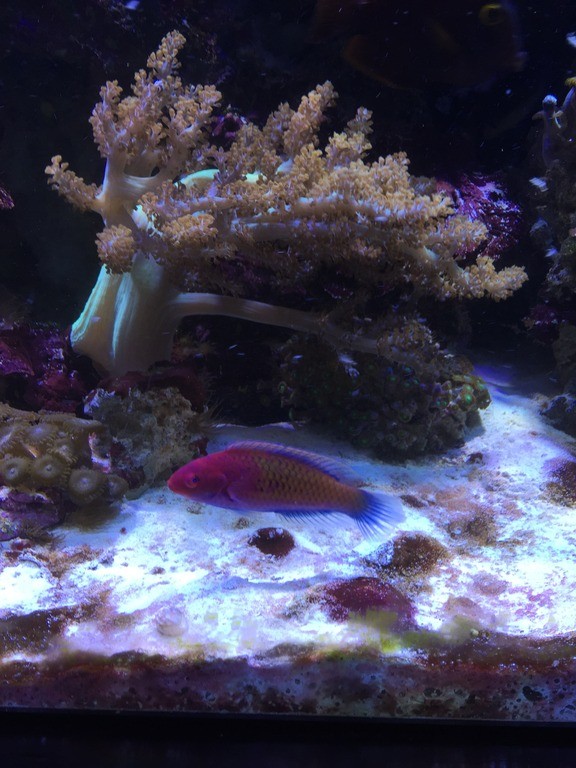
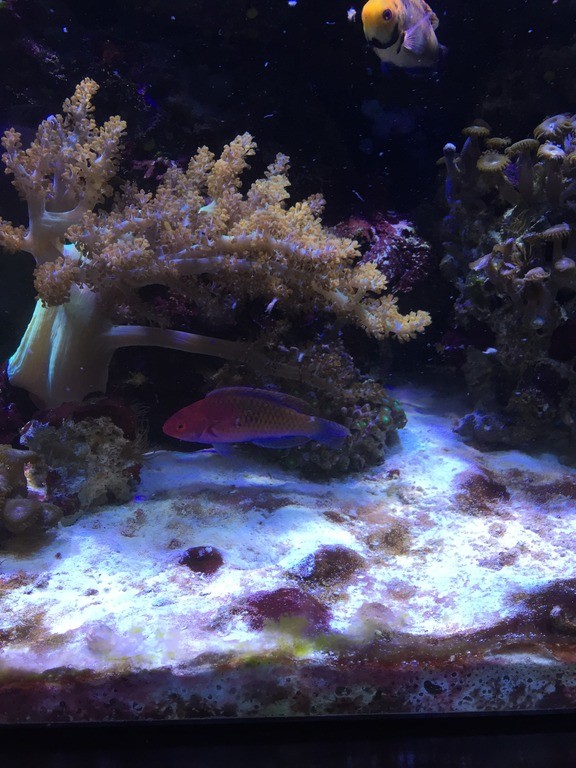
Female C. Solorensis?

devimik

Member
I received this C. Solorensis a few days ago from LA sold as a female/sub-adult, large. I am hoping this is actually a female and not a juvenile male that will become a male. I have a large male already, so wanted to get the female. So far, both my Kole Tang and the male C. Solorensis have chased her - she is about 3.5 to 4 inches long and the male is about 5 inches.

Now, the Kole is not chasing her, but the male does still chase her back into her hiding spot - hoping the male will accept her and not continue chasing her.

I don't think it's a male juvenile because I got the male almost three years ago and he was smaller than this female, but had the same colors he does now - nothing like the female. This female looks like every other picture I've seen of a female C. Solorensis.

Steve (Snorvich) indicated that it's hard to tell, based on these pics, whether this is a female or a juvenile becoming a male.

Anyone have any ideas or thoughts?

Thanks!


Irrespective of whether it's a female or sub-male now, the likelihood of it becoming male long-term is pretty high.
 
I'm not sure that it is a female solorensis at all. I think that the picture that Live Aquaria uses is incorrect.

As previously stated, regardless of type, most juvi/female wrasses will eventually turn male, a large one will turn even sooner.
 
Ok, so then the fact that this looks exactly like the LA pic of the female they show means nothing - bummer. I guess I'll have to see how this will turn out - not sure I could catch it without totally tearing up the tank.

I certainly didn't intend to add a male of the same or of a different species. What are the chances of the male getting along with this fish? Probably not good, I am guessing.

Thanks for the info.
 
Most fairy wrasses get along fine with other fairy wrasses, but if it is a Solor
wrasse and turns male, it will probably end up 'eliminating' the older male
 
The fish in the pic, although sold by LA as a female C. solorensis, is actually a male of another species. The fish in the pic is C. cf. cyanopleura. It has not been formally described yet. It is in the same complex as solorensis, so it is closely related. There may be more aggression between him and a solorensis than some more distantly related species, but I have kept the 2 together without issue. A female solorensis' colors are much more subdued.
 
Thanks again for the comments - so far, so good and they are all getting along better than I expected. The Cyanopleura I got as a female C. Solorensis is out and about and the Male C. Solorensis is not bothering it. Every once in a while, the Kole Tang backs up slowly at it, which causes it to go into a cave, but it comes right back out and swims around. After doing some research online, it looks like this is a female C. cf. Cyanopleura. She really is beautiful - hope the calm lasts.
 
Ok, I'm certainly no expert. The only reason I was thinking female is on multiple sites, the male C. cf. Cyanopleura has the blue patch near the gills and this one doesn't. I read that the males of the C. cf. Cyanopleura look the same as the C. Cyanopleura males and that the female C. cf. Cyanopleura don't have the blue patch. Either way, male or female, I agree it's a C. cf. Cyanopleura.
 
That info is incorrect. Their range overlaps C. cyanopleura, any pics that have the males looking the same has just mislabeled or misidentified them. Even if you were to look at a silhouette of your fish without color it would be possible to identify it as a male because of its proportions and fins.
 
I have a very similar fish in my tank currently, but I'm still confused as to whether it's a female solon, or male cyanopleura.

Regardless, would the temperament of both of these fish be similar?

I'm asking because I noticed that you also have a royal gramma listed in your Sig, and I'm about to purchase a royal gramma soon. Has your wrasse gotten along with the royal gramma?

Thanks!
 
Interestingly, for now, everyone is getting along fine and all the fish are usually out swimming around during the day, so I am pleased. The Royal Gramma gets along fine with the others. I do think it is a male C. cf. Cyanopleura now - after what eatbreakfast said - I can see how the fins and shape are like a male's. Regardless, it's getting along with the others, including the C. Solorensis male, which is about an inch or two larger. Now, I hope that "getting along" persists, but we'll see.
 
Back
Top