Fluidized Bed Coil Denitrator?

pskelton

New member
I have been considering building a coil denitrator and I have been doing a lot of reading on the subject. I had an idea and I wanted to get another opinion on it. Fluidized bed filters do a great job of breaking down ammonia and nitrite but you have to have a method of dealing with the mass amounts of nitrate that is generated. I was wondering if you could increase the efficiency of a coil denitrator by creating a denitrating fluidized bed filter in the oxygen depleted reaction chamber. The reaction chamber could be set up in a closed loop continuously recalculating the oxygen depleted water inside and though the sand bed.
What I am looking to do here is speed up the flow rate through the coil denitrator. I realize that you are still limited by how fast you can remove the oxygen from the incoming water but I imagine that you could use multiple coils for the deoxygenating process as long as the fluidized bed could keep up with the incoming nitrate.
Also had the thought of putting a FB at the input of the coil for Amonia and Nitrite breakdown and then another FB on the other end of the coil for breaking down the nitrate.

Any thoughts on this are appreciated,

Thanks
 
Good thinkin' :)
There were some commercial denitrators years ago that used a cellulose media (tiny sponge cubes) that were fluidized in a vat, fed with methanol and O2 deficient.
A collegue of mine made his own using carbon as the media, fluidized it in a barrel, and fed the methanol. Worked great, but took a lot of fiddling.

At one point I was going going to use a cheap lifegard FB filter on recirc, with a feed pump (like a Ca reactor flow scheme) to dial in the O2 levels. Easier to monitor with a negative ORP. The sulphur denitrators work very well too. You dont need to feed them because the bacteria eat the sulphur.
 
Well I'm not an aquarium expert, but I do happen to spend a lot of time working with fluidized bed technology so I had to comment when I saw this thread. I think that it would be interesting to see just how many fluidized beds you would have to combine in series to create an oxygen starved region in one of the beds. The ideal scenario would be to have one large fluidized bed which converts ammonia and nitrite to nitrate while removing all of the oxygen and then a second bed completely starved of oxygen which would remove the nitrate. That way you don't have to mess with finding a way to remove the oxygen in some other manner, just let nature take it's course. Another similar idea would be to use size or density segregating beds so that you could use one bed composed of two separate sections one handling the removal of ammonia and nitrite and the second removing nitrate. Then pass the water through a high oxygen zone like a skimmer and back to the tank. This sounds like an interesting idea that might be worth checking out...
 
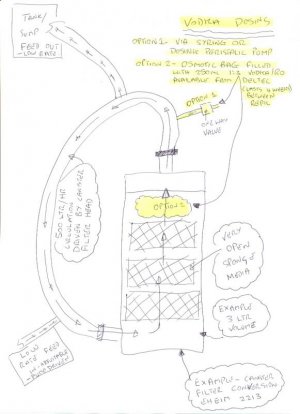
Why not just build a vodka based one using wide open filter foam in a canister filter, it would way out perform one that wasn't dosed with a carbon food base. ALso you would be eating phosphate at the same rate as anyother vodka dosing system.

I did a sketch the other day to show how to convert a canister filter into one. It works in a similar principal to the deltec off the shelf one. A few other manufacturers do very similar products too.


Anyway check this sketch out.
 

Attachments

  • scan0003.jpg
    scan0003.jpg
    51.1 KB · Views: 6
Nitrate coils have facinated me because they would seem to work without the addition of carbon. If indeed they work as per the principle, then why not fill a 5gall bucket with subtrate, and then run water through it at a slow rate? That should conceptually do the same thing as a nitrate coil, except with vastly more surface area.

Personally I feel the same way about fluidized beds as I do about bio-wheels and the like. It's a essoteric gadget performing a natural function that should be left in the tank and accopmlished with just power heads and live rock. It's the reef equivelant of somebody wanting to have a colostomy bag.
 
Nitrate coils have facinated me because they would seem to work without the addition of carbon. If indeed they work as per the principle, then why not fill a 5gall bucket with subtrate, and then run water through it at a slow rate? That should conceptually do the same thing as a nitrate coil, except with vastly more surface area.

Adding a carbon food source and recirculating over a large media means you can deal with a lot more nitrate and tackle some of the phosphate. the additional benefit is it is in a selfcontained unit. What that gives is a degree of safety. Overdosing a tank directly into the water with a carbon food source could wipe your tank, where as overdosing a self contain unit you have a fair chance of getting away with it as the return is dripping into the tank.
Other benefits are that you are less likely to end up with cloudy water and the white scum on the glass.
The above gives you the ability to have high stock of fish and keep for example SPS corals without having to do huge water changes.
The trouble with the bucket idea is that it is exposed to air, while it would work it wouldn't be that efficent for the amount of area it takes up.
 
Personally I feel the same way about fluidized beds as I do about bio-wheels and the like. It's a essoteric gadget performing a natural function that should be left in the tank and accopmlished with just power heads and live rock.

I have to agree that it is important to try to use live rock to perform the function of removing ammonia and nitrite. If these biological functions don't take place on/in the surface of the live rock then there is no chance to have the interior portions of the rock process the nitrate. However, it is rare for anyone to have all of their nitrate processed within their live rock (thus weekly water changes) so to help our systems remove excess nitrate which has been released into the water instead of into the interior of our live rock I think the addition of low oxygen zones with biological media makes sense. This is why I don't like the idea of bio-balls which only produce nitrates but don't process them because there is no lack of oxygen. Products like this simply rob the interior of our live rock of nitrates. That's why for an exterior system to work at removing everything (well most everything) it has to drop the oxygen levels. Otherwise it is simply a nitrate factory and we still have to change water (although we still need to do this in reef tanks for trace elements). Lol I hate when I realize that no matter what I'm still going to have to do water changes...
 
Back
Top