Gender of your Carpets (Gigantea and Haddoni) or any anemones

OrionN

Moved on
What are your observation regarding the gender of your Carpets?
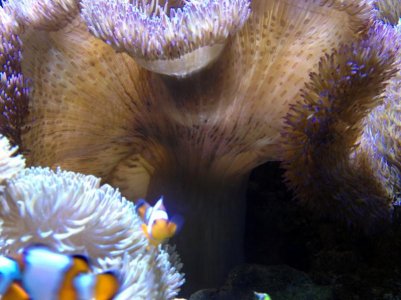
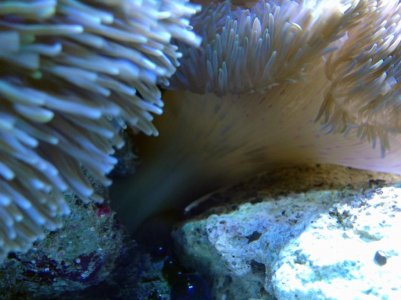
I start the ball rolling with my observation that the opaque marking that can be seen through the column is likely not gametes, egg or sperm. I have decided that this is the case because all my carpets have them even my tiny 3-4 inches Gigantea.
As you can see below, my 4 inches Gigantea is definitely too small to be sexually mature. I have observed these opaques area in my small and sick carpets in the past. Due to these observation, I concluded that they must be mesentery filaments instead of sexual organs.
I would love to hear observation of people who have had know sex of their carpets, thought spawning events in the past. What observable characteristics that you can use to determine the sex of your carpets. Pictures please.

The first picture is the column of my large purple

attachment.php


The second picture is the column of my 4 inches Gigantea from Petco

attachment.php
 

Attachments

  • GiganteaSex1.jpg
    GiganteaSex1.jpg
    66.6 KB · Views: 3
  • GiganteaSex2.jpg
    GiganteaSex2.jpg
    59.9 KB · Views: 3
I think what I wrote did not come out as I intended.

I know that anemones gametes can be seen through the columns. I think the usual marking as above are not gametes. Does your anemone have marking that is not the same as the pictures above? Do you think they represents eggs or sperms?
 
winwood and i were discussing sexing heteractis crispa this the other day. it would be nice if there was a sexing guide available for anemones.
 
In this picture, the opacites in the lower column may be gametes. I need to get a brighter spot light and shine it down the anemone and see if I can see it better. The opacities on top are not it for sure.

attachment.php
 
is this the best method for detecting the sex organs of anemones? heteractis crispa, i would imagine, would be very difficult to shine a bright enough light through their column, as it seems very dense.

what does that fancy anemone book have to say about this topic?
 
It says that one can determine the gender of the anemone by observe the games in the column. I am just not experience enough to tell which are eggs and which are sperms
 
Lets go

Lets go

This needs to be figured out. I have tried this by trial and error with two mertens, two btas, two magnificas.

I can never see a difference.


Here is the other problem, some anemones reproduce through internal brooding.

They release fertilized eggs that just like corals float in the water till they settle. Once they settle unlike corals which are fixed in place. The Anemones can move.

Personally i dont believe anemone or coral breeding can be done in tanks that we keep. I beleive that larger water volume is needed.
 
Of the hose anemones, H. malu and S. giganatea reproduced by brooding. I was told that they release fully formed babies, including zooxanthallea.

I got my H. malu to spawned and have fertilized larve developed. They released the babies the 4th night and got chew up by my filter system. Shortly after this my tank crack and I lost the female. Now I just got two H. malu males.
I did not have a thread on this but I did post pictures on one of the thread in the past.

I think with these two species, we should be able to reproduce them in captivity. I think there was a scientist in Australia who sucessfully reproduced H. malu sexually in aquarium. I am not able to determin how she does it exactly.

Up until recently, there were not that many Gigantea keep in captivity (not counting public aquariums). The number of aquarists who have more than one Gigantea, until recently, only a few, certainly no more than 5. That number increased by a lot recently. Maybe we will have more luck in anemone sexual reproduction in the near future. I am certainly trying. I need a female Malu which so far I have not been able to locate.
I got 6 Giganteas. I got 1/32 chance of having either all males or all females in my aquarium.


Below are picture of the Malu pair spawned and developing larves in the female. I observed that these larve moving under their own power.

2009-10-23%2007.59.08.jpg


2009-10-23%2017.53.53.jpg
 
A quote from one of the articles in Advanced Aquarist November 2002 by J. Charles Delbeek
Regaring H. quadricolor
Reproduction in E. quadricolor takes two forms, sexual and asexual. Asexual reproduction has been well-documented by hobbyists and was a common occurrence in this exhibit as well resulting in a large population of these anemones such that the live rock was nearly invisible when all the anemones were expanded. Sexual reproduction also occurs in this tank (see Sprung and Delbeek, 1997) and to the best of my knowledge, is the only such population in captivity that regularly does so each year. Spawning usually occurs between April and May between 0700 and 0900 a few days after a full moon has occurred. In April 2002 we were fortunate to once again witness not only the sperm release but also the release of planulae. Sperm release can occur in the morning but we have also observed it occurring in the late afternoon and this was the case this year. The exhibit was found to be rather cloudy in the late afternoon of April 25th and the incoming water flow was increased to ensure the sperm did not foul the water by being allowed to accumulate for too long and lowering oxygen levels. Four days later, on the morning of April 29th numerous green sphere-like objects were observed floating in the water. Upon closer examination it was found that the tentacle tips of several colonies of E. quadricolor contained these same spheres. Occasionally a few were observed being released from the tips of the tentacles. From previous experiences we knew these to be anemone embryos (see Sprung and Delbeek, 1997 for photos of the embryos and settled juveniles). A few days later there were still some visible in the tentacles and these were observed to be actually rotating and moving within the tentacles, and were more oblong in shape. It appeared as if the embryos had developed into planulae in the anemone and would shortly be released as such into the water. From my observations it would appear that E. quadricolor is dioecious, with males releasing sperm into the water column to be taken in by the females where their eggs are fertilized internally. A few days later embryos/planulae are released into the water column via the tentacle tips. Sprung and Delbeek (1997) also documented the presence of zooxanthellae in juvenile E. quadricolor only a few days after settlement. This time a few embryos were placed under a microscope and were found to contain zooxanthellae as well. Therefore, not only does the female brood the embryos for a short period but she also supplies them with their initial supply of zooxanthellae. As a result it is probable that these planulae can either settle very quickly and metamorphose into fully functional anemones, or they can spend a great deal of time in the plankton till they find a suitable substratum to settle on, without the need for feeding.

Regarding S. gigantea
.....Stichodactyla gigantea is also dioecious in nature with the females ingesting the sperm and fertilizing their embryos internally. However, unlike E. quadricolor, the embryos are internally brooded, developing into miniature copies of the adult. These juveniles are then egested from the mouth where they then drift in the current till they settle onto the substratum (L. Sharon, pers. comm., 1999). We were lucky to receive four of these juveniles in October 1999 from a coral farm in Belau (Palau); two green ones and two brown ones with an average oral disc diameter of approximately 4 cm (1.6 inches). These were placed in floating baskets in outdoor holding tanks in direct sunlight. Within the following three years one of the brown ones developed blue tentacles and all four had grown such that they had to be separated into individual baskets. At the present time (August 2002) the oral disk diameters of all four average approximately 30 cm (12 inches) when fully expanded. That means that there has been an almost eight fold increase in diameter in three years. I am confident that if the anemones had been directly feed on a regular basis they would have grown even larger (and perhaps faster) in those three years.
 
Regarding my H. Malu
I never did see them release. It was at night between 48-60 hrs post spawn. in the night. This tank was in my office so I did not see it. Just the morning I came in all the larves were gone from the mother. They were whitish in the body of the mother.
 
Back
Top