
You are using an out of date browser. It may not display this or other websites correctly.
You should upgrade or use an alternative browser.
You should upgrade or use an alternative browser.
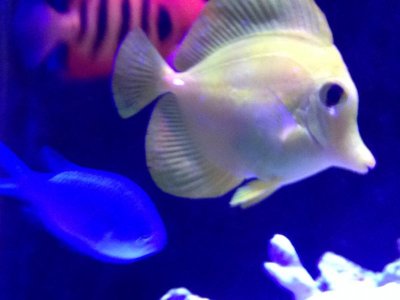
Help Identify, is it velvet?
- Thread starter Tuffloud1
- Start date

Tuffloud1
New member
Perhaps. What is the behavior of the fish? How long have you had it? Was it quarantined? If so, how.
I've had the yellow tang for 4 months. He was not quarantined.
The yellow tang is the only fish i can get a remotely decent picture of. My flame angel and royal gramma also appear to have it. The flame angel appears to have a couple of the "speckles" on his eyeballs. I noticed it for about a week now.
The royal gramma is the only one that has changed behavior. He has started "dive-bombing" my star polyp kind of sporadically.
The two oscellaris clowns, pink spotted goby and chromis show no signs of it.
Tuffloud1
New member
Ok, when was the last fish added to the tank? What was the source? I need more information since pictures are difficult.
Last fish was a Fire Fish, it was added this last Sunday. Local Fish Store

Velvet can be introduced by any fish arriving from another source and will normally exhibit symptoms within three weeks of arrival. Most commonly introduced by purchasing fish from an LFS running a low level (non-therapeutic dose) of copper. Since getting information is difficult to acquire one question at a time, look for a sheen over the body of the fish, somewhat reclusive behavior (avoidance of light), and hanging near the water returns. If it looks like a sprinkling of salt, it is more likely cryptocaryon irritans (ich). If the problem started when introducing chromis then that is a different thing altogether.
Tuffloud1
New member

SoloChromis
New member
Ive had 2 run ins with velvet in my time, and trust me, it isn't pretty. During my 2nd outbreak, due to my past experience with the disease, I was able to evacuate the survivors (vlamingii,clown,damsel) and quickly get them into cupramine treatment in my 20g quarantine tank, despite none of these fish showing any symptoms yet. I kept them in quarantine for over a month, with the tank sitting empty of all fish, besides my eel who isn't susceptible as far as I know. Velvet acts very quickly and very, very few fish will usually make it out alive without being treated early on. Good luck my friend, and keep us updated
Tuffloud1
New member
This is just terrible. 5 months into the hobby and I have Velvet? Wow, just wow.
I am going to set up a quarantine. Now I just need to know what to do with my corals, hermits, snails and shrimp.
How do I go about this to rid my tank? I am just starting to get coralline. Do I have to do an entire teardown? Please help.
I am going to set up a quarantine. Now I just need to know what to do with my corals, hermits, snails and shrimp.
How do I go about this to rid my tank? I am just starting to get coralline. Do I have to do an entire teardown? Please help.
Probably the best place to start is the read the sticky. You will also need to establish a quarantine protocol such as the one in my blog.

Spar
New member
This is just terrible. 5 months into the hobby and I have Velvet? Wow, just wow. yes, happens too often. you aren't to blame, there are a bombardment of posts on the forum saying that QT is not necessary; I didn't QT in my early days either -- eventually we all learn the hard way unfortunately
I am going to set up a quarantine. Now I just need to know what to do with my corals, hermits, snails and shrimp. see point #3 below, they can stay in your DT during the 12 week fallow period to QT them
How do I go about this to rid my tank? I am just starting to get coralline. Do I have to do an entire teardown? see point #3 below Please help.
Steve's link above is a great starting point. Below are a couple recommendations, but still read up on the stickies in the Fish Disease forum.
(1) QT all fish via Tank Transfer Method and PraziPro followed by 4 weeks of observation NOW and going forward for new additions -- this is the most effective method of ridding Ich and Flukes, and allowing isolation to monitor for Velvet and Brook, the next two big killers. Copper/Cupramine will only mask and slow signs of Velvet and Brook; a different method is necessary to rid those if you notice them showing up.
(2) QT all new addition non-fish via 12 weeks of fallow/fishless observation. This will rid the new additions of any hitchhiked parasites. By "non-fish" this means anything WET -- live rock, macro algae, snails, hermits, urchins, nems, starfish, cucumbers... you get the picture, e.g. everything. All you need is a 10g aquarium for this... keep it simple.
(3) Leave your DT fishless for 12 weeks. This will allow all parasites enough time to complete their life cycles and die. Ich takes 10-12 weeks, Velvet and Brooke take 6-8 weeks. Hence the 12 weeks recommendation to knock all out at the same time. You CAN keep all your non-fish in the DT during this phase.
Tuffloud1
New member
Thanks for the info guys.
Yes, I did read the sticky. I have a couple other questions.
Question 1) What is the success rate of leaving the tank fish less? I watched a Mr. Saltwater video where he stated that it doesn't always work and comes back, even after waiting over a month. So he broke his entire tank down.
Question 2) During the fish less period, is it business as usual for my corals, shrimps, snails and hermits? Simply feed and don't change any lighting or anything?
Question 3) Since my bio filtration will diminish during fish less, does this have an effect on corals?
Question 4) After successfully quarantined fish have waited it out, how do you ensure all copper has been removed from the fish to ensure that the fish will not bring copper into the DT and hurt any corals, etc.?
Yes, I did read the sticky. I have a couple other questions.
Question 1) What is the success rate of leaving the tank fish less? I watched a Mr. Saltwater video where he stated that it doesn't always work and comes back, even after waiting over a month. So he broke his entire tank down.
Question 2) During the fish less period, is it business as usual for my corals, shrimps, snails and hermits? Simply feed and don't change any lighting or anything?
Question 3) Since my bio filtration will diminish during fish less, does this have an effect on corals?
Question 4) After successfully quarantined fish have waited it out, how do you ensure all copper has been removed from the fish to ensure that the fish will not bring copper into the DT and hurt any corals, etc.?
Spar
New member
Thanks for the info guys.
Yes, I did read the sticky. I have a couple other questions.
Question 1) What is the success rate of leaving the tank fish less? I watched a Mr. Saltwater video where he stated that it doesn't always work and comes back, even after waiting over a month. So he broke his entire tank down. just a month is not enough, takes around 3 months to ensure it. there are scientific studies available, at least for Ich, that show the life cycle, including timing of the stages. the longest a cyst ever lasted before hatching was 72 days, most in 5-8 days. so, i personally rate the success rate of leaving fishless as 99.99%, but that is just me trusting the research
Question 2) During the fish less period, is it business as usual for my corals, shrimps, snails and hermits? Simply feed and don't change any lighting or anything? yes business as usual; make sure to keep feeding everyone, which will also keep bacteria alive
Question 3) Since my bio filtration will diminish during fish less, does this have an effect on corals? as long as you continue to feed the tank as normal, you shouldn't see much of a bio filter decrease. no harm in overfeeding during this period, just watch nitrates and do water changes as needed.
Question 4) After successfully quarantined fish have waited it out, how do you ensure all copper has been removed from the fish to ensure that the fish will not bring copper into the DT and hurt any corals, etc.? the amount of water coming over on or in the fish would be negligible, no worries here. however, please do read up on TTM where you wouldn't need copper. also note that copper will mask the effects of velvet to where you may not see it during the QT period and still be unlucky and introduce it to the DT. just another reason to do TTM, IMO/E.
Thanks for the info guys.
Yes, I did read the sticky. I have a couple other questions.
Question 1) What is the success rate of leaving the tank fish less? I watched a Mr. Saltwater video where he stated that it doesn't always work and comes back, even after waiting over a month. So he broke his entire tank down.
If he were really "Mr. Saltwater" he would know that a month being fallow is no where near enough time for any of the fish parasites. Twelve weeks fallow is 100% for ich, six weeks fallow is 100% for velvet
Question 2) During the fish less period, is it business as usual for my corals, shrimps, snails and hermits? Simply feed and don't change any lighting or anything?
Correct
Question 3) Since my bio filtration will diminish during fish less, does this have an effect on corals?
No. Plus you are feeding the tank so your biocapability will remain
Question 4) After successfully quarantined fish have waited it out, how do you ensure all copper has been removed from the fish to ensure that the fish will not bring copper into the DT and hurt any corals, etc.?
Just do not transfer any water (a collander, as an example)
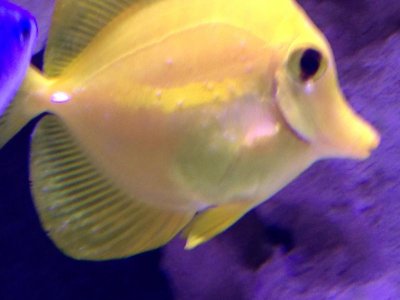
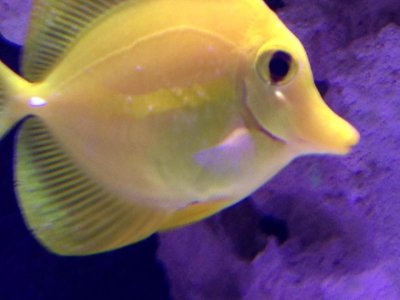
I posted a couple more pictures (post #7).
My wife is starting to think this looks more like ick.
What do you think it looks like?
While the pictures are not wonderful, the raised "bumps" indicate ich. Tank transfer is 100% for ich along with 12 weeks fallow.
Is ich something that can be overcome without taking all fish out and waiting it out?
Do fish develop a resistance if they make it through?
No, and no. About 5% of fish seem to develop temporary immunity to ich that lasts about six months, but they still carry it so it will be passed on to all fish introduced into the tank or will reinfect those that did not die.
Also, unless you develop a quarantine protocol, one day you will contract one of the more deadly parasites like velvet. Not quarantining is like playing Russian Roulette: noone wins the game, some just get to play longer.
Similar threads


- Replies
- 0
- Views
- 180