Help Identifying black tentacles on live rock

Frost_Hydra

Member
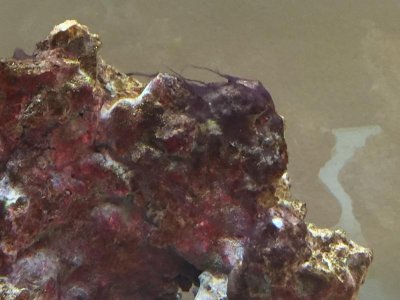
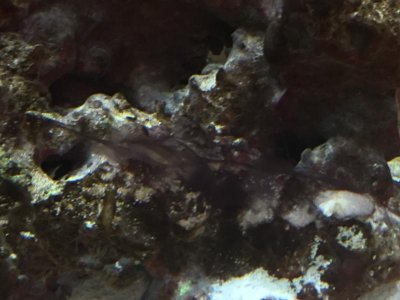
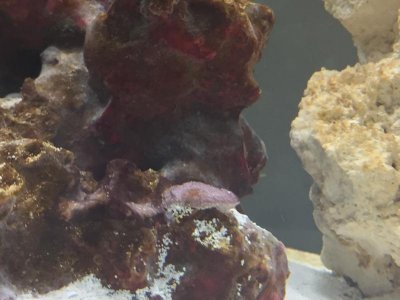
My 55g is relatively new, and has been running for 2 months. The day after I filled it up and checked all the parameters I put in a piece of live rock. I put in a powerhead and set up the lights to be on for 8 hours a day, and didn't really do anything for a month. Everything looked exactly the same from the first day I put it in, until I started the cycle (using 1 Cleaner Shrimp). I noticed a week in what I would assume is Coraline Algae appeared but I also noticed a few black strands (first picture). A week later I took the other two pictures, and I noticed the black stuff now coverers 1/3 of the live rock. My tank has a bunch of dead rock two, but the black stuff only seems to be on the live rock. I couldn't find a single picture or post about anything like it, except Black Beard Algae, but that seems to be freshwater only. I was just curious if anyone knew what it is/and or is it dangerous or bad.
 

Attachments

  • IMG_2613.jpg
    IMG_2613.jpg
    49.5 KB · Views: 3
  • IMG_2631.jpg
    IMG_2631.jpg
    54.5 KB · Views: 3
  • IMG_2630.jpg
    IMG_2630.jpg
    48.2 KB · Views: 3
What is a cycle using 1 cleaner shrimp? Shrimp method for cycling is not that. You add a dead shrimp for that not an alive cleaner shrimp.

Those are not tentacles or algae, it is biofilm of cyanobacteria. It is very thick so it appears black. It probably started as maroon/red but got darker overtime.
 
Thanks for responding, I thought the feces of the shrimp would work for a cycle, as it is waste. And is the biofilm of cyanobacteria something that should be of concern or something I should try to get rid of?
 
For starters just siphon it out during water changes and see if it clears on its own..

Some people turn the lights off too for 3 days..
Its typically an indication of water problems though..

btw..Have you been topping off your tank with fresh water (not salt water) to account for evaporation?
 
My water parameters seem to be fine, and I'm going to follow your advice about turning the lights off for 3 days, though would that be bad for the Coraline Algae/Live rock? I have not topped off the water yet as the tank is 99% covered besides the small slit where the filter sits; the water has only gone down around a centimeter so I haven't added any water. The salt level is 1.024
 
A tank and any inhabitants including algae/corals,etc... can take 3 day lights out without issue..

BUT.. a covered tank is NOT GOOD.. These tanks need good gas/air exchange and trapping all that can be very harmful... Then compound that with cyano which can suck up a lot of the oxygen in the water and you have trouble..
I'd be really concerned if you haven't topped off in 2 months..
 
Ok, so I enlarged the open area of the cover to about the size of a brick and put a fine mesh over it. I'm also going to do a 30% water change because of your concerns of the water condition; and thank you for all your advice, it's quite helpful.
 
Just a quick update

I turned on the lights real quick and I think it's working, all the black stuff is still there, but the long strands are now all broken and bent looking. In a week im going to get a cleaner crew and hope they get rid of whats left of it.
 
Most cleaner crews won't touch cyano..

I recommend siphoning as much as you can out first.. then turning lights off.. then siphon again after 3 days of lights out..
 
Cyano grows from excess nutrients. Do a few smaller water changes and see what happens. Most of the time it goes away on its own. Do you have a refugium? Some Macro algae might help starve it out.
 
My experience with cyano was solved by lights out, more frequent smaller water changes until the beneficial bacteria was cumulative enough, and reposition my powereads since cyano typically grows in lower flow areas.
 
Ok, so it's defiantly dying down or looks like its getting weaker. I adjusted my water powerhead so it's aimed at the live rock (where 90% of the cyano is) to see if that helps. Thank you for all your advice
 
Frost,
A word of advice on nutrient export. After 45/years of experience, I should tell you that I have not tested for phosphate in 35 years. I use bio-indicators to tell me what to do. Let us focus on cynobacteria, when it is present there is phosphate in the tank even if it does not measure on test kits. It can make its own nitrogen thru a process called “nitrogen fixation”, which converted earths early athmosphere from methane and sulphur gas into our oxygen rich athmosphere. Randy Holmes Farley described a process in which cynobacteria converts inorganic phosphate in substrate, calcium phosphate, into organic phosphate that is assimilated into cynobacteria biomass using a bio feed back loop. Imagine that, smart bacteria that makes its own nutrients from an athmosphere of 79% nitrogen and everything organic has phosphate in it.

Getting back to nutrient export, I just told you that cynobacteria was a concentration of nitrate and phosphate. Instead of removing bulk water during water change, which is a very diluted nutrient export, remove cynobacteria mats and detritus accumulation. Detritus is waste product. Ideally, differrent consumers of detritus, CUC, break it down further. At some point it will enter substrate. When you do partial water changes, vacume substrate surface.

PS. I just realized that this was a newbie forum. Sorry if I got to technical.
 
Last edited:
Frost,
A word of advice on nutrient export. After 45/years of experience, I should tell you that I have not tested for phosphate in 35 years. I use bio-indicators to tell me what to do. Let us focus on cynobacteria, when it is present there is phosphate in the tank even if it does not measure on test kits. It can make its own nitrogen thru a process called "œnitrogen fixation", which converted earths early athmosphere from methane and sulphur gas into our oxygen rich athmosphere. Randy Holmes Farley described a process in which cynobacteria converts inorganic phosphate in substrate, calcium phosphate, into organic phosphate that is assimilated into cynobacteria biomass using a bio feed back loop. Imagine that, smart bacteria that makes its own nutrients from an athmosphere of 79% nitrogen and everything organic has phosphate in it.

Getting back to nutrient export, I just told you that cynobacteria was a concentration of nitrate and phosphate. Instead of removing bulk water during water change, which is a very diluted nutrient export, remove cynobacteria mats and detritus accumulation. Detritus is waste product. Ideally, differrent consumers of detritus, CUC, break it down further. At some point it will enter substrate. When you do partial water changes, vacume substrate surface.

PS. I just realized that this was a newbie forum. Sorry if I got to technical.


Hey! Thanks so much for all this information. Though this thread is a few months old and I fixed the Cyano Issue by doing a 5 day lights out. Don't get me wrong though; your information is very useful and I'll use it if I ever have an outbreak again.
 
Back
Top