How to get lights to follow your area's light cycle?

Innovation

New member
As the title says, I'm wondering if there's a way to connect your tank lights to your area's natural light cycle? It would simulate seasons if it could be done, and sounds like a fun little project! :D I was walking through Lowes yesterday (A reefer's paradise, I promise you!) and noticed little light sensitive switches that you can wire to lights. Is there a way to connect those to your tanks lights without ripping your fixture apart?

Or is there something I could plug into the end of my fixture's plug, set it up outside, then run it back inside and plug it into the wall?

It would be pretty cool to do this, and if anyone has already, let me know how you did it! ;) Thanks!
 
do you want simple on/off control at the right times, or dimming as well? what kind of lights do you have? this would be extremely easy with a neptune apex controller or any advanced outlet timer (maybe one they have at home depot/lowes can do sunrise/sunset). there is no need for a light sensor when the sunrise and sunset times can be predicted.

perhaps a better question is why do you want this? is it going to provide the right duration of light for your tank? will you even be at home when the light is on?
 
Sunrise in the Virgin Islands averages around 6AM. Sunset is at 6PM. Never varies more than maybe 45 minutes beyond that.

Now what would be cool is if you could get it to follow weather patterns.
 
do you want simple on/off control at the right times, or dimming as well? what kind of lights do you have? this would be extremely easy with a neptune apex controller or any advanced outlet timer (maybe one they have at home depot/lowes can do sunrise/sunset). there is no need for a light sensor when the sunrise and sunset times can be predicted.

perhaps a better question is why do you want this? is it going to provide the right duration of light for your tank? will you even be at home when the light is on?

It would be nice to have dimming capabilities, but since I use fluorescent's, dimming is not easily done. I am not sure on the lights I have right now, as everything is packed in our garage (my family just moved). The main reason I'd like to do this is because timers have failed on me before, and it would just be fun to do! :)

Most areas of natural reefs have minimal to no seasons


Sunrise in the Virgin Islands averages around 6AM. Sunset is at 6PM. Never varies more than maybe 45 minutes beyond that.

Now what would be cool is if you could get it to follow weather patterns.


That is a good point, that did not occur to me!

I agree, following local weather patterns would be extremely cool! :thumbsup: With a few hours worth of electronics tinkering it could probably be done!
 
My profilux simulates the light cycle of any time zone when controlling LED lighting.

I'd definitely go LED if I had the money, but it's so expensive! I just did a quick google of profilux LED kits, and they can run 1700$! That's a bit too expensive for me, especially considering I'd need several.
 
Most of the animals we would keep in our reef tanks come from tropical locations closer to the Equator, which is called that for a reason as folk have noted - day/night lengths are 'equal' and have very little/no seasonal variation. This is not true for everything, livestock from Florida, for example, but it is mostly true. So unless you are trying to keep a tank containing temperate animals, following your local day/night variations (depending upon where that is) is probably not a good idea.
 
So unless you are trying to keep a tank containing temperate animals, following your local day/night variations (depending upon where that is) is probably not a good idea.

its worth nothing that nothing is actually that picky about light cycle. there is a huge range in light cycles that will work just fine.
 
its worth nothing that nothing is actually that picky about light cycle. there is a huge range in light cycles that will work just fine.

There are lots of things that can be done that probably shouldn't. Seems to me quite reasonable to replicate as closely as possible the natural environment from where these animals originate. That is the approach I'd always advocate.
 
Moon Cycle

Moon Cycle

I would think being able to replicate the moon phases and lighting spectrum would be just as important.
 
There are lots of things that can be done that probably shouldn't...

Yes that is very true but....I couldn't resist.

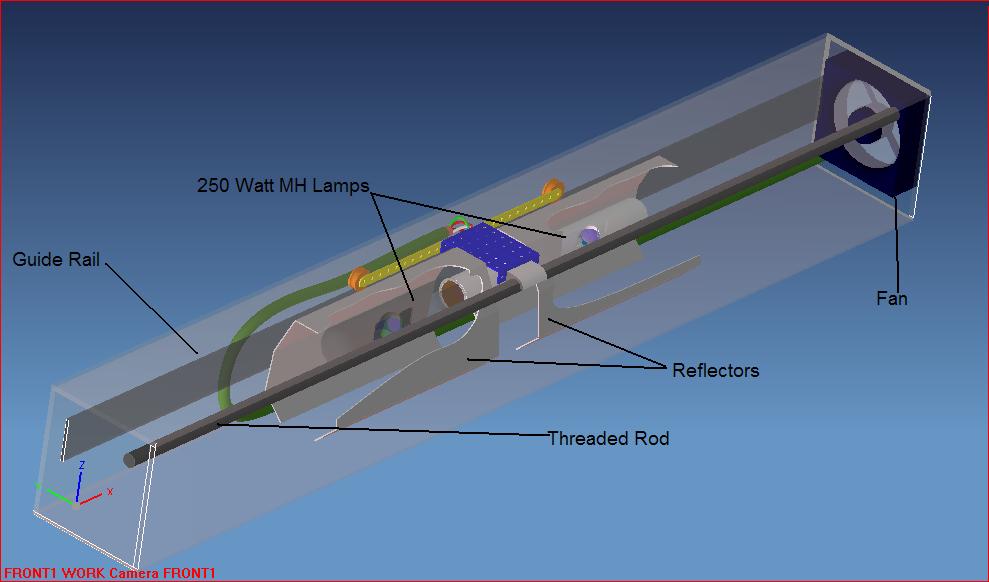
Many years ago, I built this just for fun. With the tube being made of polycarbonate and the fan directed over the lights, it never melted down.

LightBoxTube.jpg
 
Most of the animals we would keep in our reef tanks come from tropical locations closer to the Equator, which is called that for a reason as folk have noted - day/night lengths are 'equal' and have very little/no seasonal variation. This is not true for everything, livestock from Florida, for example, but it is mostly true. So unless you are trying to keep a tank containing temperate animals, following your local day/night variations (depending upon where that is) is probably not a good idea.

Good point(s)!

There are lots of things that can be done that probably shouldn't. Seems to me quite reasonable to replicate as closely as possible the natural environment from where these animals originate. That is the approach I'd always advocate.

Amen. :thumbsup:

I would think being able to replicate the moon phases and lighting spectrum would be just as important.

I agree, I am working on my own LED system to replicate the moon, as closely as possible! I might get some pics up soon.

Yes that is very true but....I couldn't resist.

Many years ago, I built this just for fun. With the tube being made of polycarbonate and the fan directed over the lights, it never melted down.

LightBoxTube.jpg

Please, PLEASE elaborate on that! Does the light actually move along the track? I have talked to some fellow reefers about moving lights along a track, but I've never seen it done!
 
I don't think that corals will benefit enough to warrant all of the effort that you would put into it unless the imagining and the doing is the fun part. One exception is that the corals would be less likely to be sun blocked by other corals and therefore perhaps have more natural growth patterns. I know of one company that uses moving lights like the indoor plant growers use to move over their corals.

In my case, when you turn the threaded rod, the carriage moved down the rail. I drilled a hole on a small block of white UHMW (much like Teflon ) and threaded it to match the rod. Then I cut it in half. I attached that to the blue part from my son's Erector set. This allowed me to rotate it up and away from the teeth of the rod when I wanted to move the carriage back and forth for resets.

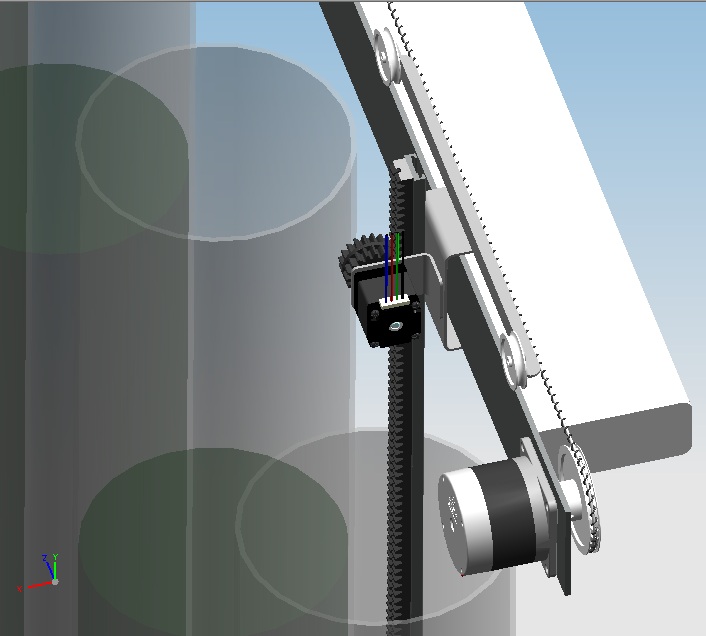
I didn't bother with motorizing it because the switching was too much of a pain back then and I didn't want to buy a very expensive latter logic controller for it . I just played with it long enough to make it work. Yes it worked great but only manually so it really wasn't worth my time except it was fun.

Since then, I built a 2 axis robot plankton feeder using an Arduino micro controller and a couple of step motor drivers which are cheap these days. It is designed to move from tube to tube adding liquid food and water throughout the day. I learned how to do it by asking questions on a few forums.

RobotAssembly.jpg


Now it is comparatively easy to do and I plan to automate my lights when I get some other stuff off my plate. I am also waiting for the technology to settle around all of the new large LED chipsets. They are just about ready to go mainstream.

I can order 100 watt chips made to custom wave lengths for under 50 bucks. I can get star shaped veined extruded aluminum heat sinks that look cylindrical to put a lot of light in a reasonable sized package.

Now days you could have dawn and dusk warm colors and change to whites and blues during other parts of the day. You could even make the light rotate so that it points at a high light requirement coral as it approaches and swivels back to continue pointing there as it passes.

You could have standard lighting "¦say from noon until you get home and then start the "œcosmetic day" when you normally get home from work. Then the entire day light cycle could unfold from then until you normally go to bed.
Isn't technology wonderful? Isn't imagination dangerous but fun?

 
That's awesome! I wish I didn't have such a low budget, or I'd have built something like this with dawn/dusk simulators, electrical storms, cloud patterns, anything I could think of haha
 
See, I could afford the controllers, motors, drivers etc It's the actual LED's that are incredibly expensive. As well as heatsinks, but that's a different topic :thumbsup:
 
Back
Top