How to safely transport 125 gallon aquarium across town?

ddang

New member
I bought this aquarium and stand from petsmart: marineland 125G for $650.

Unfortunately, there's no delivery/shipping services and I'll have to go pick it up myself.

I'll have a friend who has a pickup truck help me, and we wanted to check in to see what we should watch out for when transporting the aquarium across town (about 15-20min drive).

We live in the midwest, and it's below freezing right now. Is it safe to transport a glass aquarium in cold weather?

I'm also concerned about things like vibration from the vehicle damaging the glass....

Any advice would be greatly appreciated!
 
I would give the glass an opportunity to get cold before transporting (even if done after loading) While I would like to assume room temp glass would be fine, but I’ve broken many a tank that were warm and once bumped in cold weather shattered a pane.

With that said, I’d look into bringing a couple blankets (I like padded shipping blankets but that’s me). Beyond that, I’d just avoid pot holes and make sure the stand is secure so it doesn’t fall on the tank.
 
thank you. also, do you by any chance have any opinions on this particular brand and tank? the reviews are mostly positive but there are a few negative ones on the petsmart website. i am a bit anxious buying a tank of this size. a break would flood my living room leading to thousands or tens of thousands of dollars of repairs
 
Marineland as a general rule is an okay brand. I haven’t heard to many issues with the standard size tanks (the 125 being a standard size). With that said, it looks like 2 of the 3 negative reviews are stand related and one perhaps being a structural issue.

I would just check the stand over for defects but otherwise I wouldn’t be too concerned personally.
 
Thanks all.

The other thing I'm concerned about structural ramifications of having such large load (at least 1500 lbs) over a 6' x 1.5' area. It'll be along an exterior wall, but it's unfortunately parallel to the joists...

Luckily the basement underneath this area is unfinished, so I should be able to add some structural supports. There's a lot of electrical, HVAC, and plumbing down there though so might be a bit tricky to get some support installed.

With that said, I noticed there's a bit of a slope in the 1.5' depth direction. I think it drops about 0.5" away 12-18" away from the wall. Is this significant enough to cause issues? The flooring is red oak flooring. Perhaps I should level it?

I also checked in the length direction, and it seems much better. My level doesn't show zero slope, but it's close to it, I think
 
0.5" over a 12-18" run on an unloaded floor is a pretty significant drop off. Definitely consider leveling it to set things up for the best opportunity for long-term success. That much of a difference could also become worse once the tank is in place, filled, and starts to add additional load onto the flooring.

As you work toward leveling and supporting the area beneath, it might also be helpful to monitor, check, measure, re-measure, and re-measure again as you begin to fill the tank. On some of my larger tank set ups of the past, I did multiple test runs by just filling the tank with plain tap water, using that to help ensure I got the proper support everywhere it was needed.

The concern with being not level is that it will place a higher load force on one pane of the tank than the others (The front pane in your specific case), and this has the potential to cause problems down the road.
 
Place a rubber mat in the bed of the truck or sheets of card board, cover with a blanket, you should be fine. If you where in San Antonio I could help you
Erik 2 (2).JPG
 
0.5" over a 12-18" run on an unloaded floor is a pretty significant drop off. Definitely consider leveling it to set things up for the best opportunity for long-term success. That much of a difference could also become worse once the tank is in place, filled, and starts to add additional load onto the flooring.

As you work toward leveling and supporting the area beneath, it might also be helpful to monitor, check, measure, re-measure, and re-measure again as you begin to fill the tank. On some of my larger tank set ups of the past, I did multiple test runs by just filling the tank with plain tap water, using that to help ensure I got the proper support everywhere it was needed.

The concern with being not level is that it will place a higher load force on one pane of the tank than the others (The front pane in your specific case), and this has the potential to cause problems down the road.
Yeah, my plan was to put a permanent level on the top of the aquarium or just take periodic pics to monitor whether any sloping develops over time.

I'm not the most handy person out there, and I'm not sure how to go about leveling. Would I have to uninstall the hardwood plank to level, or do you mean just add something, e.g., a shim or something, above the lower side? Presumably, I would need some sort of transition piece to go from the lower side that tapers off/thins out towards the higher side?
 
it is easiest to run a thin strip along the front. Use some decent plywood or something like that. If you paint the edge black it wont even be noticable. Then shim at the midpoint on the side edges.
That assumes it is level side to side to start with.
Also you do not want the tank shoved up to the wall. Leave 4-6 inches behind the tank.
 
Oh thanks. I was actually planning on having it shoved to the wall (or to the baseboard since it protrudes outward of the wall by 0.5-1").
The stuff about the plywood and shim is going over my head a bit. I'll have to do some research

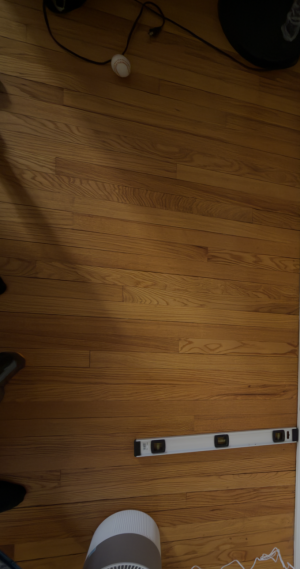
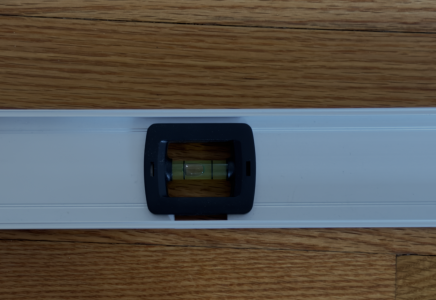
Here are a couple pics showing the area and the level btw, though this level was placed right against the baseboard. I'll have to recheck the level 4-6" away from the wall
 

Attachments

  • Screenshot 2025-12-02 at 11.02.59 AM.png
    Screenshot 2025-12-02 at 11.02.59 AM.png
    1.3 MB · Views: 5
  • Screenshot 2025-12-02 at 11.03.20 AM.png
    Screenshot 2025-12-02 at 11.03.20 AM.png
    1.4 MB · Views: 3
Sorry, I cant see your bubble.
Place the level on the stand. Lift the low end until the level is level. The distance from the level to the top of the stand is how much you need to put under the tank on that side. This can be done exactly using the level and a ruler.
If the stand is sloping down from the wall use a strip of plywood along under the long side of the thickness you measured.
The short side edges need only be supported in their middle with small shims.
Home Depot has packages of wedge shaped wood for this purpose. You shove it under and draw a line across and cut them off.
shims-csh12-42-12-48b-64_600.jpg
42 of them for about $7
 
A floor can be braced with a 4x4 and a metal post jack. A single one will take the load and the 4X4 should span all the floor joists under the tank. The post has a threaded section to adjust it's height exactly.
Not hard in a basement with a concrete floor. If a dirt floor you may have to use a concrete pad they make for deck posts or even dig a 2 foot square hole and fill with concrete to make a footer to take the load.
 
Sorry here is a close up photo of the level. It gets a little bit better when I put the level 4-6" away from the wall. earlier I had it right against the wall

I will take a look at the shims. I'm not totally sure what the bottom surface of the stand looks like. I think either the entire bottom surface sits flush against the floor, or there's some edge perimeter. I think depending on this, it'll affect the shim placement.


Non-related to leveling, but would you guys recommend putting a mat of any sort or anything else under the stand? Once the tank goes on and gets filled, it's pretty much permanent so I'm trying to make sure it's all set up
 

Attachments

  • IMG_6335.PNG
    IMG_6335.PNG
    1.9 MB · Views: 2
Is this a reef ready tank with overflows and drains through the bottom or are you going with something else? That mostly determines how close you want to the wall. There may also be lighting arms and power cords back there.

The floor. If this tank sits there a long time the floor will be affected. Every tiny drop of tank water has salt in it. Every tiny splash will leave a salt film on stuff eventually. Eventually some will build up on the wall behind the tank and the floor. Salt is not dirt. You have to dissolve it and extract the water a couple of times. Soap does nothing. Walls painted with flat paints are the worst. Glossy paints can usually be cleaned up.
You can cover walls and floors with waterproof things, usually sheet vinyl flooring or PVC sheets. Outdoor carpet with a waterproof pad (often sold as pet proof) is an option.

My tanks are in the basement on vinyl flooring now. I have no worries. I dump a bucket of water on the floor and run a carpet machine to suck it up.
 
I'm planning for it to be a freshwater tank. I do want a reef tank too in a different location and will probaly get a 75 gallon. It's also possible i may change my mind altogether and make the 75 gallon a freshwater and the 125 a reef.

I do have a turtle so I think I'll probably keep the 125 as the freshwater tank.

I won't have any supply or drains connected there.


I have a 1927 house btw with white textured plaster walls. Is the wall build up due to evaporation?


There will be one electrical outlet (2 plugs) towards the edge of the frame. I was thinking about having another outlet installed behind the frame, but I think that existing outlet should be fine and I can use a power strip there behind the tank if needd
 
Not evaporation. Just minerals left behind when water droplets evaporate on surfaces. I am terrible about splashing water everywhere.
Drains are a reef tank thing. Never mind that.
Are you going to run a HOB filter or a canister? You still need room for those.

Well the first thing you have to do is decide what you are doing.
 
I honestly haven't thought that far ahead yet and thought this was stuff I can figure out after I get the tank and aquarium (unfilled) situated, but I should probably get to it now since the aquarium + frame itself is 200lbs without water and will be hard to remove. Though I should probably leave enough space for either in case I switch in the future? I guess I could also put the filter on the front of the aquarium, but that's atypical because it's not as aesthetic right?
 
I honestly haven't thought that far ahead yet and thought this was stuff I can figure out after I get the tank and aquarium (unfilled) situated, but I should probably get to it now since the aquarium + frame itself is 200lbs without water and will be hard to remove. Though I should probably leave enough space for either in case I switch in the future? I guess I could also put the filter on the front of the aquarium, but that's atypical because it's not as aesthetic right?
Typically we hide the filters as best we can.
I use a Fluval FX4 on my 75 freshwater that sits under it. The reef tank filtration is in a special room.
 
Back
Top