
You are using an out of date browser. It may not display this or other websites correctly.
You should upgrade or use an alternative browser.
You should upgrade or use an alternative browser.
How to safely transport 125 gallon aquarium across town?
- Thread starter ddang
- Start date
sorry, another question, are scratches on fish tanks a concern? google seems to tell me it's not, unless it's an actual crack.
I had ordered the same aquarium from petsmart back in the summer, but when I arrived at petsmart, I saw lots of scratches on the bottom of the tank. The employee there said the scratches are not a big deal and were due to being scratched by decorations/rocks that they had for display. I'm not concerned about the aesthetics and was just wondering if those scratches could turn into cracks which could then leak? I ended up backing out of that purchase (more so because my living room wasn't set up at the time to house an aquarium. the scratches did affect my decision but to a lesser degree)
I'm scheduled to pick up the new one this week. I asked the employee to check for scratches and was told there weren't any on this new one, but I'll see for myself tomorrow
I had ordered the same aquarium from petsmart back in the summer, but when I arrived at petsmart, I saw lots of scratches on the bottom of the tank. The employee there said the scratches are not a big deal and were due to being scratched by decorations/rocks that they had for display. I'm not concerned about the aesthetics and was just wondering if those scratches could turn into cracks which could then leak? I ended up backing out of that purchase (more so because my living room wasn't set up at the time to house an aquarium. the scratches did affect my decision but to a lesser degree)
I'm scheduled to pick up the new one this week. I asked the employee to check for scratches and was told there weren't any on this new one, but I'll see for myself tomorrow
I forgot to respond to the rest of this.A floor can be braced with a 4x4 and a metal post jack. A single one will take the load and the 4X4 should span all the floor joists under the tank. The post has a threaded section to adjust it's height exactly.
Not hard in a basement with a concrete floor. If a dirt floor you may have to use a concrete pad they make for deck posts or even dig a 2 foot square hole and fill with concrete to make a footer to take the load.
The basement floor is concrete. I can't remember if I mentioned this, but unfortunately the joists are going to be parallel to the length of the tank (The hardwood floor planks are perpendicular to the length of the tank). I haven't measured how far apart the joists are, but I think the tank will sit entirely on 1 joist, or at most 2. there's some electrical, plumbing, and HVAC in that area in between joists/foundation wall that might make it a little more difficult to add the structural supports
I posted being concerned about the structural impact of this tank elsewhere in the past, but people usually say "would you be concerned if you had 6 200lbs+ men standing in that area" to make light of the situation. But I think that comparison is flawed, because structural problems from a fish tank wouldn’t show up instantly—any issues could develop slowly over time, and it's like 6 200lbs+ men are going to be standing there for years
I'll measure the distance between the joists tomorrow. The tank is 18" deep, and joists are usually spaced closer than that, so I think I should be able to span 2 joists. I don't have an exact reference point for where the joists are from the room of the tank though, but I could probably make some educated guesses

Jimbob
Active member
Go Blue!I'm in Ann Arbor!
Given you are in Ann Arbor, it is only about an hour up the road for you to one of my most absolute favorite LFS on the planet. For all your freshwater, saltwater, reef, reptile, bird, and any other needs, I cannot recommend highly enough that you go visit the Preuss family and their amazing team at Preuss Pets in Lansing. A Pet Store with a Purpose | Preuss Pets in Lansing, MI
They are some of the most knowledgeable people around and often provide some very solid advice. It might even be possible they can offer some help and/or direct you toward someone who can help get your new tank situated.
Last edited:
Jimbob
Active member
Unless those utility items are attached directly to the bottom of the joists and/or completely covering them, there should room to get a floor jack pad onto the bottom of the joist. Provided the space below that is open and clear all the way to the floor, the use of such a floor jack should be a reasonable option. Any house floor jack like these should work: http://bit.ly/3KF03lb... but I think the tank will sit entirely on 1 joist, or at most 2. there's some electrical, plumbing, and HVAC in that area in between joists/foundation wall that might make it a little more difficult to add the structural supports
Especially if the tank is only straddling one joist, then one jack would be enough... if straddling two joists and you have 4" of clear space between them, simply placing a piece of 4" x 4" perpendicular between those two joists and then supporting it would probably be sufficient.
Go Blue!
Lansing is a bit of a drive (about 1.5 hours) so not super easy to access unfortunately.
I'll take a look at the basement in a bit and snap a pic and see what's happening.
I just brought the tank and frame home today! Pretty excited to get it all set up. Unfortunately, I'll be going out of town for a few weeks starting next thursday, so I'll have to wait until I'm back to get everything set up. Some of the reviews mentioned this, but yeah, the frame looks pretty weak. It's also very light (maybe 20 lbs?) compared to the tank, so I'm kind of nervous about that thing actually being able to support 1200 lbs+...
Would you guys recommend putting a long mat or perhaps cardboard below the frame to protect the flooring? And then if I do that, I should probably put the shims above the protective layer (whether that be cardboard, mat or something else?)
Lansing is a bit of a drive (about 1.5 hours) so not super easy to access unfortunately.
I'll take a look at the basement in a bit and snap a pic and see what's happening.
I just brought the tank and frame home today! Pretty excited to get it all set up. Unfortunately, I'll be going out of town for a few weeks starting next thursday, so I'll have to wait until I'm back to get everything set up. Some of the reviews mentioned this, but yeah, the frame looks pretty weak. It's also very light (maybe 20 lbs?) compared to the tank, so I'm kind of nervous about that thing actually being able to support 1200 lbs+...
Would you guys recommend putting a long mat or perhaps cardboard below the frame to protect the flooring? And then if I do that, I should probably put the shims above the protective layer (whether that be cardboard, mat or something else?)

wvned
Well-known member
Putting a mat down to protect the floor is both good and bad. If dirt gets under the edges it will scratch the floor and ruin the finish.
I would suggest putting down a piece of water proof carpet matting and taping the edges down (all the way around to keep dirt out) then put something over it like a cheap area rug of almost the same size.
Yes Marineland stands seem wimpy but if in good condition it will hold the tank fine. My 75 came with a stand and it is the same way. I have used it more than 7 years.
Put the shims directly under the stand.
I would suggest putting down a piece of water proof carpet matting and taping the edges down (all the way around to keep dirt out) then put something over it like a cheap area rug of almost the same size.
Yes Marineland stands seem wimpy but if in good condition it will hold the tank fine. My 75 came with a stand and it is the same way. I have used it more than 7 years.
Put the shims directly under the stand.
hm do you think dirt can get under the mat even with all that load compressing the mat? can fine dust still get under?Putting a mat down to protect the floor is both good and bad. If dirt gets under the edges it will scratch the floor and ruin the finish.
I would suggest putting down a piece of water proof carpet matting and taping the edges down (all the way around to keep dirt out) then put something over it like a cheap area rug of almost the same size.
Yes Marineland stands seem wimpy but if in good condition it will hold the tank fine. My 75 came with a stand and it is the same way. I have used it more than 7 years.
Put the shims directly under the stand.
how will dirt ruin the finish btw? this seems to assume the tank&frame might shift over time? in that case, I could see that damaging the finish because the dirt/grit under all that load, when shifted, could have a grinding/sandpaper-like effect. I just don't understand what could cause it to shift (horizontally) over time.
Attaching a few photos here.
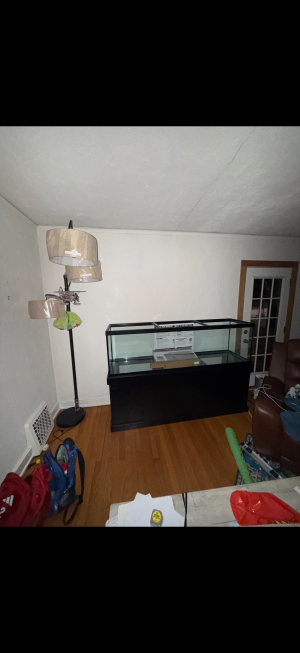
Photo 1 (Living Room):
This shows where the stand and tank frame are currently positioned. The room is messy because I’m still moving things around. I don't use that exterior door btw -- people often confuse it for my main door.
A concern I have here is the proximity of the tank to the supply vent on the left. Right now the tank is against that exterior wall with the door and overlaps the vent’s airflow path by about 6". If I move the tank outward from the wall by 4–6", the tank be pretty much entirely in front of the vent’s airflow. The tank is about 18–24" away from the vent in the current position, so maybe it's not a big blocker to the airflow. I could shift it a bit more to the right without blocking the door. I’m not sure what the best placement is, or if the vent issue is even a significant problem.
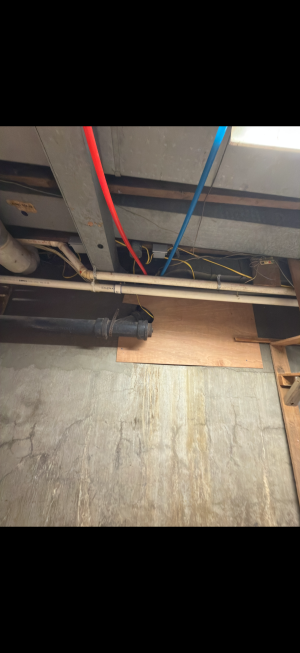
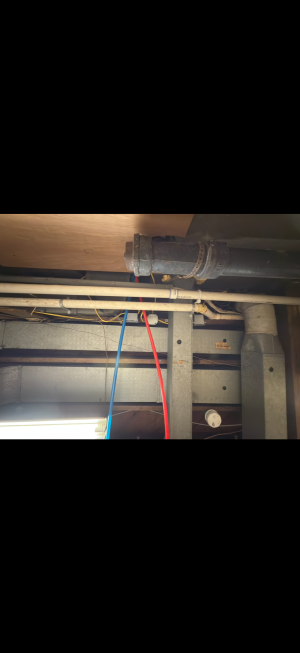
Photos 2 & 3 (Basement under living room):
These show what I believe is the area directly below where the tank is positioned upstairs. One photo is a view of the basement ceiling, and the other shows the foundation wall and joists. You can match the two photos by looking at the blue and red PEX water lines.
I think the two joists shown are the ones that will carry the tank’s load. They’re roughly 15–16" on center. Between them you can see HVAC ductwork, electrical lines, and a PVC run that’s parallel with the joists, but should be straightfowrard to squeeze some supports in there?
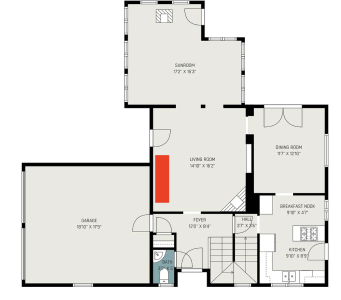
Photo 4 (First floor floorplan):
I'm also attaching my first floor floorplan for reference. I put in red approximately where the tank will sit. The living room is unfortunately a bit of an awkward layout given it has doorways on all 4 sides... and then an angled fireplace.
Awhile ago, I wanted to put the tank along that dining/living room wall on the dining room side. I decided against it because the space under the dining room is completely finished and there's no easy way for me to add structural supports.
Photo 1 (Living Room):
This shows where the stand and tank frame are currently positioned. The room is messy because I’m still moving things around. I don't use that exterior door btw -- people often confuse it for my main door.
A concern I have here is the proximity of the tank to the supply vent on the left. Right now the tank is against that exterior wall with the door and overlaps the vent’s airflow path by about 6". If I move the tank outward from the wall by 4–6", the tank be pretty much entirely in front of the vent’s airflow. The tank is about 18–24" away from the vent in the current position, so maybe it's not a big blocker to the airflow. I could shift it a bit more to the right without blocking the door. I’m not sure what the best placement is, or if the vent issue is even a significant problem.
Photos 2 & 3 (Basement under living room):
These show what I believe is the area directly below where the tank is positioned upstairs. One photo is a view of the basement ceiling, and the other shows the foundation wall and joists. You can match the two photos by looking at the blue and red PEX water lines.
I think the two joists shown are the ones that will carry the tank’s load. They’re roughly 15–16" on center. Between them you can see HVAC ductwork, electrical lines, and a PVC run that’s parallel with the joists, but should be straightfowrard to squeeze some supports in there?
Photo 4 (First floor floorplan):
I'm also attaching my first floor floorplan for reference. I put in red approximately where the tank will sit. The living room is unfortunately a bit of an awkward layout given it has doorways on all 4 sides... and then an angled fireplace.
Awhile ago, I wanted to put the tank along that dining/living room wall on the dining room side. I decided against it because the space under the dining room is completely finished and there's no easy way for me to add structural supports.
Attachments
Ah I see. makes sense.People walking in the room will cause enough vibrations in the floor for it to happen.
For the shims, is it sufficient to just slide it underneath the tank, or should they be glued or fastened to the bottom of the frame?
actually that exterior door might become useful in the future for water changes. I could easily run a hose through that door.Attaching a few photos here.
Photo 1 (Living Room):
This shows where the stand and tank frame are currently positioned. The room is messy because I’m still moving things around. I don't use that exterior door btw -- people often confuse it for my main door.
A concern I have here is the proximity of the tank to the supply vent on the left. Right now the tank is against that exterior wall with the door and overlaps the vent’s airflow path by about 6". If I move the tank outward from the wall by 4–6", the tank be pretty much entirely in front of the vent’s airflow. The tank is about 18–24" away from the vent in the current position, so maybe it's not a big blocker to the airflow. I could shift it a bit more to the right without blocking the door. I’m not sure what the best placement is, or if the vent issue is even a significant problem.
Photos 2 & 3 (Basement under living room):
These show what I believe is the area directly below where the tank is positioned upstairs. One photo is a view of the basement ceiling, and the other shows the foundation wall and joists. You can match the two photos by looking at the blue and red PEX water lines.
I think the two joists shown are the ones that will carry the tank’s load. They’re roughly 15–16" on center. Between them you can see HVAC ductwork, electrical lines, and a PVC run that’s parallel with the joists, but should be straightfowrard to squeeze some supports in there?
Photo 4 (First floor floorplan):
I'm also attaching my first floor floorplan for reference. I put in red approximately where the tank will sit. The living room is unfortunately a bit of an awkward layout given it has doorways on all 4 sides... and then an angled fireplace.
Awhile ago, I wanted to put the tank along that dining/living room wall on the dining room side. I decided against it because the space under the dining room is completely finished and there's no easy way for me to add structural supports.
wvned
Well-known member
Gee that's a lot of stuff in the way. I think you only need to brace 1 joist though. The tank load should be carried by the foundation wall and the next joist over. They should be 16 inches apart. The tank should be about 18 inches wide. Some cross bracing between joists would be good if you could get it in there too.
That is standard construction. In an old house who knows what was built. Got any handyman friends that could take a look at it.
Look especially for improper drilling of the affected joists for utilities like plumbing. Sometimes stupid things have been done and the floor is holding the joist up. It has just never had any real load on it.
You mentioned the floor is sloping downward from the wall now. It probably wasn't built that way.
When you brace a floor you just keep it where it is. Dont try to lift it. That is a very bad idea.
That is standard construction. In an old house who knows what was built. Got any handyman friends that could take a look at it.
Look especially for improper drilling of the affected joists for utilities like plumbing. Sometimes stupid things have been done and the floor is holding the joist up. It has just never had any real load on it.
You mentioned the floor is sloping downward from the wall now. It probably wasn't built that way.
When you brace a floor you just keep it where it is. Dont try to lift it. That is a very bad idea.
Last edited:
Jimbob
Active member
Look especially for improper drilling of the affected joists for utilities like plumbing. Sometimes stupid things have been done and the floor is holding the joist up. It has just never had any real load on it.
You mentioned the floor is sloping downward from the wall now. It probably wasn't built that way.
Some solid advice from wvned here for sure.
In addition to past events where someone might have hacked into a joist to run plumbing or electrical, it is also not unheard of for a joist to simply fail over time as a crack propagates through a knot in the lumber or similar. A small, extending, pocket mirror at a slight angle in combination with a bright flashlight should enable you to thoroughly inspect both of those joists.
Provided the joists are solid, I wouldn't personally be too concerned with the slope aside from ensuring the tank is leveled during set up... I've lived in plenty of old homes myself through my years and while they were all structurally sound, there wasn't a square or level surface in any of them any longer; time had taken its toll.

If memory serves, you do not want to shim between the tank and the stand. You want to shim the stand to make it level and, as a result, the tank will also be level. I've never glued or fastened shims to anything. I slide them under until they're tight and then the weight of the full tank should keep them in place.Ah I see. makes sense.
For the shims, is it sufficient to just slide it underneath the tank, or should they be glued or fastened to the bottom of the frame?
Sorry that was a typo. I meant should I just slide it under the frame without glue/fastening or should I glue/fasten it under the frameIf memory serves, you do not want to shim between the tank and the stand. You want to shim the stand to make it level and, as a result, the tank will also be level. I've never glued or fastened shims to anything. I slide them under until they're tight and then the weight of the full tank should keep them in place.
Yeah I definitely shouldn’t put it between the tank and frame. I think you want the tank and frame to be in the same vertical plane so distribute the load uniformly
Similar threads
- Replies
- 18
- Views
- 6K

- Replies
- 12
- Views
- 2K