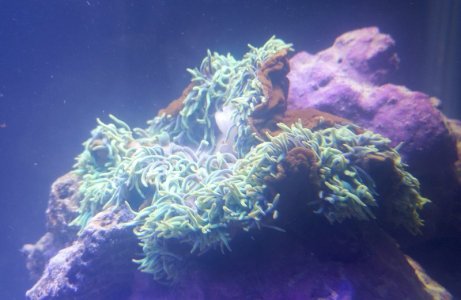
Help! huge investment here. when i returned home from a long day, it had shrunk by at least 75%. This anemone was huge. It was still attached to the rock, but i easily pulled him off and moved him closer to the light. his mouth was open, but has since closed.

You are using an out of date browser. It may not display this or other websites correctly.
You should upgrade or use an alternative browser.
You should upgrade or use an alternative browser.
Is my anemone dying!?
- Thread starter sereneabe
- Start date

D-Nak
Active member
I wouldn't worry too much yet. Anemones do all kinds of weird stuff
Huh? They actually don't normally do weird stuff like this. I would worry.
Mine closes up like that all the time. They deflate a lot
Again, no they do not deflate a lot, if ever, especially when exposed to light. They may deflate to maybe 50% when the lights are out, but rarely during the day. This looks like a full deflation to me.
If it was dying, it would detach by itself and they look like they're melting. Plus, they start losing tentacles. If it "was" still attached and not falling apart, give it some time. Moving it won't help. It will move itself to where it is happy.
And again, no they do not always detach when they are dying. Some will be dead and they will still be attached to the rock. Furthermore, anemones can't move when deflated.
To the OP:
I would remove the anemone immediately and begin treatment. Read the protocol outlined in the sticky here:
http://reefcentral.com/forums/showthread.php?t=2271385
Also, are you sure it's a BTA? As nemmy mentioned, it looks a lot like a sick Ritteri aka magnifica. You said it was a huge investment -- how much did it cost? It may also determine what kind of anemone it is, as BTAs are generally a lot cheaper than magnificas, especially for the color in the photo.
Last edited:
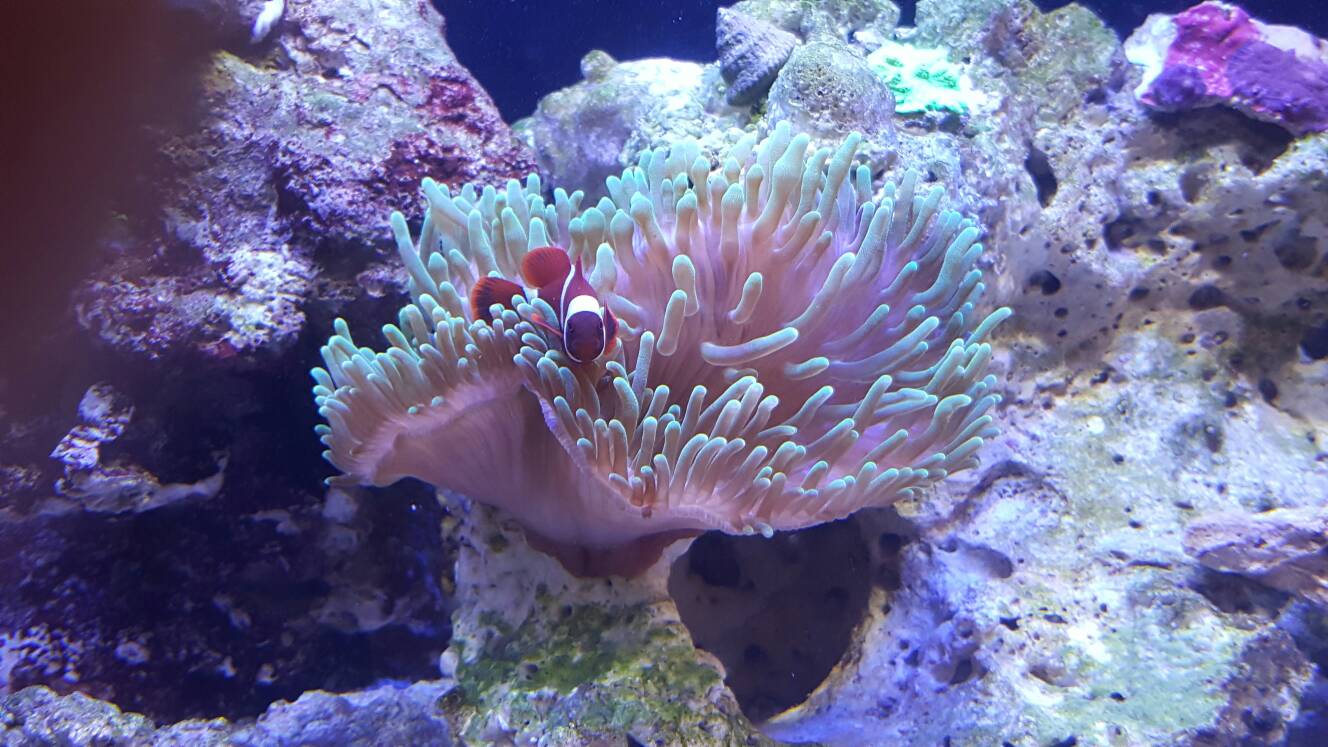
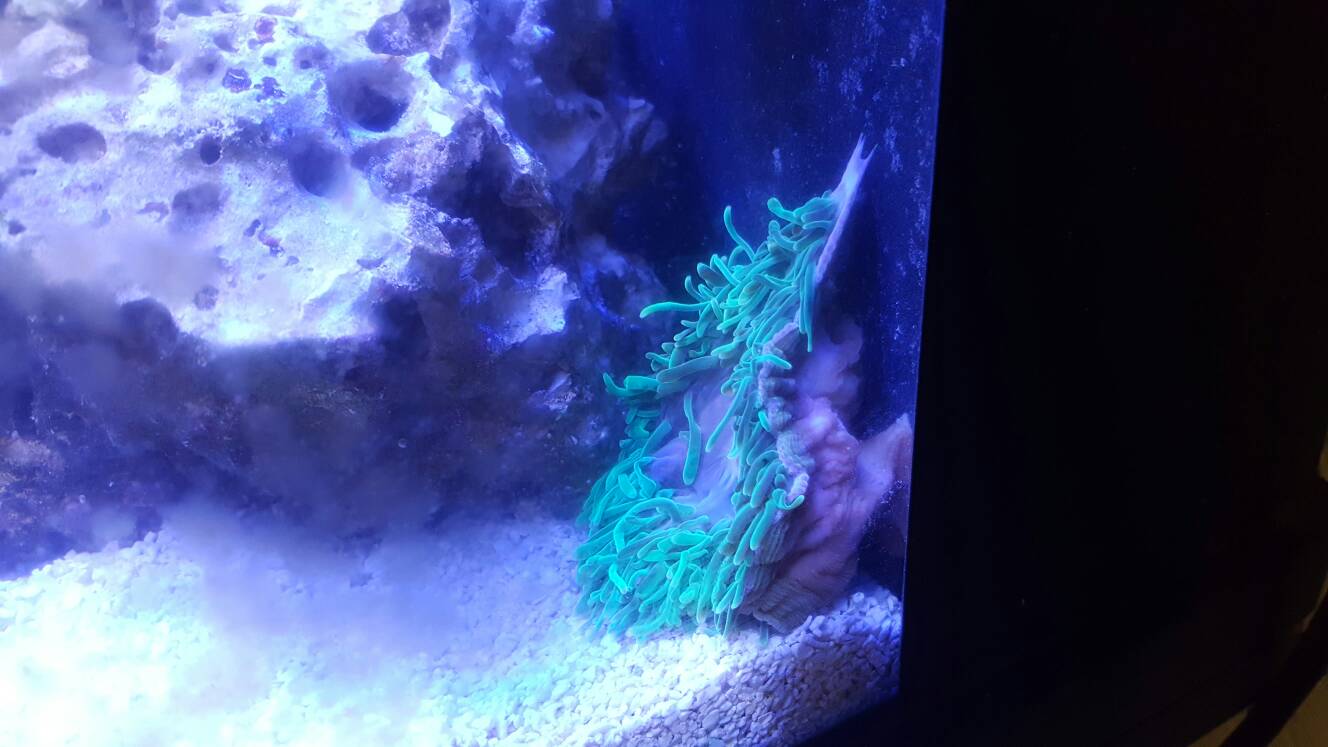
This looks almost exactly like my nem. It deflated like this atleast once a day. I'm no expert by any means. But, I've lived it and my nem has mood swings. Sometimes it's super happy and others I think it's dying. It's just temperamental and I've grown to deal with it. My BTA almost never deflates but, my LTA does often. They both eat and host clowns. When mine first did this, I freaked out. But, after asking a million people and even having a couple of my lfs owners come check it out. Most of them say it happens. Some nems will do it more them others. My nem had its mouth open so wide that the clown was actually going inside it. I thought it was the weirdest thing. But, it would close it's mouth after a while and go back to being happy
I believe the nem in the first picture has about a 50% chance of being a magnifica, mostly because you said it was huge and the color of the pedal column. If it is a BTA it will likely be just fine as it still has its color, tentacle length looks ok and the foot doesn't appear to be sagging. I would also say that pulling him off the rock to move him into more light was the wrong move, this is stressful on the nem and BTA aren't exactly high light nems. Furthermore, deflating would be an atypical symptom of too little lighting when there is no color loss.
Cpike, while your nem exhibits normal behavior in the first picture it is not a fully healthy specimen. The translucence in the oral disc is a sign of bleaching, the striations seen on the oral disc are the inner workings of the nem and would not be seen on a thriving nem. The tips of the nem are also atypical and uneven in length and distribution in a manner that does not appear to be due to flow, this also suggests bleaching as BTA will consume portions of their tentacles in instances where they are unable to obtain enough energy from photosynthesis. However, all that said it is not in bad shape either and likely is on the mend in that picture or had just recently experienced the event that lead to it losing some of it's zooaxnthelle.
As for the second pic, while it is far from being on deaths doorstep, it is not close to being healthy either. BTA "walk" by inflating a part of their foot and deflating the other slowly moving it along behind or by completely detaching puffing up the foot and pulling the tentacles in and floating. In this picture we see a nem that is attempting to attach to a surface and failing. A healthy BTA can attach to a surface within seconds and would keep the oral disc buoyant to aid in attachment. The one in the pic is sagging and has maybe half of the foot attached and in an uneven pattern. It is also attempting to hold on using it's verrucae (bumps seen on under side of nems that aids in orienting the oral disc by attaching to surfaces) which is not a good sign as it indicates it is struggling to keep its foot attached because the foot is weak and it is not trying to move.
Not trying to rip anyone here, just attempting to point out the difference in a BTA that is healthy and one that is not. Survival and recovery are different than a healthy thriving one. To the original poster, if you have a pic of it healthy it would be very beneficial to get a 100% ID because how you proceed will be very different. If it's a BTA you can simply correct whatever issue is causing it to struggle and give it time to recover. If it is a magnifica, it will be dead in a matter of days without treatment and this is not being dramatic it is a documented fact.
Cpike, while your nem exhibits normal behavior in the first picture it is not a fully healthy specimen. The translucence in the oral disc is a sign of bleaching, the striations seen on the oral disc are the inner workings of the nem and would not be seen on a thriving nem. The tips of the nem are also atypical and uneven in length and distribution in a manner that does not appear to be due to flow, this also suggests bleaching as BTA will consume portions of their tentacles in instances where they are unable to obtain enough energy from photosynthesis. However, all that said it is not in bad shape either and likely is on the mend in that picture or had just recently experienced the event that lead to it losing some of it's zooaxnthelle.
As for the second pic, while it is far from being on deaths doorstep, it is not close to being healthy either. BTA "walk" by inflating a part of their foot and deflating the other slowly moving it along behind or by completely detaching puffing up the foot and pulling the tentacles in and floating. In this picture we see a nem that is attempting to attach to a surface and failing. A healthy BTA can attach to a surface within seconds and would keep the oral disc buoyant to aid in attachment. The one in the pic is sagging and has maybe half of the foot attached and in an uneven pattern. It is also attempting to hold on using it's verrucae (bumps seen on under side of nems that aids in orienting the oral disc by attaching to surfaces) which is not a good sign as it indicates it is struggling to keep its foot attached because the foot is weak and it is not trying to move.
Not trying to rip anyone here, just attempting to point out the difference in a BTA that is healthy and one that is not. Survival and recovery are different than a healthy thriving one. To the original poster, if you have a pic of it healthy it would be very beneficial to get a 100% ID because how you proceed will be very different. If it's a BTA you can simply correct whatever issue is causing it to struggle and give it time to recover. If it is a magnifica, it will be dead in a matter of days without treatment and this is not being dramatic it is a documented fact.


