Lights - Nutrients

Vannpytt

New member
I've got a question witch I recon is best asked in the "Advanced Topics", even if it's coral related in nature.

I often read the concept of "Too much light leads to bleaching, too little light leads to browning", however, I also read about the concept of "Too high nutrient levels leads to browning and too little nutrients leads to bleaching.".

My question is, are these related? Is there any science as to where the equilibrium lies? In the ocean, corals grow faster than in our aquariums with more light and more "DOC".

If you have a tank with normal light, high nutrients and brown corals; -would more light make the corals show more color? In a tank with too little nutrients and normal light, would reducing the light help?

Also, I often read "There should be .5-2 N and ~0.08 P". The optimal value is 0, as it would indicate balance in the import/export(consumption). I also see lots of these aquariums with imbalance (measurable inorganic nutrients) without algae, and then see tanks with 0 nutrients measurable and lots of algae. Granted these algae mask the real nutrient levels, or "flow of nutrients" witch are a more correct term, however, how can you stop the flow if the algae is consuming it? For instance, if you have rocks leeching P, how would you cure it, bar doing blackouts with regular intervals?

Lots of questions, but I'm sure someone thought about this before.
 
I often read the concept of "Too much light leads to bleaching, too little light leads to browning", however, I also read about the concept of "Too high nutrient levels leads to browning and too little nutrients leads to bleaching.".

I'll give this a try for you and let any of the experts on here point out any flaws.

I think you are getting tripped up with the terms.

''Too much light leads to bleaching': 'Bleaching' is use to describe the appearance of a coral that has expelled most or all of it's symbiotic zooanthellae. There can be many causes for this, but the primary ones we are most familiar with are too much heat and/or light.

'Too little nutrients leads to bleaching': The more correct term would be 'fading' or 'pastel' instead of 'bleaching'. In a basic sense, the coral is unable to maintain or produce sufficient chemo-proteins for pigmentation.

'Too little light and/or too many nutrients leads to browning': 'Browning' is basically an over-abundance of zooanthellae (they are predominately brown colored dinoflagelates).

Any organism, such as coral, has to at least have sufficient energy to drive it's metabolism and hopefully maintain body mass, but optimally, it should have enough to grow and reproduce. 'Photosynthetic' corals have the ability to obtain this energy in a variety of ways, but to simplify we can say either through 'photosynthesis' or through 'feeding'. If a coral is satisfying much of its energy needs through optimal lighting (for that species), then it's need for feeding is reduced (but not eliminated!) and the number of zooanthellae for photsynthesis is reduced. Visa-versa, if a coral is in lower light conditions then it will try to feed more to compensate for the lack of light and increase its zooanthellae population in an attempt to get more photosythesis by-products (glucose, amino acids, etc.)

My question is, are these related? Is there any science as to where the equilibrium lies? In the ocean, corals grow faster than in our aquariums with more light and more "DOC".

I would be careful with generalizations. There are SPS dominated tanks that can grow coral as quickly (or quicker) than in nature. The 'science' is somewhat of an 'art' to get all the conditions 'just right' for a particular species. Corals in nature do have access to a greater variety and volume of food than we can supply, but luckily they can adapt to varying conditions as long as they can obtain sufficient energy.

If you have a tank with normal light, high nutrients and brown corals; -would more light make the corals show more color? In a tank with too little nutrients and normal light, would reducing the light help?

More light (up to a point) has been shown to stimulate production of chem-proteins to enhance what we call pigmentation. However, high nutrient levels in addition to high light would lead to an over abundance of zooanthellae and their photosynthetic by-products which can negatively effect corals in various ways. Corals will attempt to regulate the zooanthellae by eliminated some (mild bleaching) or all (severe bleaching).

Also, I often read "There should be .5-2 N and ~0.08 P". The optimal value is 0, as it would indicate balance in the import/export(consumption). I also see lots of these aquariums with imbalance (measurable inorganic nutrients) without algae, and then see tanks with 0 nutrients measurable and lots of algae. Granted these algae mask the real nutrient levels, or "flow of nutrients" witch are a more correct term, however, how can you stop the flow if the algae is consuming it? For instance, if you have rocks leeching P, how would you cure it, bar doing blackouts with regular intervals?

Now you are getting into 'murky waters', especially with phosphate. One thing to remember is that phosphate comes in many different forms ('species') and our test kits are limited to only reading inorganic phosphate. There is a lot more detail concerning phosphate, but on a practical level a balanced system is one where phosphates, in any of it's forms, is present at very low concentration (along with nitrate) that don't continuously rise over time. Corals on a coral reef are adapted to this type of water condition and obtain most of their phosphate from the foods that they consume. Since we can't feed as much food as what a coral would receive on the reef, many aquarists have found that slightly elevated nitrate and phosphate levels in aquaria can be beneficial.

Hope that helps a bit :)
 
Last edited:
I also see lots of these aquariums with imbalance (measurable inorganic nutrients) without algae, and then see tanks with 0 nutrients measurable and lots of algae. Granted these algae mask the real nutrient levels, or "flow of nutrients" witch are a more correct term, however, how can you stop the flow if the algae is consuming it? For instance, if you have rocks leeching P, how would you cure it, bar doing blackouts with regular intervals?

This bears some further elaboration. Concentrating on the main nutrient 'culprit', the flow and ebb of phosphate in its various forms is inevitable in a reef tank. Phosphate liberation from calcareous substrates via biological processes (bacterial and benthic algae) is one way, but indications are it's not typically a large amount. Of much more imporatance, I believe, is the consumption of animal (food inputs, mostly) and algae via carnivorous, omnivorous and herbivorous species' activities which then concentrate much of the phosphate into the fecal pellets (no creature I know of uses 100% of the phosphate it consumes and many are much less efficient at utilizing it). If the fecal pellets remain in the system they will be broken down via biological processes (a good part of the 'detritus' we all know and love) and the phosphate will then reenter the ecosystem. Since food input is typically daily and contains the largest amount of phosphate entering a tank, it's clear to see that phosphate will eventually build up over time if no steps are taken to reduce it.

In closing, phosphate reduction can be accomplished in a number of ways. I use regular detritus removal with each water change as my sole method to maintain '0' PO4 and '0' NO3 (Salifert), even with (15) year old LR and LS. Others use phosphate removal media without touching the SB, but I find this an uphill battle (and expensive) since one is always chasing the phosphate 'after the fact' instead of removing the main source upfront. Water changes alone can help remove some phosphate from the water column, but this is typically an insignificant amount compared to the total phosphate in the system. Regular harvesting of macro algae in a 'fuge is yet another way to try and control excess PO4.
 
Last edited:
Very helpful, and what I was aiming for; -getting some clarity into all these terms. I previously suggested making a troubleshooting matrix and these are the most usual and probably misunderstood, at least by me, aspects of the hobby. I understand there are many more variables.

What is "best" as a phosphate sink in a reeftank? Would you recommend a system for removing detrius as a preventive measure along with a refugium, or would GFO or similar be better? Skimming is obviously a factor, but for it to work, one would need to keep it suspended until it reaches a coral or the skimmer. Letting it break down is probably harder to correct than just removing it before it does.

Could the water be too clean?
 
Very helpful, and what I was aiming for; -getting some clarity into all these terms. I previously suggested making a troubleshooting matrix and these are the most usual and probably misunderstood, at least by me, aspects of the hobby. I understand there are many more variables.

Nice idea, but as you mentioned there are so many variables. That's what keeps the hobby so interesting :)

What is "best" as a phosphate sink in a reeftank? Would you recommend a system for removing detrius as a preventive measure along with a refugium, or would GFO or similar be better? Skimming is obviously a factor, but for it to work, one would need to keep it suspended until it reaches a coral or the skimmer. Letting it break down is probably harder to correct than just removing it before it does.

Could the water be too clean?

I'm very cautious when it comes to recommending 'what is best' since there are quite a few different ways to handle excess nutrients. Also, there are many different sizes and types of tanks with varying needs.

My current tank is a 5 year old mixed reef 12g AIO Nano tank that I set up with small pieces of LR and some LS from my previous 50g of 10 years. What has worked best for me is weekly vacuuming of the SB along with the WC and 2-3x/wk blasting of the LR with a Turkey Baster. I also clear out detritus from my tank's back compartments monthly and vacuum under the LR every 6 months or so. I do not use any chemical or mechanical filtration whatsoever and I don't have a skimmer or a 'fuge. I guess you could say I run a 'natural' system in the spirit of the late Lee Eng, but with modern water movement (instead of an airstone) and Kalkwasser supplementation made popular by the late Peter Wilkens via the 'Berlin' method way back when. Water changes take care of supplementing everything else.

Good that you mentioned feeding since I feel this is one of the most confused topics in reefing. The old school thought was to feed your tank as little as possible to try and keep nitrate and phosphate under control. Later on it was realized that corals need to feed in one way or another and keeping the food inputs very low leads to eventual coral starvation. With the knowledge of how to deal with excess phosphate, feeding of corals with either more fish (adding waste products which corals consume) and/or direct food inputs for them into the tank has thankfully become more widespread.

I have two adult Ocellaris clowns along with a medium bioload of mixed corals (SPS, LPS, Ricordia, Zoanthids, etc.). I feed the fish well 4-5x/day and feed the corals directly once a week. Even with this amount of food in only 10g of water volume, I have very little algae. I attribute this mainly to full coralline cover on the LRs (algae has difficulty growing on these surfaces), active herbivors and low nutrients due to regular detritus removal.
 
In addition to Nano's explanantions there is also the issue of different specimans of teh same species of coral adapting to different conditions so the criteria that will cause them to bleach are different even if they are utilizing the same Symbodinium species zoxanthellae. http://www.mendeley.com/catalog/experience-shapes-susceptibility-reef-coral-bleaching-3/

With regards to skimming and phosphate removal skimming itself does not remove phosphate directly. Phosphate needs to be bound up with something that has hydrophobic qualities which the skimmer will then remove.

A point I will disagree with Nano is bleaching. Bleaching is solely the loss of a corals brown symbionts which can leave the coral with some very attractive pastel coloration from the remaining fluorescing and chromo proteins. There certainly may be a complete loss of color but corals can retain their coloring proteins giving them some spectacular colors. Here's an interesting quote from Charles Delbeek "When I see the colors of some of these low nutrient tanks, I can't help but be reminded of bleached coral reefs." Coral pg 127

Now to help complicate the issue of coloration even more is the research showing brighter colors as a response to environmental stress: http://www.nature.com/srep/2013/130312/srep01421/fig_tab/srep01421_F1.html

And most certainly aquariums can be too clean. Phosphates and nitrates are limiting nutrients for corals and their symbionts. Corals also actively remove ammonium from the water so I conisder them part of the filtration in a system and in some systems they may be the most significant part. Here's some links for more reading:

http://www.mendeley.com/research/ef...ake-zooxanthella-content-tissue-regeneration/
http://www.mendeley.com/research/hi...ts-scleractinian-coral-stylophora-pistillata/
http://www.mendeley.com/catalog/nitrate-uptake-scleractinian-coral-stylophora-pistillata/

I also have seen a complete disconnect between the phosphate and nitrate readings in a system and nuisance algae in systems. And in systems where there is a problem I have found increased water changes with physical removal to be adequate most of the time for remediation. I have not found total darkness to be a viable long term solution.
 
A point I will disagree with Nano is bleaching. Bleaching is solely the loss of a corals brown symbionts which can leave the coral with some very attractive pastel coloration from the remaining fluorescing and chromo proteins. There certainly may be a complete loss of color but corals can retain their coloring proteins giving them some spectacular colors. Here's an interesting quote from Charles Delbeek "When I see the colors of some of these low nutrient tanks, I can't help but be reminded of bleached coral reefs." Coral pg 127

To clarify:

I mentioned that 'bleaching' is a condition caused by the partial or complete loss off zooanthellae. The coral's pigments can still be there, but without the underlying zooanthellae pigmentation this leads to either 'pastel' or 'white' colored corals (depending on the severity of the bleaching event).

This is a different condition to what is sometimes seen in ULN systems (Zeovit and others) without sufficient nutritional supplementation. Here we see 'Pale' or 'Pastel' coloration because the coral isn't receiving enough nutrients to produce full pigmentation and it also can't support an optimal number of zoanthellae since it has very few nutrients available (carbon from prey capture, mostly) to spare to pass to the zooanthellae.

Both conditions involve a reduction in the number of zooanthellae and their loss alone will make a coral look 'pale' or 'pastel' to one degree or another.

This is a good example of the nuances that abound in this hobby :)
 
. . . ''Too much light leads to bleaching': 'Bleaching' is use to describe the appearance of a coral that has expelled most or all of it's symbiotic zooanthellae. There can be many causes for this, but the primary ones we are most familiar with are too much heat and/or light. . .

I owe you an apology Nano! I totally missed this when I read through your post and would not have said what I said if I had!
 
About a refugium

About a refugium

Would it be correct to assume that a refugium would be less efficient than GFO or any other phosphate absorber, including bacteria if you run high intensity LEDs (for instance) in the display tank?

In my experience, having high lights in my tank and running a scrubber would make the algae in the display more efficient in taking the nutrients directly before the refugium/scrubber ever gets to them, thus making it harder to export (more of a PITA) out of the system.

Will this result in less food for the corals? (Algae produces vitamins and is breeding ground for coral food)

Will they have too much light, even if the algae can grow under it?

Who wins a nutrient fight; -a coral or an algae?

I'm trying to figure out if I want to add a refugium to my system. So far, Aluminum based phosphate absorber is doing wonders along with reducing display lights and I really don't want to waste energy and add heat with a refugium under my display.

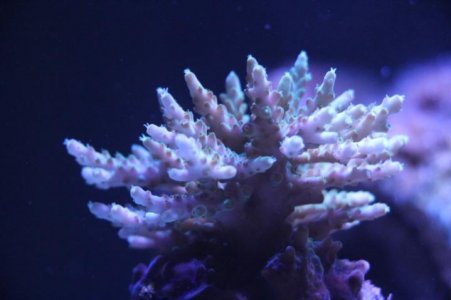
Washed out, lacking a deep color, lights or nutrients?

IMG_1570.jpg
 
Would it be correct to assume that a refugium would be less efficient than GFO or any other phosphate absorber, including bacteria if you run high intensity LEDs (for instance) in the display tank?

In my experience, having high lights in my tank and running a scrubber would make the algae in the display more efficient in taking the nutrients directly before the refugium/scrubber ever gets to them, thus making it harder to export (more of a PITA) out of the system.

Will this result in less food for the corals? (Algae produces vitamins and is breeding ground for coral food)

Will they have too much light, even if the algae can grow under it?

Who wins a nutrient fight; -a coral or an algae?

I'm trying to figure out if I want to add a refugium to my system. So far, Aluminum based phosphate absorber is doing wonders along with reducing display lights and I really don't want to waste energy and add heat with a refugium under my display.

Washed out, lacking a deep color, lights or nutrients?

View attachment 237821

Wow, lots of questions! :)

I consider a refugium as a personal choice item since a successful tank can be run with or without one. It does add additional complexity and must be maintained properly.

I have had no personal experience with algae scrubbers. I use detritus removal to control phosphate, so all these other methods of phosphate removal, while interesting, are not my specialty.

Using algae to remove phosphate has a 'lower limit' since the algae do need phosphate at a minimum level to survive. I have never needed to use GFO, but I believe that it has no lower limit to phosphate removal.

In higher nutrient waters algae will 'win'. In very low nutrient waters corals have a better chance to succeed.

And lastly, you could try increasing your feeding a bit to see if the coral colors up.
 

Similar threads

Back
Top