Liquid cooled LEDs light fixture

  • Thread starter Thread starter MK
  • Start date Start date
The other thing to consider is that, as i understand the pictures you are cooling these in series, so your lase set of LED's wont have heat moved as efficiently as the first few. You may want to plumb the tubes in parallel. This would also allow you the ability to remove a beam if it starts to fail. On the plus side, it would also allow you to plumb the pipes together in space not directly above your tank.

Just a thought... :) interesting none the less!

well, yes that's right but I'm not really worry about that because the pump has flow 500 liters per hour I'm using only two liters of fluid... :)
Like I said i gonna install three temperature probes to see the difference on the front and end.

Regards,
mark
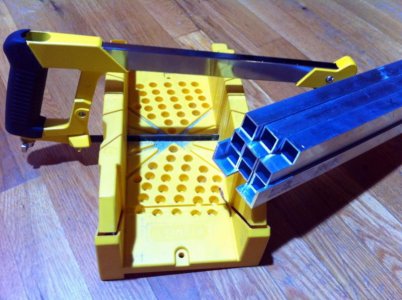
 
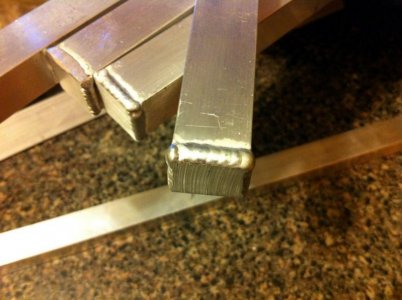
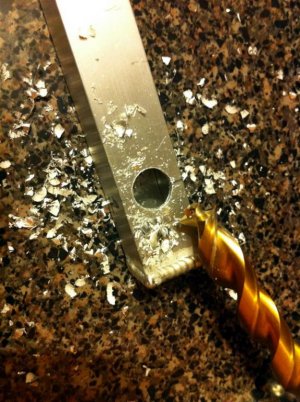
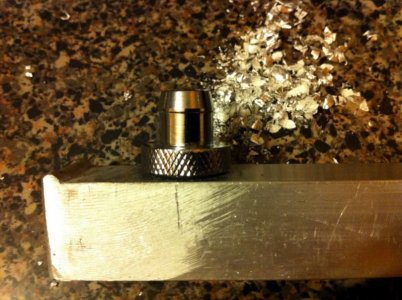
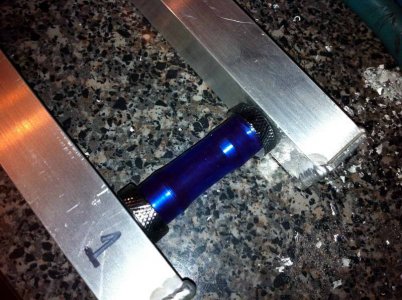
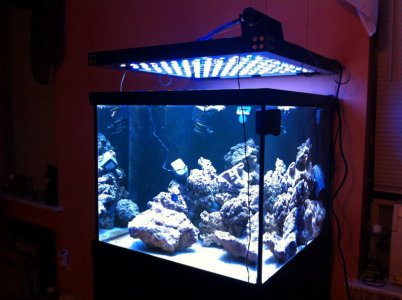
Here are few pics as I promised...
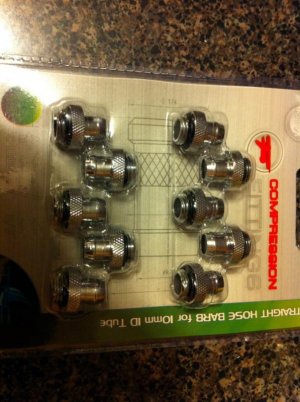
To avoid any leaks each pipe has welded cap before was attached to the angle aluminum support. I drilled holes and maked treads for 3/8' hose barbs.
 

Attachments

  • Picture 1.jpg
    Picture 1.jpg
    70.8 KB · Views: 14
  • Picture 2.jpg
    Picture 2.jpg
    58.1 KB · Views: 17
  • Picture 3.jpg
    Picture 3.jpg
    92.7 KB · Views: 16
  • Picture 4.jpg
    Picture 4.jpg
    104.3 KB · Views: 18
  • Picture 5.jpg
    Picture 5.jpg
    80.5 KB · Views: 15
I can't drill any holes to attach LED's to the aluminum pieces the best alternative was to get awesome thermal adhesive tape, I really like this idea it's preety quick. LINK
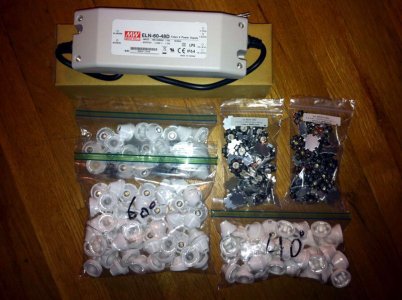
As you can see on the pic I used Mean Well drivers ELN-60-48D (8 pc)...
 

Attachments

  • Picture 6.jpg
    Picture 6.jpg
    89.3 KB · Views: 14
  • Picture 7.jpg
    Picture 7.jpg
    74 KB · Views: 14
  • Picture 8.jpg
    Picture 8.jpg
    94.6 KB · Views: 17
  • Picture 9.jpg
    Picture 9.jpg
    82.7 KB · Views: 15
  • Picture 10.jpg
    Picture 10.jpg
    82.2 KB · Views: 17
you should make ur own coolant and then dye it.. saves you a lot of money that what i do for my pc, and what thermal paste are you going to use for the water cooling blocks?

and what rad are you going to run in the loop? better yet what kinda water loop are you going to get
 
Assuming that PG in the data above has been abbreviated from propylene glycol, rather than polyethylene glycol, at a 50% polypropylene concentration, if we have a 15% decrease in heat capacity, but it is 800% the viscosity of water, then there is in fact very large disparity in the way these two properties of the solution have been affected by the addition of propylene glycol.

In short, I am well versed in the subject matter and the properties of the coolants being discussed here as well as the physics. I chose to use PG instead of PE in the example because it is a bit more viscous and has a bit less thermal capacity. A slightly worse case, if you will.

To be kind but pointed, you are steering this conversation in a somewhat pointless direction. If you honestly want to discuss how a "coolant" affects a cooling system, we can certainly develop the conversation and add equations and calculations to draw meaningful conclusions without guessing or assuming. This is a hard science where no guesswork is needed.

The initial point was simple. "coolant" is not as efficient at heat transfer as distilled water. The point was made based on a comment by the OP. The intent was not to quantify how less efficient a given coolant was.

In any case, simply saying that a given solution is 800% more viscous than water is meaningless without relevant context. If you adjust a pump curve for the properties of the fluids in question, you will see that even the 50% aqueous PG solution barely reduces the flow of a typical centrifugal pump.

For example: A centrifugal pump at 6' of head pumping 10 GPM of water (1 cP) would pump 9.8 GPM with at 6' of head with a 5 cP fluid.

So repeating: The effect of the viscosity (in the case of PG or EG) on the system's capacity is about the same magnitude as the thermal capacity of the fluid. It follows that if the drop in thermal capacity is not a big deal (as you contend) then the slightly more viscous fluid is not a bid deal either.
 
Last edited:
I completly don't understand but is very interesting :)
And helpful for somebody who know what's going on.
 
I completly don't understand but is very interesting :)
And helpful for somebody who know what's going on.


Not much to understand, as long as your system is working as expected :)

You have the luxury of increasing the radiator and/or pump size if the system can not keep up with the heat produced by the leds.
 
Not much to understand, as long as your system is working as expected :)

You have the luxury of increasing the radiator and/or pump size if the system can not keep up with the heat produced by the leds.

I can't say anything better than you just said ! :)
 
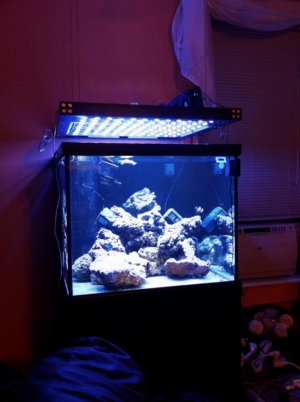
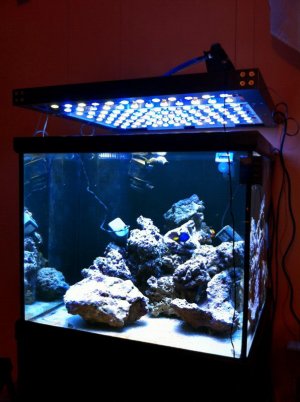
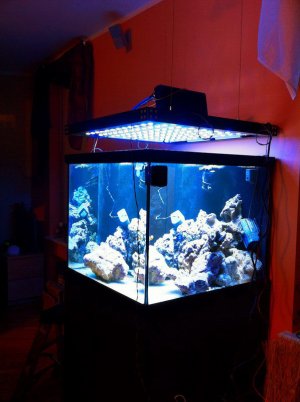
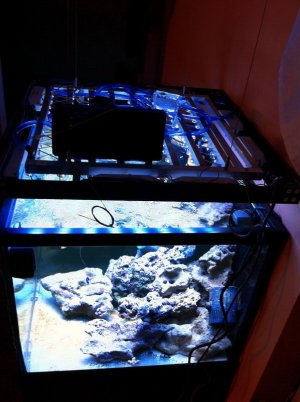
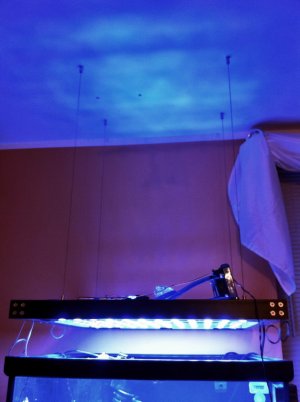
I recently sold my SLR camera... my wife cameras memory card is full and i can't delete any pic of course :lol2: cause she gonna kill me and have no choice than iphone to get some pics...
I know the quality is not good but it's everythink i can do now.
Is hard to see but both white and blue leds are running at 65% right now, in my opinion light is to much blue if ill connected back apex i have to lowwer blue about 15-20% and see what gonna happen.
Please forgive me mess and cables sticking out all around but project is still running and i gonna take care of it soon ;)
 

Attachments

  • Picture 1.jpg
    Picture 1.jpg
    93.7 KB · Views: 14
  • Picture 2.jpg
    Picture 2.jpg
    46.6 KB · Views: 19
  • Picture 3.jpg
    Picture 3.jpg
    55.9 KB · Views: 17
  • Picture 4.jpg
    Picture 4.jpg
    90.6 KB · Views: 18
  • Picture 5.jpg
    Picture 5.jpg
    47.2 KB · Views: 23
Three pics more...
 

Attachments

  • Picture 6.jpg
    Picture 6.jpg
    101.3 KB · Views: 21
  • Picture 7.jpg
    Picture 7.jpg
    98.4 KB · Views: 20
  • Picture 8.jpg
    Picture 8.jpg
    100.8 KB · Views: 17
honestly i like this idea.. nicely thought out.. but really leds dont need that much colling i wouldnt think.. but is there was a way where you could make it run thru the sump taking away the heat from the water to heat the water would be even better... that way you run your heater less also.. dunno how u could safely do that thou..
 
Nice idea. I thought about this too but after testing LEDs I figured out they don't need much cooling with a heatsink and just went that way.
 
Where does this come from? Could you link some reading material?

It was calculated...

It is pumps 101 as viscocity correction is part of any pump sizing calc. Any pump text will provide fairly detailed viscovity correction information. The viscocity of a fluid affects the properties of a pump (be it centrifugual, postive displacement, or other) in a fairly predictable and cacluable manner.

The Hydraulic Institute (and others) publish complex charts that show viscocity cxorrection curves, but they are a ***** to read if you don't know what you are looking at.
visc-corr10-100gpm_med.gif

visc-corr100-10000gpm_med.gif


Most pump engineering sites have calculators that will save you the hassle of doing hte math or reading the charts. You should be able to find more links than you know what to do with using google :)
 
Nice idea. I thought about this too but after testing LEDs I figured out they don't need much cooling with a heatsink and just went that way.

What you mean they don't need much cooling?
How you tested it? Maybe I don't know how to mix coolant but I know what is LED and what is optimum work temperature for them...
Critical temp. Is 185*F, optimum work temp is 68*F
White led life working in 150*F gonna be 4 times shorter than the same led working in 68*...
 
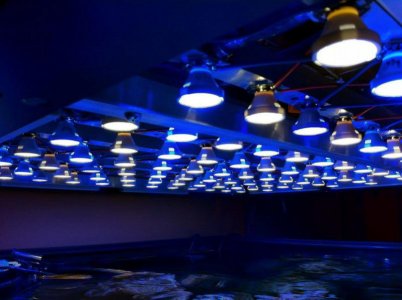
Wow, MK. That's a LOT of LEDs for that tank! What kind of LEDs are you using?

CJ

Hehehe yea maybe I have a littlebit to much, but I can always ramp them down to let say 60-70% :)
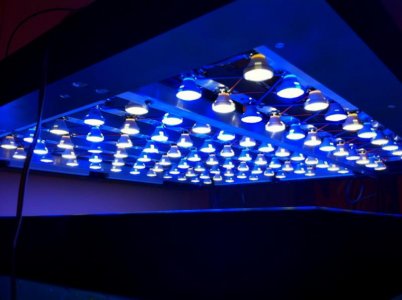
I'm using 48 luxeon white 3W 6000K and 48 luxeon blue 470nm 3W LEDs
I want to replace 6 or maybe more blue LEDs for red ones and see what gonna happen...

Regards,
mark
 
Back
Top