Marinepure bio blocks

For successful denitrification at higher rate you need to ensure these:-

1) Low dissolved or possibly none for denitrifying bacteria to do its job
2) Absent of lights where your blocks are placed
3) Very low flow, roughly 1% - 5% of total water volume

I tried all possible method and I found out as long as the above are in place, your rocks will function as intended to.
 
For successful denitrification at higher rate you need to ensure these:-

1) Low dissolved oxygen or possibly none for denitrifying bacteria to do its job
2) Absent of lights where your blocks are placed
3) Very low flow, roughly 1% - 5% of total water volume

I tried all possible method and I found out as long as the above are in place, your rocks will function as intended to.

Edited: forgot to add oxygen :D
 
Anyone ever try cutting them and lining the bottom of a tank with them? Possibly do a layer of 1" thick blocks then cover it with 1" or so of sand?
 
Anyone ever try cutting them and lining the bottom of a tank with them? Possibly do a layer of 1" thick blocks then cover it with 1" or so of sand?

I think you can do that as well, that's more or less like a deep sand bed setup. There is a reason why they manufacture the block to a certain thickness, so that denitrifying bacteria will live deep inside the pores where oxygen in low and absent of light. If you can increase these condition, the process will be much faster.
 
I plan on using these in my sump because they will take up less space then rocks. Going for the minimalist look in the DT. I don't expect any miracle from them. I think they will work just like rock. I could see stuff getting trapped if you don't place the blocks in a high flow area or something.
 
I am a fan of marine pure... have had the 8x8x4 block in my sump for about nine months now. I was battling high NO3 and discovered my bio balls to be a nitrate factory, so I removed them and placed the one brick in my non-lit sump in an area with low flow. I went from "always red" nitrates to almost undetectable within a couple months.

Like was mentioned before, I look at the marine pure block as just a super efficient LR replacement... I am sure that you might/could find some LR that is almost as good as the marine pure blocks, but in the sump, it doesn't need to look like LR. :)

(And I disagree with whoever said that it might become a nitrate factory... only way I see that happening, is maybe if someone were to use the marine pure balls without a filter sock, and get a bunch of detritus build up stuck between them and never rinse them...don't really see that being an issue with the blocks though)
 
Like was mentioned before, I look at the marine pure block as just a super efficient LR replacement... I am sure that you might/could find some LR that is almost as good as the marine pure blocks, but in the sump, it doesn't need to look like LR. :)

That is all it comes down to. People used bio balls or LR rubble before, this stuff is just a modern take on what people were trying to do previously. Much more efficient due to the super porous nature of the media and also has the possibility of nitrate removal which is a plus.

I just set up my tank and wish I had known about it a few weeks ago, would have put a few sheets under my sand bed =).
 
I am a fan of marine pure... have had the 8x8x4 block in my sump for about nine months now. I was battling high NO3 and discovered my bio balls to be a nitrate factory, so I removed them and placed the one brick in my non-lit sump in an area with low flow. I went from "always red" nitrates to almost undetectable within a couple months.

Like was mentioned before, I look at the marine pure block as just a super efficient LR replacement... I am sure that you might/could find some LR that is almost as good as the marine pure blocks, but in the sump, it doesn't need to look like LR. :)

(And I disagree with whoever said that it might become a nitrate factory... only way I see that happening, is maybe if someone were to use the marine pure balls without a filter sock, and get a bunch of detritus build up stuck between them and never rinse them...don't really see that being an issue with the blocks though)


As i mentioned before, the keys to successful denitrification will be low flow and if possible oxygen free water and absent of light.
 
Aren't these things designed to be live rock? Is there really something I could bypass or gain by going with this route as opposed to live rock? (all other things being equal) A new toy perhaps? KISS. ;)

Btw I apologize for not reading through the entire thread, but don't try and complicate something that is so easy IME. Don't forget, under the right conditions the WALLS of the tank/bucket/wine barrel etc can support the inhabitants sometimes... This bacteria doesn't discriminate. ;)
 
Last edited:
You are increasing the capacity of your tank to have bacteria.

A 1 inch cube of this stuff has significantly more surface area, thus more bacteria capacity, than a 1 inch cube of traditional fiji (etc) rock.

So, with space for rock being the constraint, this helps increase capacity in a tank.
 
You gain space by using this vs rock in the sump. To me that is the main advantage. Not all of us have a big sump or room for a container to put rock in.
 
Has anyone experienced this with their marinepure block...

in the past two weeks (after being in the sump for 6 months) my block is producing a lot of bubbles...

http://i1074.photobucket.com/albums/w417/Tom0688/WP_20160830_027_zpsoms3bsti.jpg[IMG]

Im hoping this is nitrogen from denitrification.
 
Could be nitrogen gas as denitrification byproduct. I don't use marine block but my denitrator does produce nitrogen gases.
 
Has anyone experienced this with their marinepure block...

Im hoping this is nitrogen from denitrification.

After nine months in my sump, I have never seen my block do that...you seem to also have some film algae growing on the block? I don't have any of that on my block either...

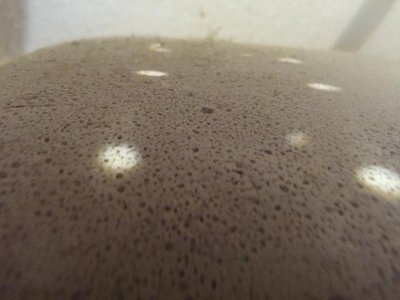
Just took this pic of the surface of my block. :)
 

Attachments

  • image.jpg
    image.jpg
    40.1 KB · Views: 3
Last edited:
I was going to reference the brs YouTube series video about this product. It's super porous, and has a very high surface area. Meaning it's ideal for biological filtration but the key would be to find an area with low flow so that it can be anaerobic. A second benefit to this is that it can early be placed in a sumo and pulled out from time to time to rinse of with old tank water. It's so porous I believe you can take a water hose and run the water straight through it.


Sent from my iPhone using Tapatalk
 
Back
Top