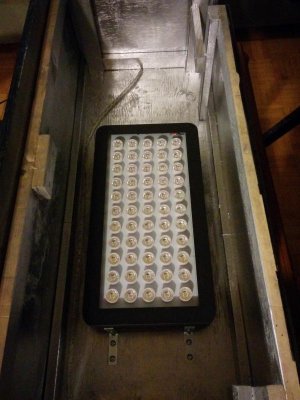
Metallic paint inside canopy

syntax_error

New member
Hi everyone,

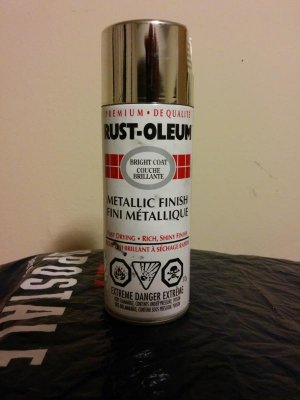
I sprayed Rust-Oleum metallic spray paint inside my canopy hoping to get maximum light reflection but I am now having second thoughts about it. Would it affect the water somehow. or have any other bad effects?

Thanks!
 

Attachments

  • 2014-06-30 00.11.44.jpg
    2014-06-30 00.11.44.jpg
    43.5 KB · Views: 6
  • 2014-06-30 00.10.58.jpg
    2014-06-30 00.10.58.jpg
    59 KB · Views: 4
Once its dry properly and as long as it doesn't flake off into the water, I don't see how it could hurt.
 
That metallic finish isn't going to give you reflectivity that you are looking for... I would look for some high polished aluminum
 
That metallic finish isn't going to give you reflectivity that you are looking for... I would look for some high polished aluminum

Having gone down this road (on a semi-intellectual level) I've come to the conclusion that high reflectance white paints are the best choice..

Aluminum and particularly stainless steel "absorbs" some wavelengths to a certain degree..and of course high polish has specular reflectance.

http://www.edmundoptics.com/testing...ndards/pre-mix-white-reflectance-coating/1325

Now cost is another matter.. but white barium based paints seem arguably the best.....

http://upload.wikimedia.org/wikiped...ectance.png/400px-Image-Metal-reflectance.png
Aluminum
400px-Image-Metal-reflectance.png

White barium paint
Avian-B.jpg


"blurb"............
Pro-Lite's range of barium sulphate (BaSO4) coatings are scientific-grade paints that exhibit near-perfect diffuse reflectance at levels up to 98% in the 250-2500nm (UV-VIS-NIR) wavelength range.
Available as an affordable water-based formulation or as an ethanol solution or ethanol pre-mix, barium sulphate is used to coat integrating spheres, lamp housings, backlight reflectors
and laser pumping chambers, in fact anywhere where you need efficient, uniform illumination.

Commonly referred to as "integrating sphere paint", our barium sulphate coatings can be used on almost any substrate material (glass, plastics, metal, wood)
and are best applied by spray painting (airless spray gun).

Interesting alternative:
http://www2.dupont.com/Diffuse_Ligh...s/downloads/NOW801_DLR_Sell_Sheet_me05-21.pdf
 
Last edited:
Hi - a coatings chemist here.

I wouldn't use the Rust-Oleum metallic - it's not really designed for anti-corrosion and I wouldn't trust it around the heat and humid environment of a light fixture.

Barium sulfate: it's just used as a cheap filler. I put it in formulations every day to drop the cost. It's actually kind of a dirty cream color by itself. "Barium sulfate" based paints are not as good as paints with a high titanium dioxide content, which you're gonna pay money for. TiO2 is the brilliant white pigment in use today. Translated, the few extra bucks you pay for your paint (spray or otherwise) are going to come back to you in brilliance of color, gloss (from a greater resin:filler ratio), durability, etc.

Of course, for the size of the object we're dealing with, why not use small mirrors?
 
Just buy a sheet of reflective Mylar and either glue it or wrap it around some small hobby board and screw it in. Should work very similar the the mirrors toothy suggested and it cheap, easy to cut and bend or wrap as you need.
 
"Barium sulfate" based paints are not as good as paints with a high titanium dioxide content, which you're gonna pay money for. TiO2 is the brilliant white pigment in use today. Translated, the few extra bucks you pay for your paint (spray or otherwise) are going to come back to you in brilliance of color, gloss (from a greater resin:filler ratio), durability, etc.

Of course, for the size of the object we're dealing with, why not use small mirrors?

That is contrary to everything I've managed to find.. Considering the needs of the likes of Kodak and laser specialists (none of which consider TiO2(?) "optimal") I would have to differ w/ you on this..Barium based paints push over 95% reflectance while Titanium are no better than aluminum..
If you can show me the data implying otherwise.. go for it..
http://hep.ucsb.edu/people/hnn/n/whitestandards.pdf
For a comparison:
http://energy.lbl.gov/coolroof/coating.htm
TiO2 is $15/lb
BaSO4 is $58/100 g
 
Last edited:
Last edited:
Heh. Learnt me sumthin'.

On the internet?? ;)

Any insight on the difference between your "filler" and expensive Barium epoxies???

I have a project coming up and cheap equiv. to the expensive products is certainly not off the table..
 
Just thought I'd throw this in:
http://www.labsphere.com/uploads/technical-guides/a-guide-to-reflectance-materials-and-coatings.pdf
For some prototyping applications, a white house paint may
be sufficient. Most commercial white paints, however, are
not particularly white, nor particularly stable. They typically
have an integrated reflectance in the 85 - 88% range over
the visible region of the spectrum and drop off sharply in the
blue end due to the use of titanium dioxide as a pigment.

At thicknesses above 0.4 mm (0.016
inches), the coating is opaque with reflectance of >98% over the wavelength range from 400 to 1100 nm. Spectraflect is thermally
stable to approximately 160° C.
 
The lenses on the LEDs will keep most of light pointed straight down. I don't think any reflector will have much of an effect on light reaching the tank.
 
The lenses on the LEDs will keep most of light pointed straight down. I don't think any reflector will have much of an effect on light reaching the tank.


Considering the depth of his canopy, and the 90 degree (assumed) optics.. It wouldn't hurt.. though it would have to be a better flatter surface.

BUT this was really more for others and future reference... ;)
 
Back
Top