Microscope ID in Indianapolis

iReefer2

New member
I have notice 1 or 2 white spots on a blue tang, I would like to perform a fish scrape and have it looked at under a microscope to confirm if it is Ich or if it is something else or nothing.

I was going to wait until the white spots show again and then do the scrape.

Just wondered if anyone in the Indy area had a microscope and could check this for a fee? Or if anyone knows a retailer that can do this?

Thanks
 
I bought mine online...Amazon and had it the next day. For less than $100 it's worth it. I have used mine so much that it has more than paid for itself. Between guessing which disease, so which med to use, to perhaps the fish dying from misdiagnosing you could spend more than $100.
 
That's good to know, can you tell me which model. I had no idea they were that cheap tbh, and was kinda more worried I wouldn't know what I was looking at
 
I'm a complete idiot when it comes to most things scientific, but here's a question that may sound pretty dumb. Because the actual ich parasite is buried well beyond the visible white spot, how will a microscope exam of a scraping ID ich? I always consider the white spots to just be a sign of the parasite, not the parasite itself. Just curious, not critical. FWIW; I think ich is very easy to ID, once you've seen it a few times.
 
I'm a complete idiot when it comes to most things scientific, but here's a question that may sound pretty dumb. Because the actual ich parasite is buried well beyond the visible white spot, how will a microscope exam of a scraping ID ich? I always consider the white spots to just be a sign of the parasite, not the parasite itself. Just curious, not critical. FWIW; I think ich is very easy to ID, once you've seen it a few times.

I've wondered this myself. I think it would be best to take a culture sample from the gills. But how do you do this without harming the fish? Sedative?
 
I've wondered this myself. I think it would be best to take a culture sample from the gills. But how do you do this without harming the fish? Sedative?

Gill scrapes/clips should only be done by those with a lot of experience. Whenever I take my fish in to the marine biologist at our science center he always tells me "no guarantees the fish will make it". But by the time I'm at that point of desperation. He doesn't use sedatives but it is recommended to do so.
I have not done a skin scrape for ich, only for flukes and brook. But, and I'm just thinking out loud, the parasite has to attack the fish from the upper layers of epithelial to get to the subderma so maybe, and it's a big maybe, if you caught one in the process of "digging" its' way down? Again, just a guess cuz I'm not an ich expert:D
 
Yeah, the reason I ask is I can't ID these white spots as ich, there is only maybe 3 spots and more towards the back of the body of my blue, and only on one side, and from images Ive seen of ich on fish it looks, ich looks like there are white specks dusted all over the fish, on my blue tang there's only a few, and the white spots are much bigger I would say from images I've seen ich looks like a grain of salt, whereas these look like a white pin head in size. From doing a lot more reading today and a picture of a blue tang with this virus it looks to me that it's lymphocystis virus, and that would make sense as it's only my blue tang that has shown these white dots, and none of the fish, even the blue tang show any signs of illness, eating and behaving normal.

The only thing that bothers me is these white dots only appear for about 24-48 hours, and I've heard lymphocystis takes months to heal? And the fact they reappear around a month later, which points more towards ich, that's why I was going to do a scrape to know for sure. I'm also tracking these white dots now, mark down the day I see them and the day they disappear and see if I can look for a pattern, that could help me compare with the life cycle of ich and might be another ID form.

Any input would be helpful, could lymph heal this quickly and then come back every now and again? Could this be ich and the white spots are just irregularly much bigger?

Love to hear from the experts

 
They come and go, I will notice them, then the next day they are much less obvious then the next day totally gone. Probably been on and off for 3 months.

Everything points to ich, it has to be, right?

No loss of life so far though, so think I may buy a Rubbermaid holding tank, and start it up, get it cycled, and then transfer all the fish out to treat and leave the display tank fallow. What a ball ache!

Problem is I have gobies, 4 of them, I will likely have to drain the tank entirely to get them, I just not sure how to do this, as I will need to empty the tank into a container so to refill quickly and not damage the corals, I have a spare 2000gph pump so I can empty and refill fairly quickly, but not sure where to put the water? Any ideas, anything I can rent that will hold the water? Or something that is cheap and I can throw away after? I just don't want to have to buy 3 100gallon rubbermaids, 1 for the holding, and 2 to store the 180 gallons while I remove the fish.
 
I'm not so sure it is ich. Crypto in trophont stage is 3-7 days. Are there any other symptoms? Flashing, scratching, gilling, lethargy? Also ich tends to be more wide spread on a fish and usually you will see spots on their fins. Can you get a pic?
 
That's what I thought also re: trophont stage, and would have thought by now that it would have bloomed and I would have had a major widespread outbreak across everyone in the tank.

No other symptoms, no flashing that I've seen, fish look healthy to me.

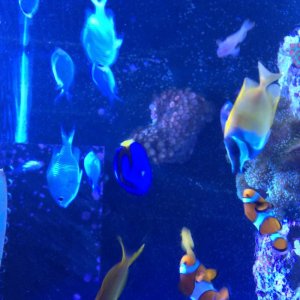
Here is a pic of a group of fish, it doesn't show the white spots, next time I see it, which could be a while, I will take a pic.

Really appreciate hearing from you on this, it's been so confusing to me what it could be, and I want to do what's right but don't want to tear everything apart risk more problems if I don't need to.

I did also see about a week ago, bristle worm hairs on her side, can't recall if it was in same location as these bumps, but she sleeps in a really awkward position inside a rock crevice, on her side kind of wedge between 2 rocks, like I said, looks very awkward, and think she must have touched a bristle worm in there and that's when she got the bristle worm hairs.

I doubt this is related, but just thought of it, in case it's relevant.
 

Attachments

  • image.jpg
    image.jpg
    77.1 KB · Views: 4
I wouldn't do anything just yet. I would just watch for a little while. I know this is going to sound silly but is it possible that it's sand?
 
I'll try to get a picture. I'm pretty sure it's not sand, the next day when it's disappeared I always think, "man was I just seeing sand!" But I'm pretty sure it's not sand.
 
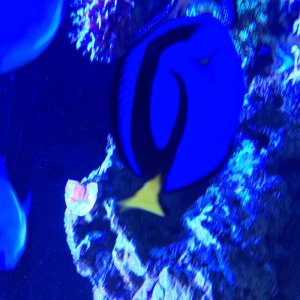
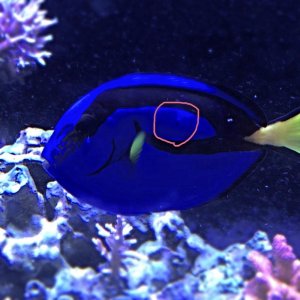
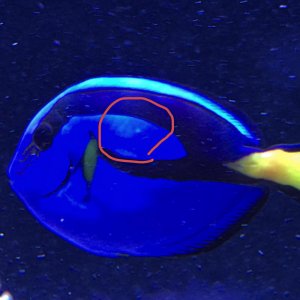
One white spot showed up today. I tried to get some pics, but IPhone pics, so not sure if there's a lot to go on.

My logs show that the last time this showed up was the 16th, was gone from the blue tang on morning of 18th.

It's now the 30th, so does that point to any type of disease?

To note there is a large RBTA very close to here cave were she sleeps, could this be a anemone sting by any chance?
 

Attachments

  • image.jpg
    image.jpg
    65.1 KB · Views: 4
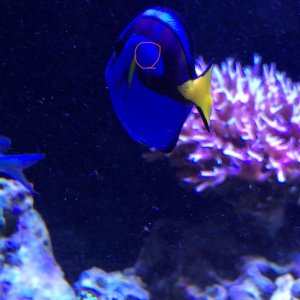
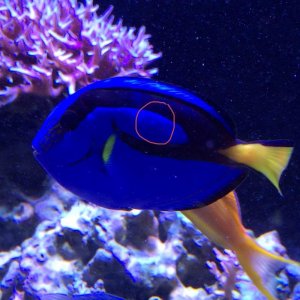
To note, the only mark on her is the one in the red circle, any other white marks are either buildup on the glass or particles floating in the water column. The nodule I've pointed out is fairly large, and is white in color. But to me seems much larger than ICH that I have seen in fish in online pictures. And there is only 1 nodule.
 

Similar threads

Back
Top