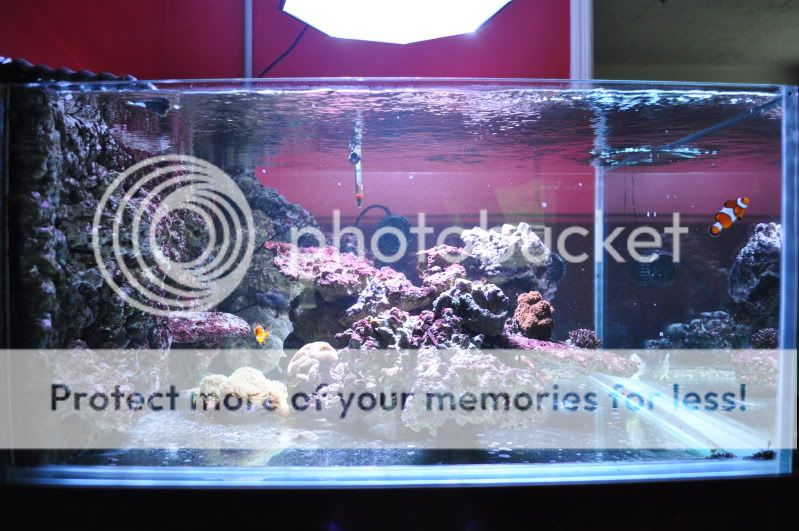
My DIY Fake Mudbank

Michael Hoaster

Registered Seaweedist
Premium Member
As I finish up my fake mangrove root project, I'm anxious to move on to the next!

Following in the footsteps of some great fake rock walls, I want to create a variation and approximate the look of a mangrove lagoonal mudbank. In keeping with my overall goal of building a Caribbean Biotope Seagrass Tank, I want a mudbank-not a reef rock wall. This is NOT a reef tank! It IS a marine planted tank-a completely different animal.

Besides trying to make it look cool, I have some specific goals and functions I hope to accomplish.

My number one goal is to provide numerous caves for some specific fish I want to keep. Because this tank will have very little live rock, there won't be enough hiding places for the fish to feel safe and secure. I want to provide additional nooks without using more live rock.

Second, I want it to take up as little room as possible. My tank is 24 inches front to back, and I'd like to keep this mudbank within about 2 inches thick.

Third, I'm building a surface overflow on the back wall that will span almost the entire width of the tank. I need the fake mudbank to integrate well with the overflow and hopefully even disguise it.

Construction will take place outside the tank, so it will have to be in more than one piece, allowing me to fit it under my hood and through the tank's top openings. One of the downsides to doing it this way, is ending up with a straight, vertical seam running up the middle of the wall. To avoid that, I will shape the wall pieces to fit together like puzzle pieces, so there won't be a straight, unsightly dividing line.

Like most of the fake-rockers before me, I will probably use egg crate light diffusor as my base structure. However, I will consider other materials that are thinner, since overall thickness is a big concern.

I've been collecting small plastic bottles, which will become my caves. Since they are all different shapes and sizes, I hope they will provide a natural look to the wall. They will be attached to the structure laying flat on it.

I will use the black pond foam, which should be almost the perfect color as-is. I may sprinkle some silica sand on it as it dries to make it more brown. I'll add shells and rubble and many small fiddler crab-like holes as well.

So there you have it! I'm excited about this because I've never seen it done in a home aquarium before.

Comments? Suggestions?
 
That's the trick, isn't it? A THIN layer of foam. I know the pond foam doesn't expand as much as 'great stuff', but I don't know HOW much.

Anybody out there know how much the black pond foam expands?
 
Yes and it is more than you think but there is a trick to the process to keep the expansion to a minimum.

You can use salt to control it or an easier thing to do is to remove the plastic tube that you screw onto the can.

Ever spread cheese whiz from a can? Hold the can over the egg crate and apply. You will get expansion but it is much less than the ones that look like cookie dough tubes that people do.
 
So, for one pass across the egg crate (with the black pond foam), how thick will it get? Can you be more specific than "more than you think"?
 
I've also seen people wear rubber gloves and just squeeze the air out of the foam after applying. It seems to limit the expansion quite a bit. Other option that would probably work would just be to put it on and let it expand in phase 1. After it has dried go back with a dremel or similar tool and shape it out.

Is there anything that the foam wont stick to? Wax paper or something might be worth a try. Wondering if you could skip the egg crate all together to save yourself a little on the thickness. I would think that the foam would be sufficiently stiff. Not sure what the best method to stop it floating away while keeping it removable would be.
 
Those are good ideas Clay12340. I think I read where someone used wax paper as their work surface while working with foam. Foregoing the eggcrate altogether is interesting, but I think I'll need something to anchor my plastic bottles to, so they stay in the positions I want. It doesn't have to be eggcrate, just something I can glue or zip tie the bottles in place.

I've thought about the buoyancy issue as well. I'll probably zip tie a piece to the bottom at a 90 degree angle to bury in the sand to anchor it. Plus, it will be under my overflow, which extends about an inch and a half into the tank. I can probably work out some kind of attachment method to it. I could even fashion some attachment 'keys' to the back of the tank to help secure it.

I'd love to hear from others out there who've made the foam walls, and lived with them for a while. Maybe you've thought of ways to improve on your designs?
 
...Not sure what the best method to stop it floating away while keeping it removable would be.

Maybe epoxy coated magnets would work? they sell some pretty strong yet thin neodymium magnets on various places on the interwebs that should be plenty strong enough to hold on a foam wall(if used right and in enough quantities)
 
I suspect that you could just sink the zip ties into the foam or rough up the bottles for the foam to stick directly to. Though I may be off base here as I'm not fully comprehending what you plan with the bottles.

The magnets are a cool idea. Could glue them into the foam and hook it in that way. Pull the mags off the back and the background would just float to the top.
 
Honestly it is hard to say but you can get an inch or more expansion depending on how much you apply etc.

Best thing to do is go burn through a can trying different techniques to see which one works the best for you.

Have you checked out the great DIY foam thread?
 
I suspect that you could just sink the zip ties into the foam or rough up the bottles for the foam to stick directly to. Though I may be off base here as I'm not fully comprehending what you plan with the bottles.

My plan for the bottles is to cut off the threaded neck at the top, so the opening is as big as the circumference. I will attach them to my support structure laying them flat, so the openings will be facing towards either side, not the front.

Basically I'll be substituting the rocks on the wall with plastic bottles. And since plastic bottles aren't exactly pretty, I will cover them with foam. I'm hoping that through careful arrangement, I can get an interesting and natural looking wall with varying undulations. I also hope to provide lot's of hiding places for the fish that I have in mind.
 
I like the idea of testing different techniques to get what I want. I'l do that, thanks!

I'm still liking using egg crate. Although it's thicker than some other choices, it may work best because the foam can expand into it, negating its thickness and locking the foam in place.
 
I like the idea of testing different techniques to get what I want. I'l do that, thanks!

I'm still liking using egg crate. Although it's thicker than some other choices, it may work best because the foam can expand into it, negating its thickness and locking the foam in place.

I had a rock wall in my 100 Gallon Rimless cube. I used eggcrate, live rock, and UV Safe Pond Foam.

Here is a photo:

DSC_0119.jpg


My one problem was when the foam was drying, it curved the egg crate into a mild U-Shape. This obviously caused some problems trying to mount the wall to perfectly flat glass. I ended up just redoing it and keeping weight on the eggcrate as the foam dried.

Also, do not underestimate the boyancy of this stuff. You need a lot of weight to keep it down. I basically has rocks plastered across the entire egg crate panel, and filled in the spaces in between. It was barely enough to keep the egg crate submerged.

If you want to cut the expansion down it's very easy to do that. Just put on a glove and poke the foam as soon as you see a skin start to form on it. The more times to do that, the less expansion you'll have. This will probably help cut the buoyancy of the foam down as well since the foam won't be trapping so much air.

Other than that is incredibly durable stuff. I had no problems at all in the entire time the tank was up. It took 3-4 weeks for everything to start blending in. I actually took a tooth brush to the entire wall when I broke the tank down this past weekend to clean some nuisance algae off for the buyer.
 
Amoore311, wow thanks, that was very helpful! Great pic too! Love the cubes. And with the rimless look, gorgeous!

Great info on the foam. I can't wait to play around with it. Poking the foam will be perfect since I was planing to do that anyway to simulate fiddler crab holes. Weighting down the panels as it dries is brilliant. Thanks for saving me a step!

Since I'm not hanging any rocks on my wall, it will tend to be very buoyant. But I am going to have a lot of plastic bottles in it (for the fish caves), that will fill with water. I'll press and poke as much air out as I can get away with. It will be anchored under the weight of a deep sand bed-around 7-8". I'll attach it to the wall with square 'keys' that fit into the egg crate, and it will be 'topped' with an overflow that spans the width of the tank. Hopefully that'll do it!

Have any of you Fake Rockers out there had success adding sand, shells, rubble to the foam as it cures? From what I remember reading, the foam tended to swallow up sand and small bits. It seemed like people had better luck adding them to a resin sealer over the cured foam. It would be great to not have to use the resin, since the foam is fish-safe already.
 
The shells and rubble get covered by foam very quickly. The sand just does not stick too well since the first part of the foam that dries is the outside skin, and that dries rather quickly.

Also, if you want to add holes, try little PVC elbows of various diameter. I used a couple in my wall for fish caves/etc. The foam covers em almost completely, and the little bit of white pvc that is left gets covered by algae/coraline/etc so quick you will never notice.
 
OK, so I gotta do the resin if I want to add sand and shells. I guess I'll see how it looks without and then make the call. I've got plenty of resin I think, which I'm sealing the fake mangrove root with as well.

It will be interesting getting the color of both the wall and the roots to look natural. Also getting them to look good together will be a challenge.

Can't wait! Thanks for following!

My other threads:

http://reefcentral.com/forums/showthread.php?t=2393807 - My DIY Fake Mangrove Root

http://reefcentral.com/forums/showthread.php?t=2391470 - Caribbean Biotope Seagrass Tank
 
Foam Practice

Foam Practice

I've been playing with the pond foam on a scrap piece of eggcrate. Not a lot of control available to this control freak! I've got to try a few more ideas before I commit to doing the final piece.
 
I made mine from eggcrate and concrete laden cloth sheets. It doesn't float and is as thin as I want it to be. The surface texture depends on what you sprinkle or paint it with.

You can add black pigment to make it muddy too.

Here's mine during construction (outside)

<a href="http://s1062.photobucket.com/user/karimwassef/media/5DC13890-5F54-423E-8C20-C76B1C4436B1_zpsgjtul7x1.jpg.html" target="_blank"><img src="http://i1062.photobucket.com/albums/t496/karimwassef/5DC13890-5F54-423E-8C20-C76B1C4436B1_zpsgjtul7x1.jpg" border="0" alt=" photo 5DC13890-5F54-423E-8C20-C76B1C4436B1_zpsgjtul7x1.jpg"/></a>

<a href="http://s1062.photobucket.com/user/karimwassef/media/E3FA8DD0-4629-4897-8AD1-AA31D7AD50DE_zpsoo76phpd.jpg.html" target="_blank"><img src="http://i1062.photobucket.com/albums/t496/karimwassef/E3FA8DD0-4629-4897-8AD1-AA31D7AD50DE_zpsoo76phpd.jpg" border="0" alt=" photo E3FA8DD0-4629-4897-8AD1-AA31D7AD50DE_zpsoo76phpd.jpg"/></a>

<a href="http://s1062.photobucket.com/user/karimwassef/media/95251280-a548-4c44-baa3-509983f56bb0_zpscf052fb7.jpg.html" target="_blank"><img src="http://i1062.photobucket.com/albums/t496/karimwassef/95251280-a548-4c44-baa3-509983f56bb0_zpscf052fb7.jpg" border="0" alt=" photo 95251280-a548-4c44-baa3-509983f56bb0_zpscf052fb7.jpg"/></a>

<a href="http://s1062.photobucket.com/user/karimwassef/media/2_zps05623693.jpg.html" target="_blank"><img src="http://i1062.photobucket.com/albums/t496/karimwassef/2_zps05623693.jpg" border="0" alt=" photo 2_zps05623693.jpg"/></a>
 
Sides before concrete - the bottom support is important to keep it upright.

<a href="http://s1062.photobucket.com/user/karimwassef/media/7D9F2D04-3051-478D-9F2B-27FE0BDBB38F_zpsj3wt3qui.jpg.html" target="_blank"><img src="http://i1062.photobucket.com/albums/t496/karimwassef/7D9F2D04-3051-478D-9F2B-27FE0BDBB38F_zpsj3wt3qui.jpg" border="0" alt=" photo 7D9F2D04-3051-478D-9F2B-27FE0BDBB38F_zpsj3wt3qui.jpg"/></a>

One of the overhang ledges

<a href="http://s1062.photobucket.com/user/karimwassef/media/2a9fa0a7-d697-421b-8a7d-63aea1f0b085_zps558ab569.jpg.html" target="_blank"><img src="http://i1062.photobucket.com/albums/t496/karimwassef/2a9fa0a7-d697-421b-8a7d-63aea1f0b085_zps558ab569.jpg" border="0" alt=" photo 2a9fa0a7-d697-421b-8a7d-63aea1f0b085_zps558ab569.jpg"/></a>
 
The ingredients
<a href="http://s1062.photobucket.com/user/karimwassef/media/1DD6B7E5-277B-47AE-BAF1-9923041DC915_zpssjkzmba8.jpg.html" target="_blank"><img src="http://i1062.photobucket.com/albums/t496/karimwassef/1DD6B7E5-277B-47AE-BAF1-9923041DC915_zpssjkzmba8.jpg" border="0" alt=" photo 1DD6B7E5-277B-47AE-BAF1-9923041DC915_zpssjkzmba8.jpg"/></a>
 
Back
Top