Needed PAR levels for varying corals.

hypnoj

Member
Any quick articles that outline needed PAR levels for different corals?

SPS: monti cap, Acro, etc
Clams:
LPS: bubble coral, plate coral, lobo, acan, chalice, favia, etc
Softies: mushroom, leather, Z & P's, etc
Anemone's: BTA, LTA, H. Mag, etc

I understand that things can vary a lot between some of these in the same family, but I'd still like to see some PAR numbers.
 
There really aren't any.

Depends too much on other factors, like light quality, flow, overall health of coral, and temperature just to name a few.

A lot of people find that 500 PAR from LEDs will bleach corals that aren't thoroughly acclimated, while it's pretty rare for corals to bleach at nearly double that under natural sunlight.
 
There really aren't any.

Depends too much on other factors, like light quality, flow, overall health of coral, and temperature just to name a few.

There are certainly guidelines based on consistent experience and research

A lot of people find that 500 PAR from LEDs will bleach corals that aren't thoroughly acclimated, while it's pretty rare for corals to bleach at nearly double that under natural sunlight.

Huh ? I guess the corals that are the 1K par were always under the sun and didn't need to be acclimated. Kind of a pointless statement isn't it ?
 
PAR (Photosynthetically Active Radiation) takes into account all wavelengths between 400-700nm, so sunlight has high PAR value. Corals don't need or use a good protion of all these wavelengths. The portion of the spectrum that they primarily do use is known as PUR (Photosynthetically Useable Radiation) and is in the mostly violet to blue ranges as well as red. An LED fixture can produce relatively low PAR (compared to natural sunlight) yet produce high PUR. If PUR is too high for the coral to effectively deal with, it can bleach as it attempts to regulate damaging oxygen radical by-products produced its own zooanthellae population.
 
Not sure, I would necessarily group red in with the blue. It is more complicated than that. Danna Riddle gets deep fast. It sounds like you have done a lot of research on specific spectrum response.

Two deep water Red Macros, Dragons Breath and Red Grapes, are collected by Russ Kronewetter, diver-owner of live_plants.com. In his reference book on his website, he list that they are collected between 60'-120'. When you look at the energy level of each frequency in the light spectrum, the reds and yellows are absorbed in the first 10' of water. By the time one reaches 60', the remaining light spectrum is 10% of green remainig with increasingly large amount of blue, violet, and ultra violet remaining. Why do most macros grow in the top 10' of the water column? I do not know, my best answer is "Because they can". Some are very adaptive, just as coral are. Do deep water macros and coral photosynthesis best at blue and purples or is it because they do not compete well with other corals that use all the light spectrum, which is available near the surface?

A large reason of favoring reds and blues in choice of LED spectrum is because it looks good to the person on the outside of the tank. When I look at displays that pop with coral fluorescence, I am disappointed with washed out colors of Clowns and Yellow Tangs.
Patrick
 
Last edited:
PAR (Photosynthetically Active Radiation) takes into account all wavelengths between 400-700nm, so sunlight has high PAR value. Corals don't need or use a good protion of all these wavelengths. The portion of the spectrum that they primarily do use is known as PUR (Photosynthetically Useable Radiation) and is in the mostly violet to blue ranges as well as red. An LED fixture can produce relatively low PAR (compared to natural sunlight) yet produce high PUR. If PUR is too high for the coral to effectively deal with, it can bleach as it attempts to regulate damaging oxygen radical by-products produced its own zooanthellae population.

The reason that I do not use LED on commercial tanks is because of the mono specific wavelength produced by the light emitting diode. To illustrate in agreement with your point about natural sunlight and PAR. I experimented with a new 1000W MH eballast and reflector over a 150G Rubbermaid propagation tank. The PAR values doubled when I went from 6500 Kelvin to 2700 Kelvin bulbs.
Patrick

Dear OP,
The answer you seek on cook book numbers is not that simple.
 
Last edited:
Sprung's "Corals, A quick Refference Guide" I think illustrates the issue pretty good. Just for the Acropora species he lists, which is just a small percentage of the species in the genus, he gives 10 different lighting ranges and while there is overlap there is a significant difference between the lows and the highs.

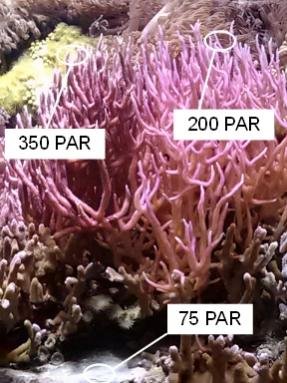
Additionally, intensity can have a significant influence on a corals coloration. Depending on the fluorescing and chromoprotiens a coral uses and the extent to which a corals symbiotic dinoflaggelates are present can give a coral a range of colors. Here's is one example from one of my tanks:
 

Attachments

  • Two Tone Birdsnest PAR.jpg
    Two Tone Birdsnest PAR.jpg
    29.5 KB · Views: 46
Not sure, I would necessarily group red in with the blue. It is more complicated than that. Danna Riddle gets deep fast. It sounds like you have done a lot of research on specific spectrum response.

Two deep water Red Macros, Dragons Breath and Red Grapes, are collected by Russ Kronewetter, diver-owner of live_plants.com. In his reference book on his website, he list that they are collected between 60'-120'. When you look at the energy level of each frequency in the light spectrum, the reds and yellows are absorbed in the first 10' of water. By the time one reaches 60', the remaining light spectrum is 10% of green remainig with increasingly large amount of blue, violet, and ultra violet remaining. Why do most macros grow in the top 10' of the water column? I do not know, my best answer is "Because they can". Some are very adaptive, just as coral are. Do deep water macros and coral photosynthesis best at blue and purples or is it because they do not compete well with other corals that use all the light spectrum, which is available near the surface?

A large reason of favoring reds and blues in choice of LED spectrum is because it looks good to the person on the outside of the tank. When I look at displays that pop with coral fluorescence, I am disappointed with washed out colors of Clowns and Yellow Tangs.
Patrick

From reading some of Dana's articles, it is my understanding that the 'red' spectra are potentially around 33% more efficient than 'blue' at promoting photosynthesis in general, but since red light is attenuated within a few meters it is only available to corals in very shallow water. Red light is evidentally used by corals to gauge light intensity and adapt accordingly.

Since red is not needed by corals per see, you are correct that it is important for our viewing pleasure. I use neutral white LEDs which supply some red wavelengths, but red spectra specific LEDs can also be incorporated into the LED array/fixture.

Further detailed study: http://www.plosone.org/article/info:doi/10.1371/journal.pone.0092781

Ralph.
 
Last edited:
The reason that I do not use LED on commercial tanks is because of the mono specific wavelength produced by the light emitting diode. To illustrate in agreement with your point about natural sunlight and PAR. I experimented with a new 1000W MH eballast and reflector over a 150G Rubbermaid propagation tank. The PAR values doubled when I went from 6500 Kelvin to 2700 Kelvin bulbs.
Patrick

Dear OP,
The answer you seek on cook book numbers is not that simple.

The 'perfect recipe' for LEDs is still being written, but we are getting much closer as manufacturers are releasing more varieties of emitters covering more spectra. As I remember, it took quite a while to obtain the 'perfect' blend of T5 bulbs, too, in the beginning :)

What is quite exciting is that emitters are now becoming available that are not just blue emitters that have been coated to produce green, yellow or whatever, but actually produce these colored wavelengths without the blue base. With the correct complement of these in place, LED arrays can be created that are not so excessively violet/blue heavy.

Ralph.
 
Last edited:
Ran into the '60 second' edit rule...

"From reading some of Dana's articles, it is my understanding that the 'red' spectra are potentially around 33% more efficient than 'blue' at promoting photosynthesis in general, but in corals excessive red light can cause bleaching. Since red light is attenuated within a few meters it is only available to corals in very shallow water. Red light is evidentally used by corals to gauge light intensity and adapt accordingly.
 
Sprung's "Corals, A quick Refference Guide" I think illustrates the issue pretty good. Just for the Acropora species he lists, which is just a small percentage of the species in the genus, he gives 10 different lighting ranges and while there is overlap there is a significant difference between the lows and the highs.

Additionally, intensity can have a significant influence on a corals coloration. Depending on the fluorescing and chromoprotiens a coral uses and the extent to which a corals symbiotic dinoflaggelates are present can give a coral a range of colors. Here's is one example from one of my tanks:

Tim,
I think I have that book, I'll go look up whatever I can find. Thanks for posting the PAR numbers for your tank. Very helpful :) Now I just need to get some PAR numbers for low light corals like chalices.
 
Tim,
I think I have that book, I'll go look up whatever I can find. Thanks for posting the PAR numbers for your tank. Very helpful :) Now I just need to get some PAR numbers for low light corals like chalices.

Sorry for getting a bit technical, but with lighting it does happen to be quite a complex topic.

Many chalices can be maintained in quite low light (40 - 80 PAR LEDs), depending on how much PUR (violet/blue) light that they actually are receiving. Under T5s and MH, a bit more PAR would likely be fine. Better to err a bit on the lower side and work up from there.
 
wow, so my pale-almost-white corals at 150-190 PAR could be suffering from too little light? They look bleached, or maybe I need good instruction on what bleaching looks like vs. extreme paleness from lack of light.

grateful for this thread - I am learning much from you guys.
 
wow, so my pale-almost-white corals at 150-190 PAR could be suffering from too little light? They look bleached, or maybe I need good instruction on what bleaching looks like vs. extreme paleness from lack of light.

grateful for this thread - I am learning much from you guys.

There are very few ocean species that would need more PAR then 150-190.
 
Organism Genus Species Lighting Req Min Ideal Max
Coral Acropora cervicornis Medium 281 306 331
Coral Acropora digitifera High 82 327 600
Coral Acropora divaricata Very Low 10 77 200
Coral Acropora formosa High 170 340 600
Coral Acropora gemmifera High 170 340 600
Coral Acropora granulosa Low 53 107 450
Coral Acropora microphthalma High 170 300 600
Coral Acropora millepora (coenosarc) Medium 100 190 500
Coral Acropora millepora (polyp) Medium 140 230 550
Coral Acropora nobilis (coenosarc) - 170 310 600
Coral Acropora nobilis (polyp) - 100 180 500
Coral Acropora Species Medium 131 246 503
Coral Cyphastrea serailia - 100 150 200
Coral Cyphastrea Species - 100 150 200
Coral Montipora capitata - 135 193 250
Coral Montipora tuberculosa (coenosarc) Low 130 180 250
Coral Montipora tuberculosa (polyp) - 100 300 400
Coral Montipora Species - 122 224 300
Coral Pocillopora damicornis Medium 100 300 400
Coral Pocillopora eydouxi High 250 323 425
Coral Pocillopora meandrina - 275 350 425
Coral Pocillopora Species - 225 299 417
Coral Pavona varians Low 110 230 350
Coral Pavona Species - 110 230 350
Coral Porites cylindrica - 150 200 250
Coral Porites lobata Medium 250 300 350
Coral Porites lutea High 400 575 750
Coral Porites Species - 267 358 450
Coral Sinularia densa High 207 304 400
Coral Sinularia Species - 200 300 400
Coral Stylophora pistillata (Shade) Diverse 40 200 600
Coral Stylophora pistillata (Light) Diverse 40 300 600
Coral Stylophora Species - 40 250 600


Organism Genus Species Lighting Req Min Ideal Max
Coral Acropora Species - 70 - 600
Coral Alcyonium Species - 200 - 800
Coral Blastomussa Species - 200 - 600
Coral Briareun Species - 200 - 700
Coral Fungia Species - 600 - 900
Coral Montipora Species - 135 - 500
Coral Nephthea Species - 200 - 900
Coral Pachyclavularia Species - 200 - 700
Coral Pocillopora Species - 200 - 600
Coral Sarcophyton Species - 200 - 800
Coral Stylophora Species - 40 - 600
Coral Dendronephthya Species - N/A - N/A
Coral Tubastrea Species - N/A - N/A
 
Organism Genus Species Lighting Req Min Ideal Max
Coral Acropora cervicornis Medium 281 306 331
Coral Acropora digitifera High 82 327 600
Coral Acropora divaricata Very Low 10 77 200
Coral Acropora formosa High 170 340 600
Coral Acropora gemmifera High 170 340 600
Coral Acropora granulosa Low 53 107 450
Coral Acropora microphthalma High 170 300 600
Coral Acropora millepora (coenosarc) Medium 100 190 500
Coral Acropora millepora (polyp) Medium 140 230 550
Coral Acropora nobilis (coenosarc) - 170 310 600
Coral Acropora nobilis (polyp) - 100 180 500
Coral Acropora Species Medium 131 246 503
Coral Cyphastrea serailia - 100 150 200
Coral Cyphastrea Species - 100 150 200
Coral Montipora capitata - 135 193 250
Coral Montipora tuberculosa (coenosarc) Low 130 180 250
Coral Montipora tuberculosa (polyp) - 100 300 400
Coral Montipora Species - 122 224 300
Coral Pocillopora damicornis Medium 100 300 400
Coral Pocillopora eydouxi High 250 323 425
Coral Pocillopora meandrina - 275 350 425
Coral Pocillopora Species - 225 299 417
Coral Pavona varians Low 110 230 350
Coral Pavona Species - 110 230 350
Coral Porites cylindrica - 150 200 250
Coral Porites lobata Medium 250 300 350
Coral Porites lutea High 400 575 750
Coral Porites Species - 267 358 450
Coral Sinularia densa High 207 304 400
Coral Sinularia Species - 200 300 400
Coral Stylophora pistillata (Shade) Diverse 40 200 600
Coral Stylophora pistillata (Light) Diverse 40 300 600
Coral Stylophora Species - 40 250 600


Organism Genus Species Lighting Req Min Ideal Max
Coral Acropora Species - 70 - 600
Coral Alcyonium Species - 200 - 800
Coral Blastomussa Species - 200 - 600
Coral Briareun Species - 200 - 700
Coral Fungia Species - 600 - 900
Coral Montipora Species - 135 - 500
Coral Nephthea Species - 200 - 900
Coral Pachyclavularia Species - 200 - 700
Coral Pocillopora Species - 200 - 600
Coral Sarcophyton Species - 200 - 800
Coral Stylophora Species - 40 - 600
Coral Dendronephthya Species - N/A - N/A
Coral Tubastrea Species - N/A - N/A

Curious where these #'s came from. Thank you for posting them.
 
Be advised that some PAR meters only measure photons in the middle of the visible spectrum and may not accurately report the actual PAR value of light that is heavily weighted to the blue end of the spectrum. Sometimes I think this might lead to bleached corals where PAR is reported as quite low. LEDs may make this problem worse because of their narrower spectrum range.

Look up Sanjay Joshi if you want a great read of reef lighting.
 
Organism Genus Species Lighting Req Min Ideal Max . . .
I too am curious what the criteria were that determined these PAR levels? Acropora cervicornis is found from the surface to depths of 180' (Humann, Caribean Reef Corals) so it certainly will live outside the range you've given and Pocillopora damicornis is found in mangrove swamps, sheltered lagoons and in areas exposed to strong wave action so I suspect it also may be live in a wide range of lighting conditions.
 
Back
Top