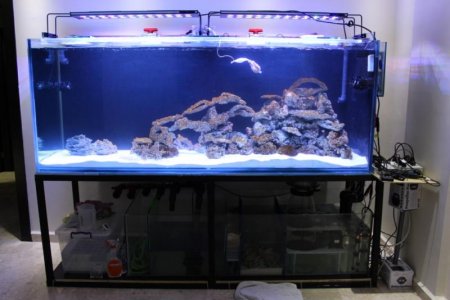
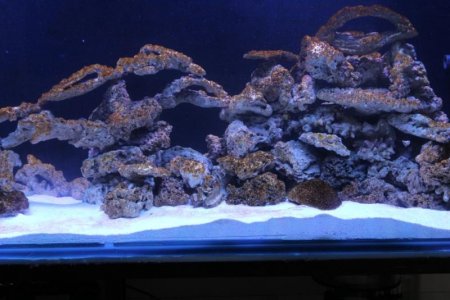
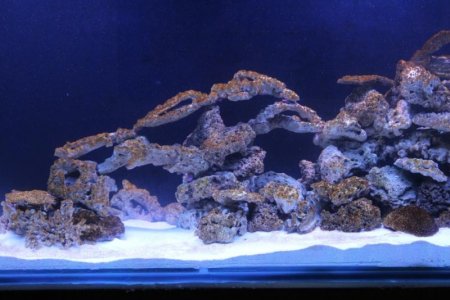
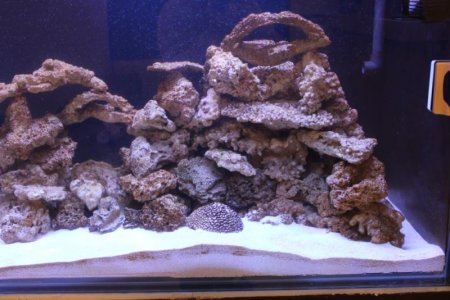
i am new to the salt water world but have good experience in fresh water tanks... i decided to start a reef tank it is mainly going to be softies anemones and clowns.... the tank now is 18 days old i threw a shrimp inside the tank about 10 days ago, i am using 2 led sanrise, reef octopus pump 12500 wave blaster, a reef octopus skimmer int 2000 not working yet in order to build up faster the nitrates.... 2 jebao wave makers RW 15 and RW 20, i will post some pictures in order for you to comment on the process i would appreciate the help and your inputs... i think that the green alge on the rocks is building very fast is it normal to be like that in just 18 days from starting the cycle and i started with dead rock about 100 kg and 80 kg of crushed corals .....

You are using an out of date browser. It may not display this or other websites correctly.
You should upgrade or use an alternative browser.
You should upgrade or use an alternative browser.
new 300 Galons tank
- Thread starter marinedoc
- Start date

CritterHeaven
New member
That's a big tank to start out with!! I take it you have been testing for the cycle?
no i did not run any tests now except salinity and temperature since everything should be building up and rising, maybe in a week or so i will do my first tests but i am assuming tha everything should be sky high.... what do you think about the shrimp keep it in the tank until it almost dissolves or remove it already... i am guessing that the nitrates should start dropping when the algae starts to lose ground and starts disappearing from the tank...
CritterHeaven
New member
I know everyone has their own way to set up a tank and I the biggest I have set up is a 150G. But I like to use actual ammonia (pure unscented etc) and get a decent ammonia reading. Then test every few days to see the cycle complete through nitrite and nitrate. Typically once the nitrite starts to come down I will add more ammonia so there is always a supply of ammonia in the tank. Then I will run that cycle a few times til the cycle completes in a short amount of time ( a few days max). Cranking your heat up a little can help shorten the cycle as well.
I would test it and see what ammonia levels are at this point before deciding what to do next. No sense overwhelming it completely with crazy high levels of ammonia.
I would test it and see what ammonia levels are at this point before deciding what to do next. No sense overwhelming it completely with crazy high levels of ammonia.
joshua_00030
New member
+1 to CritterHeaven. Pure ammonia cycles so much faster than decomposing food. It's a little tedious to find but it can save you weeks of waiting for the food to convert into ammonia
ScienceRulez
New member
+1 to CritterHeaven. Pure ammonia cycles so much faster than decomposing food. It's a little tedious to find but it can save you weeks of waiting for the food to convert into ammonia
Pure unscented ammonia should be readily available in any supermarket. check the cleaning isle. I use it to make glass cleaner, it's much cheaper than buying actual window cleaner, particularly the amount we go through.
But yes, pure ammonia cycles much faster.
CritterHeaven
New member
The other plus to ammonia versus decomposing food, you can get some not so beneficial bacteria in your tank from the decomposing shrimp. May not always be critical but for me when I am setting up a seahorse tank it is very critical.

sde1500
Active member
no i did not run any tests now except salinity and temperature since everything should be building up and rising, maybe in a week or so i will do my first tests but i am assuming tha everything should be sky high.... what do you think about the shrimp keep it in the tank until it almost dissolves or remove it already... i am guessing that the nitrates should start dropping when the algae starts to lose ground and starts disappearing from the tank...
You can't know where you are in the cycle, or if it has even started if you aren't testing the water. And we couldn't say whether you should remove the shrimp or not, if you don't know what your ammonia reading is. Need to have ammonia spike to know the cycle is starting, and followed by a nitrite spike and finally both those should be zero and nitrates should be the only thing showing. I'd start testing ammonia and nitrites to make sure the cycle is going.
And second, why do you think nitrates will drop when algae disappears? On a new tank you won't ever really see nitrates fall. It takes a mature tank, if at all, to process nitrates. The main way to reduce nitrates is through water changes. The algae is a normal part of any new tank, and has nothing to do with the cycle.
With dry rock, I'd suggest keeping an eye on phosphates, or starting a GFO reactor right at the start. Many tend to leach phosphates and you get a lot of algae from that. Good luck with the new tank, I'd love one that big!
i just tested for phosphate the result was between 0.34 and 0.43 .... so it is very high for a 20 days old tank .... the test is ELOS phosphate high resolution.
i could not test for ammonia since i non was found at the local vendor maybe by next week ... what do you think ?
i could not test for ammonia since i non was found at the local vendor maybe by next week ... what do you think ?
Last edited:

Dkuhlmann
New member
I think you don't need to worry about anything but ammonia and nitrites right now. After your ammonia spikes to 2ppm or higher and goes to 0 you need to watch your nitrites until they go to 0. At this point I don't think your tank cycled at all with only putting in one shrimp for a 300 gallon tank.
The following you can do to test your cycle. If you add the ammonia and the ammonia and nitrites both go to 0 after 24 hours then you are cycled. If not let it run the cycle as I've laid out below.
If I were you, I would wait until you get the test kits, then dose pure ammonia that you can get in the cleaning section of most grocery or hardware stores. You want ammonia that has no additives. Being scent free is a good indicator but shake the bottle, if it foams up it has additives, if it doesn't that is the one you want.
Then dose ammonia until you get 2-3ppm if it goes over that's ok it will just take longer to cycle. Then all you have to do is wait for the ammonia to go to 0, then nitrites and finally you can test your nitrates when your cycle is complete and then do a 50% WC, but do not do a WC or add anymore ammonia until your cycle is complete. Once complete dose ammonia one more time to 2ppm and then test after 24 hours. If your ammonia and nitrites are 0 after 24 hours your tank is fully cycled. This second dose of ammonia is to test your cycle.
This is how I cycle tanks and it works very well and is faster than some other methods like adding shrimp or feeding fish food daily until the ammonia is present, this can take a while.
The following you can do to test your cycle. If you add the ammonia and the ammonia and nitrites both go to 0 after 24 hours then you are cycled. If not let it run the cycle as I've laid out below.
If I were you, I would wait until you get the test kits, then dose pure ammonia that you can get in the cleaning section of most grocery or hardware stores. You want ammonia that has no additives. Being scent free is a good indicator but shake the bottle, if it foams up it has additives, if it doesn't that is the one you want.
Then dose ammonia until you get 2-3ppm if it goes over that's ok it will just take longer to cycle. Then all you have to do is wait for the ammonia to go to 0, then nitrites and finally you can test your nitrates when your cycle is complete and then do a 50% WC, but do not do a WC or add anymore ammonia until your cycle is complete. Once complete dose ammonia one more time to 2ppm and then test after 24 hours. If your ammonia and nitrites are 0 after 24 hours your tank is fully cycled. This second dose of ammonia is to test your cycle.
This is how I cycle tanks and it works very well and is faster than some other methods like adding shrimp or feeding fish food daily until the ammonia is present, this can take a while.

frey
New member
did you only add dry rock to prevent unwanted hitchhikers? I used 80% dry rock to set up my 180 and after that cycled I added the rest in actual live rock to get the beneficial bacteria and pod population going. I hope you do not get cyno outbreak following the completion of the nitrate cycle, I have had it happen in the past. As soon as nitrite goes to 0 and nitrate has readings I would do a water change. I also would like to add this since you have a really nice big tank in the works. Down the road you will probably like to add a mandarin or some wrasses etc....if you are unlike me and can have some self control don't add any fish for months. Start with corals and a few inverts. Let your pods and everything get built up. I always say I am going to do it, but always get to excited the first time I go to the LFS. You can save yourself a lot of losses by really letting the tank mature before adding fish. there was a great article on it and I cant find it right now, but good luck!
I think you don't need to worry about anything but ammonia and nitrites right now. After your ammonia spikes to 2ppm or higher and goes to 0 you need to watch your nitrites until they go to 0. At this point I don't think your tank cycled at all with only putting in one shrimp for a 300 gallon tank.
The following you can do to test your cycle. If you add the ammonia and the ammonia and nitrites both go to 0 after 24 hours then you are cycled. If not let it run the cycle as I've laid out below.
If I were you, I would wait until you get the test kits, then dose pure ammonia that you can get in the cleaning section of most grocery or hardware stores. You want ammonia that has no additives. Being scent free is a good indicator but shake the bottle, if it foams up it has additives, if it doesn't that is the one you want.
Then dose ammonia until you get 2-3ppm if it goes over that's ok it will just take longer to cycle. Then all you have to do is wait for the ammonia to go to 0, then nitrites and finally you can test your nitrates when your cycle is complete and then do a 50% WC, but do not do a WC or add anymore ammonia until your cycle is complete. Once complete dose ammonia one more time to 2ppm and then test after 24 hours. If your ammonia and nitrites are 0 after 24 hours your tank is fully cycled. This second dose of ammonia is to test your cycle.
This is how I cycle tanks and it works very well and is faster than some other methods like adding shrimp or feeding fish food daily until the ammonia is present, this can take a while.
thank you Dkuhlmann
did you only add dry rock to prevent unwanted hitchhikers? I used 80% dry rock to set up my 180 and after that cycled I added the rest in actual live rock to get the beneficial bacteria and pod population going. I hope you do not get cyno outbreak following the completion of the nitrate cycle, I have had it happen in the past. As soon as nitrite goes to 0 and nitrate has readings I would do a water change. I also would like to add this since you have a really nice big tank in the works. Down the road you will probably like to add a mandarin or some wrasses etc....if you are unlike me and can have some self control don't add any fish for months. Start with corals and a few inverts. Let your pods and everything get built up. I always say I am going to do it, but always get to excited the first time I go to the LFS. You can save yourself a lot of losses by really letting the tank mature before adding fish. there was a great article on it and I cant find it right now, but good luck!
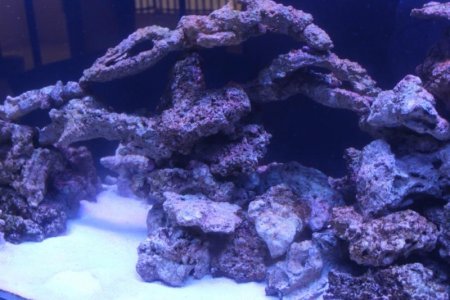
yes frey mainly to prevent unwanted hitchhikers, i added yesterday the biopellets and the GFO reactors and turned the skimmer on i am planning in about a 1.5 to 2 months to add few cleaner crews and fish not sooner than 3 months... it is a great hobby a lot demanding than fresh water hobby but much more interesting and every day with each new challenge i got drawn to it more and more :lmao: crossing my fingers :thumbsup:
Similar threads
- Replies
- 8
- Views
- 238

