Please Help! Hydrogen Sulfide under DSB

jpshwayze

New member
Hello I am new to reef central and happy to have found it!

I recently moved my 90g reef tank, which has a few zoanthid* colonies, 2 clown fish, and one rather large 2ft Spotted snake Burrowing-eel(aka Sharp-tail eel).
While moving the tank I decided to add a DSB($180-160lbs of .5mm-1.7mm carib-sea) beneath my old established sand.

But on the sand bags it said that if you have burrowing eels, i would need to put rocks scattered on the bare glass to keep the eel from disturbing the anoxic/anerobic levels at the bottom of the DSB.

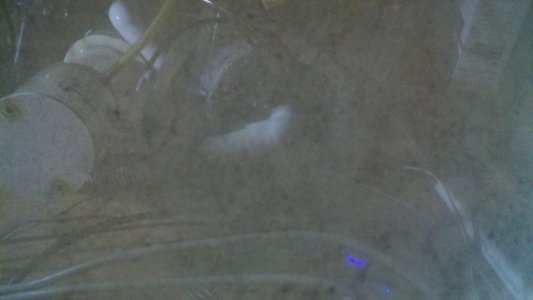
But i made the horrible mistake of using some of my small/medium sized established live rock. after a couple of days i was and still am able to see hydrogen sulfide buildup underneath the tank looking up at the bottom of the DSB.

I assume this is because i trapped every living thing in those rocks underneath the DSB and doomed them to die.

So my question is basically what do i do?
is there some way to eliminate the HS buildup?
Or do i basically have to tear the tank down throw out the sand and start over with new sand?

And also is a burrowing eel like mine have a good, bad or neutral affect on the DSB?

P.S.
I just tested my nitrates are 1ppm, calcium 440, and alk 5 something(i added some alk suppliment and will be doing a 35g water change tomorrow, while i add my new sump/refugium tomorrow)
 
Last edited:
also just a side note i understand the controversies over DSBs and i have decided to do it just to try it for myself.
 
DSB work I have one in my nano. But the reason you got hydrogen sulfide is definitely because you trapped fauna under the sand and it died. When you do a DSB its best to do it when starting a new system with really good live rock so you can seed the new sand.
 
Also stay away from anything that filters the sand for its liking. Like gobys,sand sifiting starfish and such they will destroy what you are trying to achieve with the DSB.
 
DSB work I have one in my nano. But the reason you got hydrogen sulfide is definitely because you trapped fauna under the sand and it died. When you do a DSB its best to do it when starting a new system with really good live rock so you can seed the new sand.

Way off. Hydrogen sulfide is supposed to be in your deep sandbed, it's the byproduct of the denitrifying bacteria doing exactly what you put a deep sandbed there to do. It means everything's working, just don't stir it up and start to release the hydrogen sulfide bubbles into your tank.
 
No hyrogen sulfide will be present if you did it wrong. Yes you can have some hyrogen sulfide but thats why I said you need to seed the DSB with good quality live rock so you can get all the critters that stir it. I have one and you will not see hydrogen sulfide in mine just worm tubes and gas pockets. I can stir my bed and I will get sulfide but in a matter or days its gone. IMO hydrogen sulfide should me minimal in your DSB very minimal.
 
FreakFish - you may want to do some research on hydrogen sulfide as Organism is correct in his statement and you are not. In a deep sand bed, regardless of the quality of live rock, you are crating an area devoid of oxygen.

Hydrogen sulfide (British English: hydrogen sulphide) is the chemical compound with the formula H2S. It is a colorless, very poisonous, flammable gas with the characteristic foul odor of rotten eggs. It often results from the bacterial breakdown of organic matter in the absence of oxygen, such as in swamps and sewers; this process is commonly known as anaerobic digestion.
 
FreakFish - you may want to do some research on hydrogen sulfide as Organism is correct in his statement and you are not. In a deep sand bed, regardless of the quality of live rock, you are creating an area devoid of oxygen.

However, it is my opinion that a DSB creating hydrogen sulfide is too deep. You want an area with little oxygen, not completely devoid. But that is a topic for another thread.

Hydrogen sulfide (British English: hydrogen sulphide) is the chemical compound with the formula H2S. It is a colorless, very poisonous, flammable gas with the characteristic foul odor of rotten eggs. It often results from the bacterial breakdown of organic matter in the absence of oxygen, such as in swamps and sewers; this process is commonly known as anaerobic digestion.
 
No hyrogen sulfide will be present if you did it wrong. Yes you can have some hyrogen sulfide but thats why I said you need to seed the DSB with good quality live rock so you can get all the critters that stir it. I have one and you will not see hydrogen sulfide in mine just worm tubes and gas pockets. I can stir my bed and I will get sulfide but in a matter or days its gone. IMO hydrogen sulfide should me minimal in your DSB very minimal.

You do know those "gas pockets" are hydrogen sulfide right? I'm not sure what you're under the impression they're composed of, and you're messing up right off the bat stirring up your DSB because it releases hydrogen sulfide. It's why you're not supposed to do it.

You need refrain from giving bad advice until you really know what you're talking about, because it can lead to people making decisions that are either wasteful, bad for their tank, or, in this case, both. If you don't know that hydrogen sulfide is the natural byproduct of anaerobic denitrifying bacteria then you have a lot more learning to do before arguing about how right you are.
 
You do know those "gas pockets" are hydrogen sulfide right? I'm not sure what you're under the impression they're composed of, and you're messing up right off the bat stirring up your DSB because it releases hydrogen sulfide. It's why you're not supposed to do it.

You need refrain from giving bad advice until you really know what you're talking about, because it can lead to people making decisions that are either wasteful, bad for their tank, or, in this case, both. If you don't know that hydrogen sulfide is the natural byproduct of anaerobic denitrifying bacteria then you have a lot more learning to do before arguing about how right you are.

you need to take your own advice!!!! hydrogen sulfide is only a byproduct of anaerobic denitrifying bacteria when the DSB is not working properly. if maintained a DSB will produce very little h2s. the anaerobic bacteria only produces hydrogen sulfide when it runs out of no3.
 
CHSUB you and FreakFish are 100% correct, hydrogen sulfide results from trapped fauna under the sand and the gas released normally is nitrogen, looks like I learned something new today, looked it up and found RHF's post.

http://www.reefcentral.com/forums/showpost.php?p=18773641&postcount=5

Sorry for being crappy FreakFish, so used to people who legitimately don't know what they're talking about that I jumped the gun on something I hadn't fully researched, my apologies.
 
CHSUB you and FreakFish are 100% correct, hydrogen sulfide results from trapped fauna under the sand and the gas released normally is nitrogen, looks like I learned something new today, looked it up and found RHF's post.

http://www.reefcentral.com/forums/showpost.php?p=18773641&postcount=5

Sorry for being crappy FreakFish, so used to people who legitimately don't know what they're talking about that I jumped the gun on something I hadn't fully researched, my apologies.
 
Hydrogen sulphide is NEVER supposed to be present in a DSB. If it is, its the bed is Clogged with detritus build up. As stated before if H2S is present it is HIGHLY TOXIC to all life in the aquarium. H2S is also highly acidic/corrosive and if its present in an aquaruim it will drive pH down. Some oxygen must always be present in a DSB or it can no longer break down nitrite to nitrates and ultimately turn that into nitrogen gas. The Nitrgen cycle depends on aerobic bacteria in all phases in order to function. H2S is what you get when the nitrogen cycle goes anerobic.
 
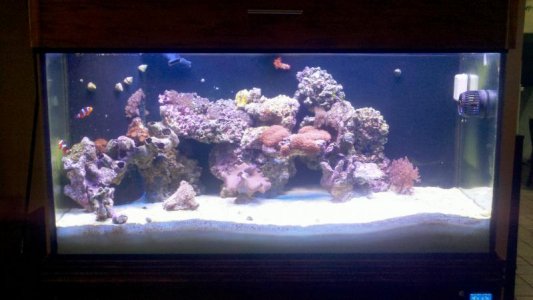
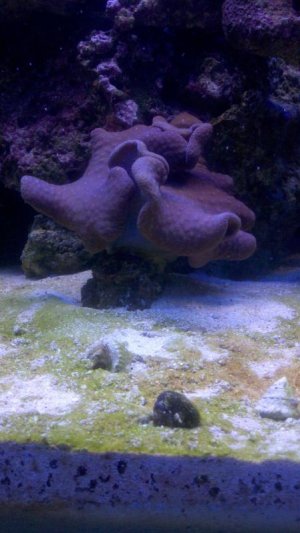
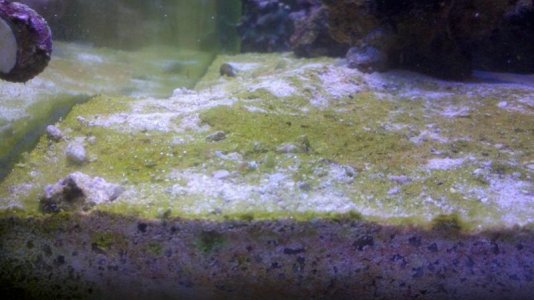
here is some pics
 

Attachments

  • 2013-01-22_21-50-33_307.jpg
    2013-01-22_21-50-33_307.jpg
    28.6 KB · Views: 10
  • 2013-01-22_21-50-12_228.jpg
    2013-01-22_21-50-12_228.jpg
    47.1 KB · Views: 9
I dont see any problem with your sandbed from these pictures. Your bio-load is small and the tank looks too new to have an H2S problem. The bubbles in the sand might just be air that is trapped there from when you filled the tank. Stir that sand bed once or so a month, dont overfeed and you will probably never have to worry about sand bed problems.
 
I dont see any problem with your sandbed from these pictures. Your bio-load is small and the tank looks too new to have an H2S problem. The bubbles in the sand might just be air that is trapped there from when you filled the tank. Stir that sand bed once or so a month, dont overfeed and you will probably never have to worry about sand bed problems.

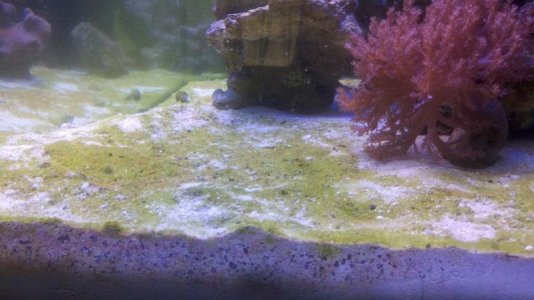
I have heard to never stir a deep sand bed because u can trap live to deep and it will decay. and the picture really doesnt do it justice, i will try to get a better one today when i get home. but there are very close to black spot all around where i think the live rock is on the bottom of the tank.

and the bubbles i see in the sand bed near the glass are not trapped from the original instillation. they have accumulated at bacteria makes it.

now i have heard two different things. 1 that these are nitrogen bubbles forming. and 2 that they are oxygen bubble forming.
both of which have positive connotations, but the nitrogen theory is kind of hard to believe because i whould have to have very large amounts or nitrates in order for the bacteria that converts it into nitrogen to for that much of it. which is not the case. my nitrates are noticable but they are by no means high enough to visually see the formation of nitrogen bubbles to the extent of covering the entire top inch of my sand bed.

does anyone know the truth about these bubbles?

also i have recently had a flame scallop begin to die(i was unaware that it is next to impossible to keep them alive for long). and i think because i had him in there decaying for a few days that i have since then (just before and now after i have removed him) have a severe problem with green algae forming all along the top of my sand bed. i am thinking about siphoning it out but i dont want to get rid of the critters and bacteria that i have waited so long to see and now have.

What should i do? water changes? dosing of something?

i just started up a refugium with miracle mud and am waiting a week or two before i add any live rock and macroaglae(as i read somewhere that i should wait) can i add it now to help with my phosphates? will that get rid of the green layer on top of my sand bed?
 
Im not so sure that by looking at this picture that you have a sand bed deep enough to be considered a true DSB. Thats why I recommended keeping it stirred and clean.Detritus should always be in suspension when ever possible. Thats why flow is imortant in a reef tank. Dirty sand can become a nitrate factory. With regard to the other problems you are having, are you sure the tank is done cycling? I would vaccuum out the algea on the sand, replace what you removed with new sand and see how things go. You might have to do this more then once. You wont remove much of anything beneficial if you just skim the top layer of sand.

The reason for green algea is there is a source of extra nutrients in the tank and the algea is consuming them. Remove the algea and you help remove nutrients the algea has locked away.
 
Im not so sure that by looking at this picture that you have a sand bed deep enough to be considered a true DSB. Thats why I recommended keeping it stirred and clean.

My sand bed ranges from 5" to 7" deep in different spots. It doesnt look that way because the trim around the bottom of the tank is 2" tall.

Detritus should always be in suspension when ever possible. Thats why flow is imortant in a reef tank. Dirty sand can become a nitrate factory. With regard to the other problems you are having, are you sure the tank is done cycling?

I bought this tank in July 2012 from a guy who had it established for 3yrs. Unfortunately including this past/last move and when i first bought the established tank, i have moved it 3 times. And needless to say this is my first saltwater tank.
So my question is: How do i know if the tank is cycling and when it is done??

I would vaccuum out the algea on the sand, replace what you removed with new sand and see how things go. You might have to do this more then once. You wont remove much of anything beneficial if you just skim the top layer of sand.

I was already thinking about just taking the top layer out, but not adding new sand immediately. Should i do that or wait a day, a week, or what?
Does anyone else concur or have a different opinion(s)?

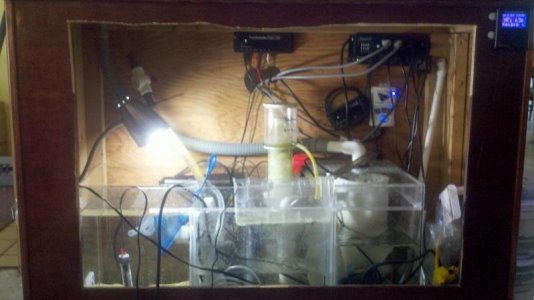
also i have attached some more pics of the tank and sump/(2-day old)refugium
 

Attachments

  • 2013-01-23_14-00-34_16.jpg
    2013-01-23_14-00-34_16.jpg
    53.2 KB · Views: 9
  • 2013-01-23_13-59-59_965.jpg
    2013-01-23_13-59-59_965.jpg
    55.5 KB · Views: 12
  • 2013-01-23_14-00-13_274.jpg
    2013-01-23_14-00-13_274.jpg
    54.6 KB · Views: 9
  • 2013-01-23_14-56-51_654.jpg
    2013-01-23_14-56-51_654.jpg
    43.1 KB · Views: 9
Back
Top