Question about current mirror in LED array design

Aqualund

New member
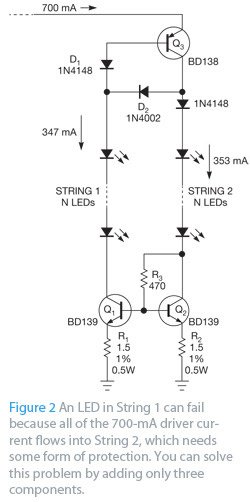
Hello, looking for some of the more advanced electrical peeps to see if I can get some insight on this question. According to this article: http://ledsmagazine.com/features/6/2/2, current coupling is the way to go in order to make parallel strings feasible and safe. In the article they are using 350mA osram leds. With that, and all the known values...I have no clue how they came up with using the 680R resistor in the last diagram.

Can anyone shed light on their method for calculating the proper resistors? Specifically, the two 680R's they use in the last diagram, and if so, shed some light on what resistors I should use in my array of 700mA leds driven by my choice of either 24v or 36v driver...to where I would like to keep V at about .9 (7 leds per string)....so .9V/.7mA = 1.3 Ohm, right?

Ive tried different variation of ohms law with their numbers and for the life of me cant come up with how they got 680R's as the solution.
 
might I suggest this thread:
http://www.reefcentral.com/forums/showthread.php?p=21858074#post21858074

the 680 resistors are not shown correctly as it was explained to me in that diagram.
They are intended to compensate for the current used by the transistors and pulled away from string 1 in order to operate the mirror. String 1 should not have a 680 resestor connected to it's base as the diagram shows.

I don't like this approach as it appears that it will waste alot of the excess power if one string fails. (I need to build one but never have enough spair parts laying around)

There is a full shut down version on the thread I linked that works beautifully, just pick the proper transistors for your application needs.

or a simplified version with fuses for protection (which I've been running now a very long time and they work great and are very easy to implement without a PCB)
 
Last edited:
Since the start of that current mirror thread the meanwell LDD drivers have came along with some nice pcb designs by O2surplus for them that make the mirrors and parrelel string designs less practical in most applications (except maybe when your talking hundreds of LEDs).
 
so do you think it would be better just to use more ldds? I have about 20 on the way, and at $5 a piece its just less headache?

But btw, thanks for replying and doing the legwork you did on this.
 
Zachts...from what I read, in that thread, do I have the right idea on the wiring schematic? I have a few questions...

1. your schematic shows a 700mA in to the circuit...but you described using a 1050mA driver? do you have it turned down?

2. Are your leds rated for 350mA or 700mA? What is their forward voltage?

3. What are you using to calculate the value of the 470 ohm resistor?

I will likely be doing a test run of 30 leds in this configuration before doing a few hundred, and I would like to be able to do the math myself.
 

Attachments

  • schematic.jpg
    schematic.jpg
    25.8 KB · Views: 2
1. that is just a schematic off the internet. the circuit will divide what ever driver current you put in as long as the components can handle it.

2. Depends. at minimum 700mA but I use cree and luxeon also. doesn't mater as long as same LEDs on each string. (though it will balance if they are different it just gets really hot and needs heatsinked)

3. It is in the wrong place in that diagram and I ended up not using it and adding a third diode to the mix to balance things out. I didn't test beyond that, got busy with work and smaller multi channel builds. It is intended to compensate for the current drained from the controlling LED string by the transistors and more accurately match the two strings current. it was working close enough to ballanced for me that I called it a day. michael_in_nc suggested that MOSFETs might work better but I haven't given that any thought.

I'll probably jump back into the current mirror issue this fall when I get around to building some plant lights.
 
Back
Top