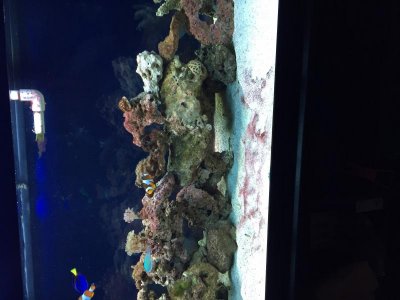
Red algae, cyano??

Dust_draf

Member
Hey everyone! Kelvin here, pretty new to this website but im always reading threads from here very often but now its times to actually post lol! I just had a few questions as im new to the hobby as well. I want to say ive been in the hobby for about a year and a half. My main question is why am i getting red algae or cyano? My water parameters are as listed: nitrite - 0, nitrate - 0, Ph - 8.1, Phosphates - .25. My tank is 150g with a 29g sump and an asm g protein skimmer. The tank is currently stocked with 2 clownfish, 1 blue tang, 1 chromis, 1 lawnmower blenny, 2 gobies, and a banded shrimp. I do have snails and hermit crabs but not aware of how many i have lol. I feed them brine shrimp and occasionally mysis shrimp. I run my actinics from 8am to 10pm, my white 10k lights from 1pm to 6pm. Are my actinics on too long? Or is the shrimp leaching phosphates? Anyway, any help os appreciated! Thanks in advance! :thumbsup:
 
I would cut back the actinics to 12 hours and if your not doing so start rinsing the frozen food you use. The companies put a lot of phosphate additives in there so it will help lessen the po4 you add to the tank. As for the cyano a lot of times this shows up in areas do to lack of flow which allows excess food and detritus to build up and then algae goes nuts
 
Thanks for the reply! As for rinsing the shrimp, how do i go about that? And i will cut back on the actinics and get another powerhead. I have two 1320gph powerheads so ill try and get another one to focus on the cyano.
 
You take a cup put some tank water in it and then add the shrimp you want to thaw out to feed your tank. Once thawed out shake out up and then dump into a brine shrimp net and gently squeeze the net tell the food is basically dry again and then you can feed to your tank.
 
Try to firstly understand cyanobacteria, it is needed everywhere and it thrives on every things waste-end result.
Its relatives also gave every thing life via the first oxygen to enable complex life like us to exist and still to this day, nothing would be able exist without it here!
Okay it hates excessive magnesium and the best way to fight it is to set up some phos reduction methods and nitrate reduction as well.
If you starve it via lights out, the reason it came along in the first place, if still there when lights go back on, just remember cyano is in your water, always!!!!
 
Thanks for the great info liquidg! What would be some great phosphate reductions methods? Is running a gfo reactor good or bad? Ive been thinking of getting one but have never used one so im not to sure on how those things realy work.
 
So how goes the fight with cyano?

Its actually working! Lol never thought those small things would have such a great impact. Anyway, the rinsing the shrimp and waterflow has helped a ton. Im trying to figure out how to post pics cause i use this on my phone lol. Thought id show a pic of my cyano
 

Attachments

  • image.jpg
    image.jpg
    54.6 KB · Views: 3
Glad it has helped and yeah I was pretty amazed myself when I first found that video

I know! Thanks, i aprectiate the help! That video had loads of info. Another question, do i have to quote you or people in general so they are aware im replying back? Im mew to this website lol thanks!
 
cyano will come back after lights out unless you keep nitrates above po4.

gha and cyano both thrive in po4 dominant systems. po4 dominant meaning that there is more phosphate than nitrate.

get nitrates to 5 ppm and have it help drive down the phosphates. phosguard or gfo should also be incorporated.

never let po4 get above nitrate and strive for a 16 trate to 1 po4 ratio.

this is referred to as the redfield ratio. incorporating other bacteria such as mb7 and stability during the EVENING will also help.
manually remove whatever cyano you can
 
cyano will come back after lights out unless you keep nitrates above po4.

gha and cyano both thrive in po4 dominant systems. po4 dominant meaning that there is more phosphate than nitrate.

get nitrates to 5 ppm and have it help drive down the phosphates. phosguard or gfo should also be incorporated.

never let po4 get above nitrate and strive for a 16 trate to 1 po4 ratio.

this is referred to as the redfield ratio. incorporating other bacteria such as mb7 and stability during the EVENING will also help.
manually remove whatever cyano you can


Are you saying its best to keep Nitrates at 16?
We strive for 0 po4 and if we are to keep nitrates at 16 to ratio with 0 phosphate.... i have 0 phosphates and my nitrates are below what most test kits can read... ...

Also OP One thing to think about with Nutrients... You can have algae growth and low Nutrient FACTORS on test kits.. Sometimes if you TEST Because you see a OUTBREAK. Your test is only a number. Because you cant Measure what the outbreak Contender is Consuming... That Amount of Nutrient consumption would be building up had the Cyano or GHA NOT BEEN there.. Its how nature balances things..
So by watching your Feeding. Rinsing the food adjusting light cycles.. You lowered the Available nutrients for the Cyano Before it Became High nutrient levels.......

MY Conclusion to a long winded and probably bad written paragraph..
Use test to keep a eye on nutrients when they are WITHIN Check. But once there is a OUTBREAK. Use your eyes .Test results matter not as long as the Stuff is growing....
Glad you have a handle on it .. GHA AND Cyano can be a pain....
 
Are you saying its best to keep Nitrates at 16?
We strive for 0 po4 and if we are to keep nitrates at 16 to ratio with 0 phosphate.... i have 0 phosphates and my nitrates are below what most test kits can ...

i can detect .1 ppm nitrate. that terrible advice kills every seriatopora if i actually had 0. and my system can be 0.

if you have 1 ppm po4 obviously get some phosguard or gfo and drop it down. the universal consumption in the ocean is 106c:16no3:1po4.

if you have .1 ppm po4 raise nitrate to 1.6

regardless what you read, or observed, or what your api kit tells you, photosynthesis cannot occur with 0 nitrate and phosphate.
 
Last edited:
Thank you all for chimming in, you guys are giving me excellent advice and im glad you guys are taking your time to inform and educate me as im only a beginner! Im learning as i go and this advice is excellent. I will keep this thread updated with my battle against cyano. As far as chemically removing phosphates, would a gfo reactor have any posotive impact? Ive read a lot of mixed opinions, you all are very experienced and i would like to listen to your advice. Also, RussIV, you mentioned to never let phosphates go above nitrate, how do i keep my nitrates a bit higher? sorry for the rookie questions lol. Thanks again
 
Thank you all for chimming in, you guys are giving me excellent advice and im glad you guys are taking your time to inform and educate me as im only a beginner! Im learning as i go and this advice is excellent. I will keep this thread updated with my battle against cyano. As far as chemically removing phosphates, would a gfo reactor have any posotive impact? Ive read a lot of mixed opinions, you all are very experienced and i would like to listen to your advice. Also, RussIV, you mentioned to never let phosphates go above nitrate, how do i keep my nitrates a bit higher? sorry for the rookie questions lol. Thanks again

use gfo. once it hits 0 turn it off. rinse and repeat on weekends. if po4 is higher than 16:1

if you are having trouble getting nitrate, dose potassium nitrate like i had to. (and still do).

with your po4 you wont hit 0 though. the lack of nitrate to put po4 in its place is lacking so itll ALL be on gfo to do the job which is huge. (like change gfo out every 3-7 days huge).

i use seachem flourish nitrogen

if you are carbon dosing, just turn the reactors off.

tbh you have a bacterial infection in the tank. you can go the slow road, but it will take a while and you really need to know what you are doing. lights out will buy you time but it wont balance the system. that is where the nitrate/po4 issue is coming from.

a simpler fix would be to remove all you can, then dose chemiclean at 1/2 the doseage recommended.

otherwise, lights out, dose competing bacteria and fight the good fight. also cyano will "bind" nitrates. whatever you do, make sure you manually extract what you can before anything to avoid toxins released.
 
Last edited:
I'm having a I little outbreak...nothing crazy just on the rocks and not on the sand. I forgot to turn my lights off before I went to work one night and they stayed on for more then 24 hours. At least I'm pretty positive that it's cyano and not coraline lol


I'm having a I little outbreak...nothing crazy just on the rocks and not on the sand. I forgot to turn my lights off before I went to work one night and they stayed on for more then 24 hours. At least I'm pretty positive that it's cyano and not coraline lol


yup. parameters?
 
Back
Top