Reef fish evolution

Luiz Rocha

Salty Dog
Since a discussion about this topic started on another thread I decided to start a new thread about it to clear up some misunderstandings and maybe inform the community in general.

First, let me start off by saying, this is a fascinating subject that stirs passion and often people make it political. Let's try not to do so here, you know that if it gets political the thread will be closed and that's the end of it.

So, there are hundreds of definitions out there, let me start by pasting the scientific and most accepted one just to make sure everyone is in the same page:

Evolution: Biological evolution, simply put, is descent with modification.

Natural selection: The process by which biologic traits become more or less common in a population due to consistent effects upon the survival or reproduction of their bearers. It is a key mechanism of evolution, a.k.a. survival of the fittest.

With those two concepts in mind, let me tell you that the reef fish fauna that we see today is a result of tens of millions of years of evolution. I will start off with some photos of fossil reef fishes from the Monte Bolca formation in Italy below. Hopefully this will generate some interest and discussion about this fascinating group of organisms that inhabits so many living rooms today.

50 million years old damselfish fossil (Palaeopomacentrus orphae).
Alt_420Palaeopomacentrus20orphae20fossil.jpg
 
;)

Reefs are one the oldest known biotopes in evolutionary history.. The evolution of reef biotopes in general has often been described as "The same evolutionary play with different players"

It is amazing over time how differnt organisms show similar evolutionary traits when facing similar characterisic selective pressures. Reef fauna has changed dramatically over time. Long before there were the first real reef fishes (circa early devonian), vastly different organisms filled the roles of todays reef fishes.
 
One of my favorite pics... "proto-clownfish." Definitely helps to illustrate one possible route towards specialization.

Anakao_Madagascar.Fish_Three-spot_dascyllus_Dascyllus_trimaculatus.580.0xb1710952c78235b.PA270325.JPG.aspx
 
This could easily become one of the best threads ever. There's no point in arguing here...this could be a great place to share information about some of the reasons that some of the fish in the sea have their behaviors, relationships, and colorations.

Here's a question I've wondered about before: Is there any information about the inheritance of the ability to change sex in certain reef fish? I know that some fish are simply not dimorphic but never read much about why some fish have the ability to change sex. Also, clownfish start out as males where as anthias start as females (correct me if that's too generic) but is there any specific period this began to occur?
 
Did that 50 million year old damselfish crack its own fossil? Man, they' re mean :).

Ever see a school of fish move as if they were one organism? Looks just like a flock of starlings. I have always been amazed at the similarities. Fish evolution seems similar to bird evolution. Individual species developed very specialized characteristics selected for by specific environmental characteristics. Amazing diversity.

Starlings

Anchovy

Dan
 
Great question about sex-changing Dustin. Actually there is not a lot understood about it. Here is what we do know, the order of the sexes is more or less phylogenetically stable, which means that many closely related species in a group have the same strategy, indicating that they all had a common ancestor with similar characteristics.

Clownfish do start as males (the technical term for that is protandry), and not only anthias, but also most wrasses start as females (protogyny). Some species (like the Caribbean hamlets) are simultaneous hermaphrodites. Again, the entire group of hamlets (genus Hypoplectrus) shares the same reproductive strategy, also indicating a common ancestor. Changing sex is an evolutionary advantage because in general fishes that change sex don't have to worry about finding mates. If the dominating female on an anemone dies, the local males don't have to wonder around looking for another one (exposing themselves to predation), they can just sit tight and wait for the next largest male to change sex. It is also advantageous because each individual has the opportunity to reproduce as a different sex, and the female energetic investment from a biological point of view is usually higher (eggs are bigger than sperm).

As for the specific period when hermaphroditism started, since it is present in so many groups (wrasses, groupers, damselfish, gobies, seabreams, etc), and we haven't yet accurately dated when those fish diverged, it is really hard to tell. We do know that it was early in fish diversification history and in general families containing hermaphroditic fish today are very diverse, indicating that it is a successful reproductive strategy.
 
Last edited:
Did that 50 million year old damselfish crack its own fossil? Man, they' re mean :).

Ever see a school of fish move as if they were one organism? Looks just like a flock of starlings. I have always been amazed at the similarities. Fish evolution seems similar to bird evolution. Individual species developed very specialized characteristics selected for by specific environmental characteristics. Amazing diversity.

Starlings

Anchovy

Dan

Wow, that is an amazing similarity. Convergent evolution is a fascinating subject...
 
Luiz,

Thanks for the response. Never thought of reproducing as both sexes in a lifetime! Too cool.

I have another one for you that I've wondered recently. Here in the mountains of NC/TN there are distinct species of salamanders + newts that were separated by rains/flooding/vegetation long ago that started as a single species. Each species was isolated to different peaks of mountains...some on the same peak but separated by varying elevations. Now many are living together again and just recently it was determined that they were different species entirely. Similarly, some of these amphibians were thought to be different species but had in fact been the same due to such minimal evolutionary changes over the years.

I love Lyretail Anthias and the specimens from Fiji are different from the Maldives to a degree but they do not live amongst one another in either place (that I know of). Are there any other extreme differences of fish such as this on single reefs? For example, some reefs were isolated for long periods of time but the fish went through minimal changes and are still considered the same?

Given that fish are very mobile I would imagine this wouldn't really occur beyond things such as purple and yellow tangs living together. I guess this is a really open ended question because most families have a common ancestor...but I'll see what you say about anyway!

Thanks,
 
Another good question, there are so many cool examples.

So, here we go, I assume you know that the Earth goes through glacial cycles every 100k years or so. Today we are in what we call a warm interglacial. During interglacial periods, due to warm temperatures glaciers and polar icecaps melt and sea level rises. During cold glacial periods the opposite happens, glaciers get bigger and sea levels drop by as much as 300-400 feet.

With sea levels that much lower, many of the islands in Indonesia connect to each other forming a gigantic land bridge between the Indian and Pacific oceans, what severely restricts fish movement between those two oceans. We now have evidence that shows that this process is responsible for the formation of several species pairs, with one component of the pair in each side of the barrier. Now the similarity to your system, during warm interglacial periods, high sea level allows for much more connections between the oceans and Indian ocean species "invade" the Pacific (and vice-versa). So, even though we do find those separate species in each ocean, some areas have both species. Here is an example:

Chaetodon lunulatus from the Pacific:
C_lunulatus.jpg


Chaetodon trifasciatus from the Indian Ocean:
C_trifasciatus.jpg


They are isolated for the most part, but co-occur and now hybridize in many parts of Indonesia.
 
beautiful fish. though i think the theory of evolution is interesting, i prefer not to support it. i'm just here for the fish! lol
 
I love these topics. Like why does the C. auriga from the Red Sea lose it's dorsal spot? Or how about all the different "pearlscale" butterflies? :)

350_500_csupload_22808115.jpg
 
Last edited:
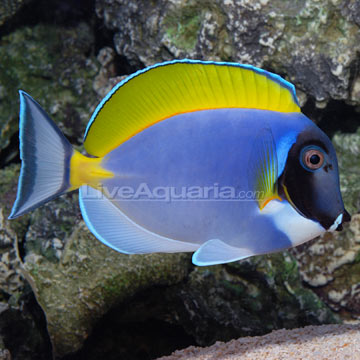
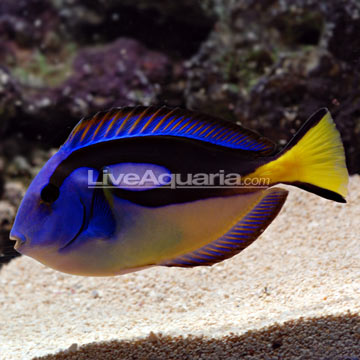
Luiz, has there been any theories explaining why blue/yellow is a very common combination in reef fish?

resplendent.JPG


p-66024-angel.jpg


p-70444-yellowtail-damsel.jpg


p-67142-imperator-juven.jpg


lg-90004-pseudochromis.jpg


p-74214-Powder-Blue-Tang.jpg


p-39901-tang.jpg
 
Great questions guys, some possible answers:

I love these topics. Like why does the C. auriga from the Red Sea lose it's dorsal spot? Or how about all the different "pearlscale" butterflies? :)[/img]

The explanation for the different C. auriga (and many other slightly different and/or unique fishes) in the Red Sea has to do with the glacial cycles that I just talked about too. The connection between the Red Sea and the Indian Ocean, the Bab el-Mandeb Strait, is very narrow and shallow, so when the sea level is lower fish get isolated in the Red Sea and differentiate. There are even some periods in which the Red Sea was completely cut off from the ocean.

Luiz, has there been any theories explaining why blue/yellow is a very common combination in reef fish?

Yes, many theories out there, but the most accepted one is the following:

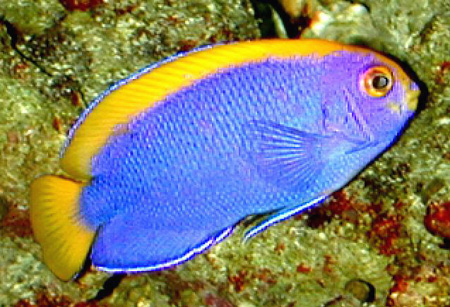
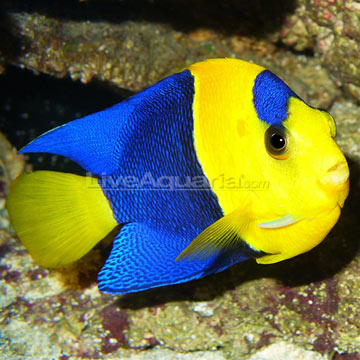
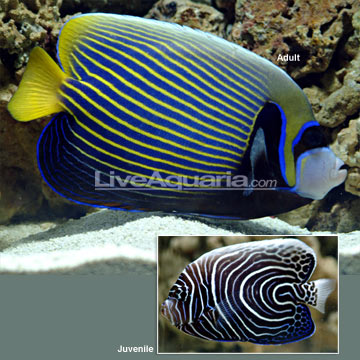
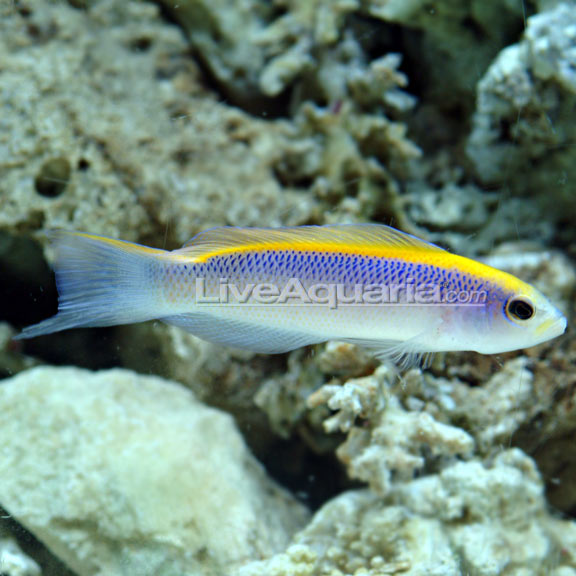
Fish use colors mostly for two things, display and/or camouflage, but regardless of the reason, the visual signals emanating from reef fish all depend strongly on contrast. Yellow and blue are an extremely effective combination, with peaks in different parts of the spectrum. The two colors are said to be complementary—exhibiting a high degree of contrast—because of this spacing of their spectral peaks. In addition, because of their wave lengths, yellow and blue propagate further in the water than other colors like red.

Here is a link to an excellent article on color in reef fishes if you want to read more about the subject, it is a PDF and that's where I extracted the explanation above from:

Article in PDF about color in reef fishes
 
The striping on the Red Sea auriga also looks quite different (at least to me). I'm surprised that they are genetically the same species, while fish like xanthurus and the IO mertensii are different. I find the differentiations just so interesting though! I wonder what "allowed", or was lacking for, the red sea auriga to no longer require an eyespot as an adult.
 
The striping on the Red Sea auriga also looks quite different (at least to me). I'm surprised that they are genetically the same species, while fish like xanthurus and the IO mertensii are different. I find the differentiations just so interesting though! I wonder what "allowed", or was lacking for, the red sea auriga to no longer require an eyespot as an adult.

A few things, first, we are not so sure the Red Sea and Indo-Pacific auriga are the same. I was just in Saudi Arabia a few weeks ago and collected a bunch exactly to test this, so I will let you know.

As for the lack of the eyespot in the Red Sea auriga, it has never been tested, but there are several possible (yet not confirmed) explanations. One possibility is that the eyespot in the Indo-Pacific auriga is not all that advantageous, and because the Red Sea auriga was isolated from the remaining ones, they may have lost the spot just randomly but the no-spot morph remained in the Red Sea. Another explanation is that selection to have the spot is driven by predators that are not in the Red Sea. The problem is that those hypotheses are really hard to test...
 
what interests me is the fact that gobiesl/blennies/dragonnets have a fused fin allowing it to "suction" itself upon the terrians .
 
what interests me is the fact that gobiesl/blennies/dragonnets have a fused fin allowing it to "suction" itself upon the terrians

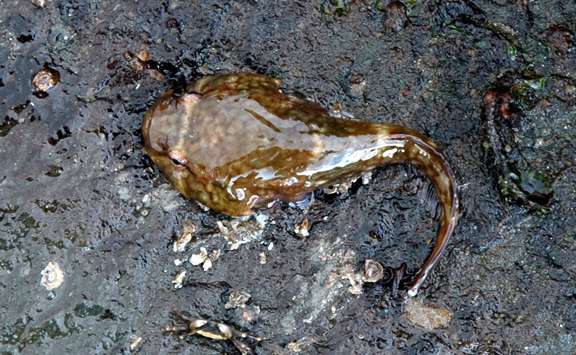
Yes, that is a very interesting adaptation. Blennies and dragonets don't have fins completely fused though, only gobies and clingfishes (family Gobiesocidae, not common in the aquarium trade). Clingfishes are the most extreme examples, they attach to rocks in the intertidal and hold on even when waves hit them.

clingfish2.jpg


And a ventral view showing the fused fins:
clingfish_ventral.jpg
 
Back
Top