Second Story Question

chrismhaase

Active member
So I have lived in FL most of my adult life and have always lived in ranch/single story homes. I now live in a multi level home and I want to start a 150 or 180 gallon tank on the second story. Any issues in doing this? I assume not.

As a FYI the home was built in 1985 and the tank will go against an outside wall.
 
Seems like weight could be a real concern in this type of situation.

Using some rough math, you're probably looking at over 300 pounds for the empty tank, 150 or so pounds of rock, and probably over 800 pounds of water... conservatively, you may be talking about putting a load on the floor of around 1,250 pounds or more.

If you do it, I'd definitely make sure it goes above a structural beam to at least help keep some of that weight off of the parts of the flooring that weren't designed to carry a load.
 
Seems like weight could be a real concern in this type of situation.

Using some rough math, you're probably looking at over 300 pounds for the empty tank, 150 or so pounds of rock, and probably over 800 pounds of water... conservatively, you may be talking about putting a load on the floor of around 1,250 pounds or more.

If you do it, I'd definitely make sure it goes above a structural beam to at least help keep some of that weight off of the parts of the flooring that weren't designed to carry a load.


Water volume alone in a 150 would be around 1250lb not including nothing else. That's some heavy weight.
 
Well I guess I will start with an assessment of which way the rafters are running. Hopefully they will be perpendicular to the tank and wall. If not I will get a structural engineer to take a look.

Never easy I guess.
 
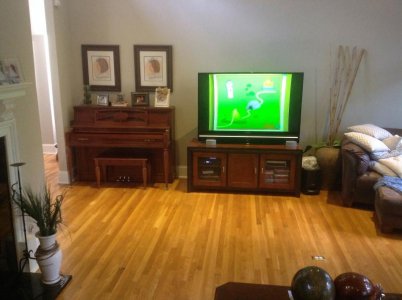
So this is the wall that I want to put the tank on. I had approval to move the piano. The wood is running perpendicular to it and the rafters are running in parallel. I went downstairs under the living room and pulled a light box out of the ceiling and verified my fear that the rafters are not running the way I need them to.

So I guess this is going to be a no go for me. I either go with a smaller tank 60-90 cube or find another wall which will cause more begging and placing the tank in an area I can't always watch it. This stinks!!!:mad2::mad2::mad2:
 

Attachments

  • image.jpg
    image.jpg
    53.3 KB · Views: 21
As was mentioned above, you are looking at adding close to 2000 pounds of weight to a joist floor. How the floor was constructed and how the floor joists are oriented relative to the tank also come into play. In addition, even if the floor 'holds,' if there is excessive bounce due to the load, it can cause strain on the silicone tank joints and/or stand leading to premature failure.

It certainly can be done, but it is difficult/impossible for anyone here to say whether it can be done in your house. A few hundred dollars to have a qualified structural engineer look at the construction would be well worth it before investing many times more in a tank and livestock.

This post gives an idea of the issues involved
 
As was mentioned above, you are looking at adding close to 2000 pounds of weight to a joist floor. How the floor was constructed and how the floor joists are oriented relative to the tank also come into play. In addition, even if the floor 'holds,' if there is excessive bounce due to the load, it can cause strain on the silicone tank joints and/or stand leading to premature failure.

It certainly can be done, but it is difficult/impossible for anyone here to say whether it can be done in your house. A few hundred dollars to have a qualified structural engineer look at the construction would be well worth it before investing many times more in a tank and livestock.

This post gives an idea of the issues involved

Thanks for posting that article. I just read it and now I am trying to figure out a second plan. Looks like the big build may be on hold.
 
It may work - I can't say that it will or won't. But you're wise to pause. When you're investing the time and money in a big tank, take the time to do it right!
 
So this is the wall that I want to put the tank on. I had approval to move the piano. The wood is running perpendicular to it and the rafters are running in parallel. I went downstairs under the living room and pulled a light box out of the ceiling and verified my fear that the rafters are not running the way I need them to.

So I guess this is going to be a no go for me. I either go with a smaller tank 60-90 cube or find another wall which will cause more begging and placing the tank in an area I can't always watch it. This stinks!!!:mad2::mad2::mad2:

The good news is that you know that the floor can hold around 800lbs where the piano is since it hasn't decided to pay a visit to the ground floor yet... note, 800lbs is if it's a large upright piano. I can't really tell from the photo whether it's a large one or a small upright.
 
It is actually a smaller piano, probably 30" deep. I didn't move it but from the looks of the three guys who moved it, it was really heavy.
 
what are the dimensions of the "rafters" actually called joists rafters are for the roof.

What is the span from the exterior wall to the main center wall of your home?

What is below?

Your tank certainly won't collapse your floor but it may cause deflection that will put gaps in your hardwood and put a bit of strain on your stand. Your tank will be fine provided your stand is up to par.
 
I have 2X10 joists every 16" and on top of it is 3/4" or 1" particle board. Then from there are real wood floors. I am thinking I would feel comfortable with a 120 and 40 gallon sump.
 
2x10 @ 16" provides a lot of strength. Even a 180 might be do-able depending on the orientation of the tank over the joists... 72"/16"= 4.5. With wood floors and assuming the 3/4 material isn't particle board, I would consider 5 joists to be taking the load. 180gallons *10#/gal(conservative) = 1800#. 1800#/5 joists = 360#/joist. Imagine 5 fat people standing side to side.

to be REAL conservative take the weight over 4 joists... 1800/4= 450. Imagine 8 average sized people standing next to each other.

There are plenty of design charts and other useful tables you can find online to help see what your floor is rated for, based on span length, type of wood and joist spacing.

Good luck
 
Back
Top