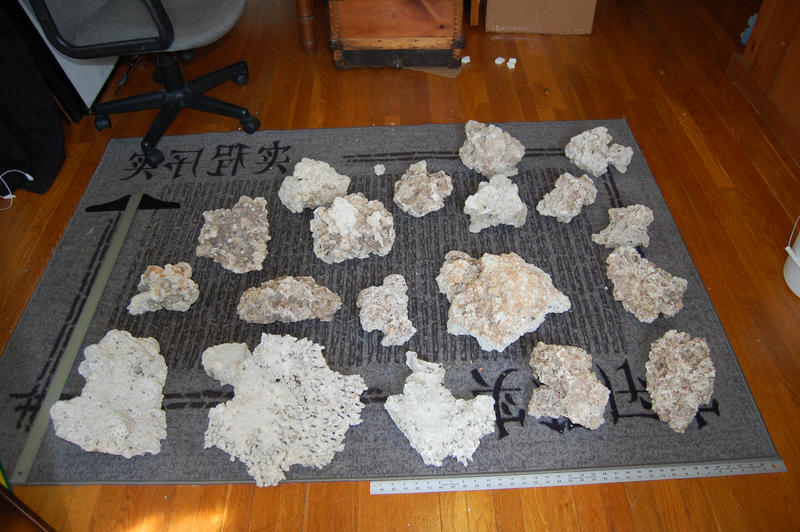
Should I cook Marco Rocks (dead base rock)?

tonyespinoza

Premium Member
Setting up a new SPS system largely based on dead rock (similar to Marco Rocks but from Bulk Reef Supply since the Marco folks didn't even bother to email me back and BRS rocks (no pun intended!)!).

Should I cook these?

Seems like there are two options:

A) cook like normal rocks going through saltwater changes and dunking and swishing all the while in total darkness, with circulation and a heater.

B) soak in 10% bleach for a couple days, then freshwater for a few more and air dry.

C) Same as B), but follow with "cooking" in freshwater in total darkness assuming there's some bacterial activity that will further cure the rock.

of the options above, B seems most logical. A seems strange since there's nothing to keep alive in the rock, but thought i'd check with the experts here.

the notion is that i want to remove as much phosphate (or other nutrients) as possible from the rocks and have heard of folks having issues when they don't somehow prep these rocks.

-tE
 
cooking it won't accomplish much since there's no life to 'cook' off.
to remove excess phosphate, you need to soak in freshwater and do total water changes at least once a week until the tests show no PO4. if the rocks are small enough, you could even put them in the toilet tank for treatment and get constant WC's.
 
good to know, about to place an order myself.

seems to be a lot of different views on what to do, but this makes the most sense, and is cheapest! I would probably do RO water though since it will pull out the phosphates better... regular tap water could even add contaminants to the rock.
 
Go with bulk reef supply if they have rock in, way faster. Shipping to cincy was less than 40 bucks and it arrived at my door 72 hours after my order.

Mine came super clean but I soaked it anyways. Its in my tank running right now, the skimmer is pulling out some stuff but I threw food in to help get some algae/bacteria in there.

Been running for a week and half, tested for no ammonia. I do not have a phos test but I dont see why there would be phosphates if there is no ammonia because I am guessing it would all have come from dried up critters on the rock.

120lbs (only ordered 100):

Rock_2_by_Logzor.jpg
 
there's phosphate because dry rock is mined from below the surface and anything that was alive for the last 6 million years or so died and deposited all it's phosphate into the earth as it decomposed (PO4 is a building block of all DNA). carbonate rock soaks it up. ammonia is the result of new organics breaking down and being metabolized and isn't related to phosphates.
 
i've got 200 lb of BRS rock showing up any day! :-)

thanks for the advice rick!

next question:

if i *don't* choose to seed with live rock, will the tank cycle and provide biological filtration adequate for SPS? i know it's not going to have the bio diversity, but i will be running a large fuge and a large cryptic zone. just trying to create as much of a "refugium" for SPS in my display as possible. it's shallow, 60x40x20 and will have nothing but freshly cut frags from aquaculture so almost no chance of pests. in this particular tank, i'd be fine with a lower level of biodiversity as long as the corals are happy. i do run some zeo products and reef fuel for my bacterial system.
 
I dont think mine was mined below the surface, it still has squishy sponge tissue growing on it, purple coraline algae, and some small bivalves that still have color on them. Maybe below the surface of the water or partially under some sand.

How the heck would you get a fragile shelf piece like the ones they gave me from below the surface?

New_Rock_3_by_Logzor.jpg


Here is what I did with the rock:
Rock_in_Tank_by_Logzor.jpg
 
hey rick - just had a thought. does my deltec phosphate kit work with fresh water? or do i need to go get a freshwater version of the test!? if so can you recommend one?
 
I've never used deltec kits. I find the red sea phosphate kit fairly accurate for the price and yup, it also tests fine in freshwater.
that doesn't look like standard florida/bahama base rock, did you get their fiji dry rock? I believe that may be the stuff collected as live rock, tossed up on a shore collection point to sun dry/bleach then containerized and sent over by ship (think months). this rock could have dead life and may need to be cured. check your ammonia levels in a few days.
 
hey rick - so i got the same fiji dry rock... so as far as "curing" goes - should i do so in saltwater (a la cooking) or is it possible to do in fresh water? also, would bleach help accelerate breakdown of any organisms/organics in the rock?
 
since the point of 'cooking' it is to rid it of algae, etc, without killing the bacteria, and there's no bacteria left now anyway, I'd say soak it in RO water for a few days then test the phosphates. if the phosphate level is good, bleaching it in regular chlorox (no scents, no economy stuff) will oxidize most of any remaining organics off of it. a sun dry for a day or two will gas off any remaining chlorine.
if phosphates are detected, a FW cure until PO4 is gone would be the way to go.
 
I'd recommending to give you rock a few weeks to cure, I bought 50 lbs of the Pukani and some shelves, and while it looked pretty clean, there was some dried algae down in the deep cracks. I noticed it more after soaking it a week in salt water and the water turned a light tea color, and when I swished the rock around a few bits of re-hydrated algae came out of it. Checked nitrates and the water the rock was in was reading about 80. I changed the water completely, swished the rock off in fresh salt water, and soaked it another couple weeks. This time the nitrate was 5, so I figured it was ready, and put it in the tank. It's been great, and within 3 weeks the coralline have begun to cover some of the rocks completely. It's well worth the effort, and has worked out quite well in the end.

And it's definitely not "mined rock". The pieces I have are definately coral skeletons, and quite porous at that. They look like rocks that may have been washed up on the beach, or broken off into rubble piles, as some are smoother than others, but you can still see the coral that made up with rock when you look at it.
 
<a href=showthread.php?s=&postid=13578564#post13578564 target=_blank>Originally posted</a> by tonyespinoza
hey lee - thanks for tips! mind if i ask why you wanted to cure it in salt water vs. fresh?

I had spare water from doing some water changes, and thought that it would help get the bacteria growing on the rock. I don't know if it helped, but the coralline did find it rather quickly when I put it in the tank. The first small spots began just a week after it went in the tank, though I don't know if soaking in old salt water helped it on that or not. I guess it's possible that the coralline spores were in the water and began to settle in on the rock even before I put it in the tank.
 
I got a 50lb box from marcorocks in June and was very pleased. I did as marco recomends and just put in in my tank and started cycleing.

2 months i was at zero. Although i've just gotten my first fish this past week to help mature the tank. Got first coral in tank a month ago : )

Also i didn't think about how much wieght the rock takes on once wet. I had a 50 gallon system so i got 50lb rock. Once wet it will take on 1-1.5 lb more per 1lb. FYI now i got 25 extra lb's.
 
Back
Top