Happyschneider
New member
Hi all,
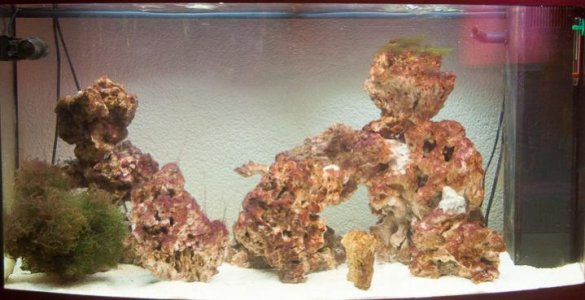
I just started with sea water aquariums so I hope that some of you might be able to help me. My 180 liter tank (approx. 40 gallon, JUWEL VISION 180, approx 15 liters of stones (half LR and half dry LR) and sand) is running for a good 2,5 months now and is pretty much established. The values are more or less stable.
Temp 25 °C (+/- 1°)
salinity 34 ppt (refractometer)
pH 8.0 (+/- 0.2 depending on when I measure, using an electronic, freshly calibrated)
phosphates 0 ppm (milwaukee)
ammonia 0 ppm (salifert)
nitrates 5 ppm (salifert)
magnesium 1275 (salifert)
calcium 425 (salifert)
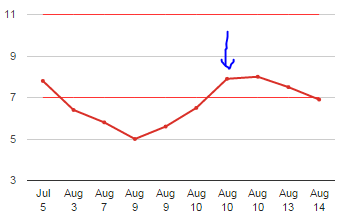
The only value that bothers me is the alkalinity. Ever since I started measuring it, it seems low (started at 6). I then got it back up to 7.5 using carbonate (fauna marine). Unfortunately, it seems not stable as it went back down. It is now back at 6.9. I am not sure what could use it up at the moment as I do not have any complicated corals.
I have a sand bed (shallow, approximately 3cm/1'), some hermite crabs, turbo snails and some nassarius. Almost no algae anymore but a lot of cyano growth. Is it possible that the cyanos are the things that are using up the alkalinity? There is also a ball of Caulerpa that is supposed to help me with the nutrient removal for the cycling period. I plan to remove it soon.
Corals in the system at the moment: sinularia flexibilis (1 week, 3 arms, approx 5 cm long, not very happy, the attachment seems to get brownish so probably need to cut that one off), Briareum sp (1 week, about 3 by 2 cm, happy, polyps already out and fluorescent green), Zoanthus sp (1 week, about 1 cm radius, happily opening up), easy to keep gorgonia (1 week, about 5 cm long, happy as far as I can tell). To my understanding none of these should use up the alkalinity like this and also they came into the system after I adjusted the alkalinity (original measurement and adjustment was done before I bought the corals).
Another lead might be that the tank stands in a cellar room where we are not very often. So there might not be much CO2 in the air. Also, the tank is covered by the JUWEL cover. Maybe this is a problem for CO2?
Appreciate any thoughts or input, thanks!
Michael
I just started with sea water aquariums so I hope that some of you might be able to help me. My 180 liter tank (approx. 40 gallon, JUWEL VISION 180, approx 15 liters of stones (half LR and half dry LR) and sand) is running for a good 2,5 months now and is pretty much established. The values are more or less stable.
Temp 25 °C (+/- 1°)
salinity 34 ppt (refractometer)
pH 8.0 (+/- 0.2 depending on when I measure, using an electronic, freshly calibrated)
phosphates 0 ppm (milwaukee)
ammonia 0 ppm (salifert)
nitrates 5 ppm (salifert)
magnesium 1275 (salifert)
calcium 425 (salifert)
The only value that bothers me is the alkalinity. Ever since I started measuring it, it seems low (started at 6). I then got it back up to 7.5 using carbonate (fauna marine). Unfortunately, it seems not stable as it went back down. It is now back at 6.9. I am not sure what could use it up at the moment as I do not have any complicated corals.
I have a sand bed (shallow, approximately 3cm/1'), some hermite crabs, turbo snails and some nassarius. Almost no algae anymore but a lot of cyano growth. Is it possible that the cyanos are the things that are using up the alkalinity? There is also a ball of Caulerpa that is supposed to help me with the nutrient removal for the cycling period. I plan to remove it soon.
Corals in the system at the moment: sinularia flexibilis (1 week, 3 arms, approx 5 cm long, not very happy, the attachment seems to get brownish so probably need to cut that one off), Briareum sp (1 week, about 3 by 2 cm, happy, polyps already out and fluorescent green), Zoanthus sp (1 week, about 1 cm radius, happily opening up), easy to keep gorgonia (1 week, about 5 cm long, happy as far as I can tell). To my understanding none of these should use up the alkalinity like this and also they came into the system after I adjusted the alkalinity (original measurement and adjustment was done before I bought the corals).
Another lead might be that the tank stands in a cellar room where we are not very often. So there might not be much CO2 in the air. Also, the tank is covered by the JUWEL cover. Maybe this is a problem for CO2?
Appreciate any thoughts or input, thanks!
Michael