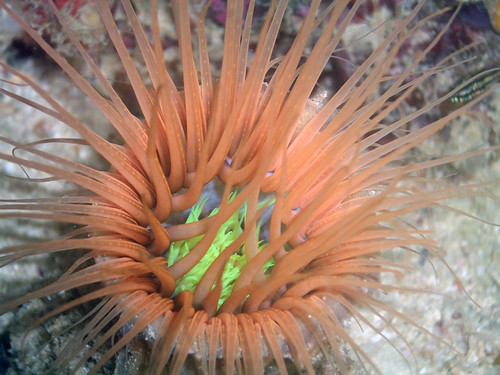
Tube anemone - without tube

dendro982

New member
Just picked the Tube Anemone (Cerianthus) from LFS. It looked fully open and very healthy in the LFS tank, but after arriving home I noticed, that it has no hard tube, soft body only, and the dense cover on the body is torn out and look like a puss at the bottom end. Removed it.

The body is quite alive. I did research more, than year ago, and generally knew, what to expect. Just didn't see absence of the tube in time.

Well, for this night it sits in plastic tube, filled by finest sand (followed information from Toonen article). Cerianthus started to open and look good again, but for how long?

What should I do tomorrow?
1. Put it in plastic tube without sand - how much free space should be between body and walls, how long should it be in relation to the body?

2. Here , pdf file, was mentioned, that it could live without own tube, in plastic or glass tube, covered inside by gelatinous substance.
I could try that, if necessary, but afraid to put it in something, that may rot.

What else?
Any ideas and experiences will be greatly appreciated.

BTW, is it really critical for it to live in tank with temperature 72-75F, with several months in winter at 68F?
It is described as a filter feeder (I'm assuming food size should be less than 200 micron), but that it should be fed by pieces of krill, shrimp or fish.

Did anybody kept them? What they really need?
Thanks.
 
I had one awhile back, but I did not have good success with it. It was missing a hard tube as well, so maybe that was the issue. I also kept it in a bit warmer water. It seemed to do well for about a month, then it went bad. When it was doing well, I would feed it bits of krill, silversides, etc.. It also seemed to constantly be grabbing things from the water column. Every now and then one of its tentacles would retract towards the mouth as if feeding. Feeding on what, I have no clue. One thing I would be weary of is that they will devour a fish or ornamental shrimp if one gets too close. This is the main reason why I wouldn't try one in my tank again.
 
Thank! More experiences welcome, especially with damaged tube anemones.

Here it is - morning after arrival. The damaged part was cut ~7 PM (19.00 for the rest of the world) and body buried in the sand in plastic tube (ReefPlus bottle).

So far it is 2.5 times larger, that it looked in store - 5.5" from the center to the end of tentacles, 90g tank. Seio 630, adult percula clown and young mombasa lion for comparison:
Dec09_07ta3.jpg

Dec09_07ta6.jpg

Dec09_07ta7.jpg


So far burned face of the valentini puffer - likely puffer tried to check, if it is edible. Two white streaks.

Any advices? Will move it in more open space, of course.
 
Call me cRaZy, but I thought they "Built" the tubes around themselves, like Feather dusters...Right??

In my experience, I have had one in a tank I set up before, and it came without a tube. I put it in a medium to low current area. Sucked the sand out of the area, layed it down where I thought it would like to open, and poured the sand over it with a cup. It formed its own tube for me.

Im looking for one of the 3 color ones for my 200gal at the moment.
 
Am I missing something? I've had my tube anemone for over 2 years and it's never had a hard tube,just soft outer tube.
 
You see now, why I am looking for the infrormation from keepers? :D

Thanks! Add more.
Mention temperature, food and frequency of feeding too, please.
 
Temp 78-82 with no problems to date. Mine eats any and everything the fish don't get to first. I normally just let it catch leftovers from feeding fish.
 
Hi dendro

just berry them in fine sand as mentioned they will make their own tube. Be sure that the Cerantius is in a very low flow area which is why it is difficult keeping them with dendro scleros or gorgoninans. They will eat almost everything that you feed your fish from frozen food to flakes.

Cheers
Danny
 
Thank you, people, you are life saviors!
I started to panic a little after reading temperature requirements :p

Had to rearrange rock, powerheads and corals, in order to make lower flow in the only available open area.
 
I have had mine for 7years, its gone through tank upgrades, downgrades and crashes and its still here. This creature is pretty hardy. They have great colors but I have come across people mentioning they eat fish. But it has never happened, if a fish goes near it and gets stung the fish would than jolt across the tank and rub and bounce of the sand alittle and after wards they stop. I notice if you feed them shrimp alot they get bigger, but I don't feed the little guy that much maybe once in awhile. The one I have looks exactly like this one
onlinecerianthid.JPG

more information here
http://www.advancedaquarist.com/issues/june2004/invert.htm
 
How big pieces of shrimps, and how many at one time?
So far mine took a flat thin shave across the shrimp, small krill, but spit out pretty soon the group of mysis and larger pacific plankton (given in the same manner, as for sun coral).

How would you evaluate the flow on the last picture - a little bit too high, but still acceptable?
 
I just cut the shrimp up into 3 pieces and feed once everyweek. Sometimes I add selcon to it. I would say medium flow is best, if you give it too much flow it would look like its flopped over and you won't be able to see the center.
 
Thank you!
Without seeing the size of mouth, I underestimated its capability, and a common description as a filter-feeder added confusion too :p
 
hi dendro,

I have a tube anemone, without the tube also. I placed it in the sand and it seems to have made a new tube within a month, but thinner looking than the tubes of other anemones I see. They say it's a filter feeder, but it's more responsive when fed with bits of shrimp, clam or fish.

I feed mine nightly, it looks healthier than when fed every other day. :)

btw, guys
is your anemone always visible even during the day? mine only pops out during the dark.
 
Thank you! More welcome.

Mine is open all the time - day and night, fully extended. Huge - it should have own 60g hex.

Same with purple frilly gorgonian, that should open at night only, it looks drab, when open.

The tank is 90g (342 L) with 110W PC, 10,000K. Filter feeders food is added several times a day, if this matters.
 
Mine is always out, I agree yrema about the feeding, if you feed it more it looks better. For awhile back I didn't feed the tube anemone and it start to shrink in size. but if I kept feeding it alot the colors would brighten up and get bigger too. great kind of invert and hardy, but most don't want to get them because they heard rumors about fish being devoured by them.
1005659248_a2e0fd25e8.jpg
 
Mine deflated once - after catching piece of the Angel food, but then restore. Sting in the valentini puffer face became almost not noticeable in two days, and hammer and sun baby are recovering after close contact during the whole night too.

Are the thin tentacled (as yours) and thick tentacled (as mine) tube anemones the same species, only young and older?

I'm considering the smaller grape colored anemone with green center, and it is thin tentacled. Will it grow?
And dark violet vs. lighter grape colors - does it depend on health or it is a permanent coloration? I don't like too dark ones.
 
Hello

lets get some correct information in this post and hopefully stop all the rumors about tube anemones. The tube anemone that you have is a warmer water one. you can keep it around 76 to low 80's for temperature. the purple ones can be kept at a lower temperature of around 68 to 75 but they can also be kept at higher temperatures if you would like to. these are very hardy animals and can go threw a lot before dying. they should have a dsb of sugar sand at least 4 inches. more is better here. the pvc tube is also fine for them with sand around them inside. they should not be left on a crushed coral bottom or wedged between rocks. they do not create a hard outer shell but rather build a soft mucus shell out of the sand and stinging cells they produce. try to keep this shell on them if you can unless it is really damaged then you can gently pull it off. it takes a lot of energy for them to create a new one. they are filter feeders and eat anything that sticks to there tentacles. you can feed them any kind of meaty food as well, varied diet is always better. frozen shrimp cut up, mysis, bloodworm's, krill, clams as long as it is small compared to the anemones mouth. even dt's phyto or live brine shrimp don't feed to much or they will spit it up later in the night and 2 or 3 times a week for feedings should be fine. if it grows to big cut feedings to once a week and over time it will get smaller. these are nocturnal animals so they may not like bright light and come out mostly at night. they also get about 1/3 bigger at night then during the day. they will get used to the light over time and also get used to the time for feeding. they may not come out for a day or longer and have there tentacles and body inside there tube, don't be worried just something they do. a moon light is a must for having a tube anemone and fish in the same tank so the fish can see it so they wont get stung. the reports of tube anemones eating fish is a terrible rumor, they may get stung once and a while but if someone here who has one has seen it happen then speak up. i hate hearing everyone post that info with out any proof. it has been clinically proven that a tube anemones sting is actually a lot weaker then a lot of the anemones that we all keep. i have 3 purple kinds in a 5 inch dsb and they are all growing strong, i am currently setting up a 40 gallon with a 8 inch dsb just for them. may keep a pistol shrimp and a catalina goby in the tank with the snail cuc. temp will be 72 and aq 100 for a fuge, no skimmer and lighting for algae growth only. it should be a great project. please dont forget that tube anemones are animals and they can get very big. some cold water species can be over 4 feet. cooler water and warmer water tube anemones should not be kept together or else they will sting each other. the water flow should be minimal, the less is better would be a good approach. the tentacles should sway but not be forced in any one direction. food needs to be able to stick to the tentacle and then be brought into the middle set of tentacles. if flow is to strong this cant be done or food will be lost. any other questions i may be able to answer them.

Jason
 
Last edited:
Back
Top