using a microscope

fsbbn@hotmail

New member
I just bought a nice microscope with x4, x10, x40 and x100 objectives. I am trying to figure out how to see the organisms in my water etc. Does someone have expirence with using one? Any advice as I seem to not see much. I also have some fish in QT and I was trying to see if I could find ich or flukes.

thanks
 
For looking at things in a drop of water, place drop of water on slide and then place a cover slip on top of that. Start with the low power objective and work your way up. It's also entirely possible to get a drop of tank water without any wee beasties too see, so don't be surprised if you find nothing at times. Taking some scrapings of biofilm off of the sides of the tank or some rock should provide plenty, however. For parasites on fish, you need to carefully take some skin/scale scrapings from the fish. Best place is to lightly scrape just behind the pectoral fins. Place the scrapings on a slide, a cover slip over them, than put a small drop of clean tank water on your finger and lightly touch the outside edge of the cover slip. The water will wick under and give you a nice wet mount to examine. Keep in mind a scraping from one fish can still miss the parasites. In an aquaculture scenario, we'll to scrapings on several fish for that reason.

 
100X objective

100X objective

FYI "“ You will not see clearly using the 100X objective. The 100X objective, on most microscopes, is called an oil emersion lens. To use it properly you need specifically manufactured emersion oil. You also have to match the refractive index of the oil with that of the objective & cover slip.
 
Diaphragm type?

Diaphragm type?

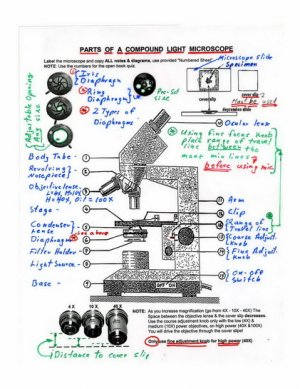
What type of diaphragm (controls light) does your scope have? Is it iris, like in a camera lens or a disk with different sized wholes in it? I have attached one of my overhead notes, look in the upper left corner for the 2 types. If the resolution is too low email me & I will send higher res copy to you.

The reason I ask is that I have a trick to help you find small organism, the method depends on the type of diaphragm.
 

Attachments

  • Microscope Parts  .jpg
    Microscope Parts .jpg
    102.1 KB · Views: 23
The way I always have done it is to start off with a smaller iris aperture on a bright field 'scope (somewhat dimmer) and a slightly lower objective magnification--say 10x or so, depending upon the organism(s). Don't try to start with an exceptionally high magnification, or you'll be searching for a while. Other than bacteria and exceptionally small algae, I doubt you'd ever use the 100x oil-immersion objective.
 
Back
Top